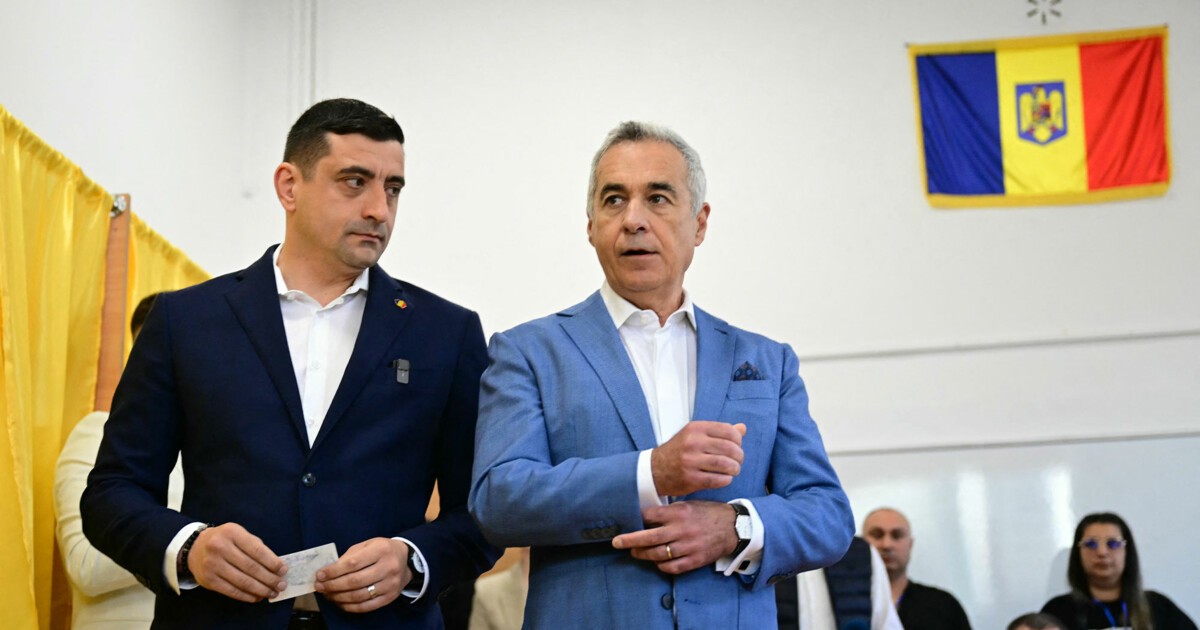
Among the overseas guests invited by Tommy Robinson to speak at the Unite the Kingdom rally in London last September was George Simion, a far-right politician who had lost to the liberal candidate in the Romanian presidential election in May. The rally, an all-you-can-eat buffet of anger, conspiracies and victimhood, drew more than a hundred thousand people who broadly share the idea that innocent white Britons are oppressed, silenced, cheated and disrespected by a malign, power-wielding coalition of immigrants, non-white natives, perverts, vax maniacs, corrupt officials, crooked politicians, Marxists, gender heretics and academics. Not long ago the attendance would have seemed impossibly huge for a far-right rally in the UK. But the once fringe ideas of Robinson, whose real name is Stephen Yaxley-Lennon, have become mainstream for Reform and the Conservatives, and for populist right-wing movements around the world.
The starriest guest at the rally was Robinson’s admirer Elon Musk, who took part by video link. Simion’s presence was barely noticed amid the British MAGA wannabes eagerly partaking of the martyrdom of Charlie Kirk. Simion himself paid tribute to Kirk in his brief speech. He marched onto the temporary stage on Whitehall wearing a hoodie bearing the slogan ‘red is bad’ and waving British and Romanian flags. ‘Raise the colours! Come on, come on!’ he said, in English. ‘We stand with Charlie Kirk. We as free Romanians stand with Great Britain. We are all here to stand for freedom and democracy, and we stand with President Donald Trump and the United States of America. Across Europe, dictatorship is being imposed by Emmanuel Macron and Ursula von der Leyen!’ The crowd booed the monsters of liberalism. ‘We must stand up for our rights, for homeland, for God and for our families, for our children and for the future of our civilisation.’
One of Musk’s assertions at the rally, along with his demand for the ‘dissolution of Parliament’ and his threat that ‘violence is coming to you,’ was that British governments are importing immigrants to skew elections in their favour. It sat oddly that he was sharing a platform with Simion, who, despite losing the presidential election, had won a chunky majority among the half a million Romanian immigrants in the UK – immigrants his friend Tommy is itching to chuck out.
On the face of it, Simion was an edgy pick even for Robinson. For now at least, the populist white right on both sides of the Atlantic still generally accepts that murdering Jews is wrong, and that millions of Jews were killed by white Europeans on racial purity grounds in the 20th century. Simion kind of accepts this too, which is good to know, since after the Nazi Holocaust, the Romanian Holocaust killed the largest number of Jews. He kind of accepts this. But also he kind of doesn’t.
Two men in particular, the fascist Christian terrorist and mystic Corneliu Codreanu, founder of the Legion of the Archangel Michael, later known as the Iron Guard, and Marshal Ion Antonescu, dictator during the Second World War, were responsible for the killing. Codreanu, strangled on royal orders in 1938, was the hugely influential prophet of a fanatical creed of blood, soil and Christian Orthodoxy; Antonescu was a willing collaborator in the Nazis’ Final Solution. From the massacres of the legionary rebellion in Bucharest in January 1941, when members of the Iron Guard hanged Jews, still alive, on meat hooks in an abattoir, to the slaughter of Odesa, then briefly under Romanian rule, in October 1941, when tens of thousands of Jews were hanged, shot and burned alive, to the brutality of Transnistria, where hundreds of thousands of Jews and Roma were sent after being driven from their homes, only to die of cold, hunger and disease, somewhere between 250,000 and 400,000 people are estimated to have died. Only the defeat of the Axis army at Stalingrad early in 1943, which brought the realisation that he might have picked the wrong side, prevented Antonescu from sending Romania’s 300,000 surviving Jews to be killed by the Germans in the camps.
In 2023, Simion issued an anodyne written statement condemning antisemitism and expressing regret for Romania’s role in the Holocaust in order to score a meeting with Israeli officials, who were trying to win support from right-wing European populists for the occupation of the West Bank. How sincere is Simion? If you were the leader of a party trying to distance yourself from Romania’s fascist past, you wouldn’t get married in a ceremony designed to resemble Codreanu’s wedding, minus the swastika-decorated hats. Simion did. You would sever ties with senior party figures who openly venerate the Iron Guard and Antonescu. Simion hasn’t always done so. Luckily for him, when he travels outside Romania these days, it isn’t as a one-time football ultra who fronts a party riddled with fascist sympathisers. It’s as a democratic martyr from the liberal-controlled EU country that stopped a national vote for head of state when it looked as if the wrong candidate was going to win.
In December 2024, Romania’s Constitutional Court cancelled the second and final round of the presidential election when Călin Georgescu, an obscure former ally of Simion’s, unexpectedly topped the ballot in round one. The court justified this extraordinary step on the grounds that Georgescu, who claimed he hadn’t spent a penny on his campaign and wasn’t actively campaigning at all, merely waiting for God and the Romanian people to choose him, hadn’t properly labelled his promotional material to show who’d paid for it. The judges said his campaign, which was fought primarily on TikTok, had benefited from a large-scale financial and social media operation by a ‘state actor’, presumed to be Russia. The election was rescheduled for May 2025; Georgescu wasn’t allowed to run. Simion led the field in the first round, but was beaten by Nicușor Dan – the liberal former mayor of Bucharest, who ran as an independent – in the second. The liberals and the international institutions and causes they support – the EU, Nato, Ukrainian resistance to Russia, tolerance for ethnic and sexual minorities – won the Romanian presidency, but at great cost to their democratic integrity. When Robinson introduced Simion to the crowd at the London rally, he listed a string of elections the global populist right claims, falsely, were stolen. But if not absolutely stolen, the Romanian vote was postponed on tenuous grounds and in a chaotic, ham-fisted way, in a country that is a member of the world’s paragon of liberal democracy, the EU. ‘Just as we saw the election robbed in the United States of America,’ Robinson said, ‘we saw the election robbed in Brazil, the election was also robbed in Romania.’
The Romanian establishment was in a ferment after Georgescu’s first-round victory. The government and judiciary seemed to panic: something had to be done to stop him but nobody knew what legal instrument could be found to do the job. On 28 November 2024, four days after the first round, a full recount was ordered, but it didn’t change the result. The Constitutional Court judges agreed unanimously on 2 December that the second round should take place as planned, with Georgescu up against Elena Lasconi of the centre-right Save Romania Union. Then, with the second round only four days away, the outgoing president, Klaus Iohannis, published a dossier of reports from Romania’s intelligence agencies containing circumstantial evidence that shadowy forces were financing and organising a social media campaign on Georgescu’s behalf. Another two days passed. The court did a U-turn and declared the election void. It was so close to election day that Romanians living abroad had already begun to vote. Georgescu, who seldom talks to journalists, released a statement claiming that the cancellation was ‘a barbaric act done by the oligarch state against democracy … the corrupt system in Romania made a pact with the devil.’ Lasconi, who was also deprived of her shot at the presidency, said it was ‘the moment when the Romanian state trampled on democracy’.
Almost a year had passed since the annulment when I met two young political analysts, Răzvan Petri and Vlad Adamescu, creators of a popular cross-platform channel called Instant Politics, on a rainy afternoon in Bucharest. ‘You need to come forward and tell the people why you cancelled the very thing that makes democracy democracy, the first thing, the elections, the ability to vote,’ Petri said. ‘There was a press conference by the president. He only said: “The court cancelled the elections, according to the constitution I am still the president, we will redo the elections, have a nice evening, happy holidays.” And everybody was trying to find reasons. You could see news outlets trying to explain this, they called the analysts and stuff like that, but the state was silent on it … There still isn’t a coherent narrative about why it was cancelled.’
In fact, Georgescu’s insistence that he had spent nothing on his campaign, that it wasn’t even a campaign but a procession towards popular acclamation, gave the court a gotcha. Posters supporting Georgescu didn’t have the legally required codes tying them to a registered political finance operation. But the court’s rambling and imprecise judgment – which most people, without evidence, assume was forced by political pressure and back-channel consultations with other Western governments – doesn’t make a clear distinction between posters on hoardings, pro-Georgescu social media organised by clandestine foreign-sponsored networks, and people using their accounts to support Georgescu simply because they liked what he had to say.
‘It’s assumed on both sides, okay, even by the pro-Europeans, that [the cancellation] was a political decision, but they agree with it, because they didn’t want him to be president,’ Petri said. ‘So even the liberals are like: “I’m okay with illiberal measures so as to protect democracy.”’
Our surroundings were redolent of Bucharest’s luxurious side, the high-gloss world of those who did well out of the revolutionary rejection of Ceaușescu’s autarkic communism in 1989 and the embrace of the EU eighteen years later. We met in a shop that only sold expensive éclairs, hundreds of them in brightly coloured icing arrayed along the counter like the displays of cosmetics in a department store. Adamescu and Petri, bright, energetic, open, with their MAs from elite London universities, were born long after the revolution, long after Romania’s five decades of fascism and communism. They’ve never lacked for material in their country’s cynical and systemically corrupt democracy, in which parliamentary power is held by a self-serving coalition of historical opponents, a grubby marriage of convenience between neoliberals and social democrats. But the rise of Georgescu and Simion, whose Alliance for the Union of Romanians (AUR) has become a powerful force in parliament, has had the effect of making the democratic spectrum of nominal economic and social liberals coalesce into something like a necessary defensive alliance.
I pressed Adamescu and Petri on whether they thought cancelling the election had been the correct choice, morally or tactically. ‘I think it was the right thing to do, in a completely horrendous manner that impacted democracy in Romania, that will have huge consequences in 2028 … when the people who claim that the election was stolen will win the parliamentary elections, most likely,’ Adamescu said. ‘The alternative would have been much worse. Because the alternative would have been to have a completely deranged, far-right figure in the presidential office. And the president in Romania, despite what you might hear, holds a lot of power.’ Petri agreed: ‘I also think it was the right decision. But you couldn’t have done it in a less democratic way, which sets a terrible precedent for whenever the [far right] come to power.’
Georgescu emerged as a minor figure in Romanian politics in 2020, when Simion’s AUR (the letters also spell ‘gold’ in Romanian) unexpectedly won 9 per cent of the vote in the parliamentary elections, giving it 33 seats in the lower house. AUR put forward Georgescu, who wasn’t a party member, as its candidate for prime minister. He’d been talked up before as a possible prime minister: in 2011, in a Romanian newspaper that ran photos of him practising judo under the headline ‘See why technocrat Călin Georgescu is called “Putin of Romania”,’ and in 2016, by the Russian propaganda channels Sputnik and RT. Other than that, and a thin résumé of government posts a generation ago, his public career has been a series of important-sounding but practically meaningless jobs in opaquely funded NGOs that met at international talking shops to exchange platitudes about sustainable development with similarly ineffectual peers. From 2000 until 2013, he was head of Romania’s National Centre for Sustainable Development, which doesn’t have official status. He was secretary-general of the Romanian Association of the Club of Rome, which isn’t part of the Club of Rome. He was a special rapporteur to the UN on toxic waste, which didn’t make him an employee of the UN. He was for a time the executive director of a Swiss-based outfit that hosts gigs at Davos called the UN Global Sustainability Index Institute Foundation – which is not an arm of the UN. Its founder and CEO, Roland Schatz, also owns a media research company called Media Tenor International, which has a branch in St Petersburg that was run in the early 2000s by Yelena Shmelyova, who has since become a senior official in the Putin circle.
The Romanian investigative journalist Victor Ilie has looked deeply into Georgescu’s online support, especially the viral spread of his video clips in the weeks leading up to the first round of the 2024 election. He scraped information from social media accounts and used innovative techniques to look into the ads placed on Romanian web pages by the agency AdNow, founded and run in Moscow until 2018 by Yulia Serebryanskaya, a former senior campaign operator for Putin and his party (it’s currently owned by a Georgian citizen based in Bulgaria). During the Covid pandemic, a London-based marketing company owned by AdNow was found to have offered money to video influencers to promote misinformation exaggerating the risks of the Pfizer vaccine. AdNow specialises in ‘native ads’ – adverts that look almost identical to a site’s non-advertising content. Ilie obtained tax records showing that Romanian media firms linked to the far right and anti-vaxxers have received at least €2 million from AdNow in recent years. Come the election, they all got behind Georgescu.
Ilie found bundles of accounts on X, newly registered within an hour of one another outside Romania, which immediately followed Georgescu and then began the process of liking and reposting that rapidly boosts an account’s popularity. After the election, when Georgescu was banned from running again, the same accounts switched to boosting Viktor Orbán in Hungary and the AfD in Germany. ‘We also scraped TikTok,’ Ilie told me, ‘and we’ve been able to see automatically created accounts with random names, names like Călin Georgescu 01, Călin Georgescu 02, Călin Georgescu 03, hundreds of accounts endorsing his content.’
Few have done more than Ilie to back up government claims of illegal foreign interference in Romania’s election. His work has been cited in official indictments against Georgescu, who has been charged with multiple offences, including misrepresenting his campaign finances, supporting banned fascist movements and, most recently, plotting a coup. If any endorsement of the decision to cancel elections carries weight, it’s his. But he thinks the annulment was a mistake. He’s offended first of all by the government’s refusal to tell all it knows. Nicușor Dan promised transparency, but Ilie doesn’t think he has fulfilled that pledge. ‘Online, it’s been really easy to spot some Russians. But offline, it’s not like in the John le Carré books, when you see the handlers, and you really understand the mind games behind it and so on. We more or less know nothing. I feel like the Romanian state knows something, but we have a historical lack of transparency that doesn’t allow them to bring up the proof.’ His findings, and those of the rest of Romania’s investigative journalists, add up, he said, to ‘correlation, not causation’. ‘I see it as a multi-layered operation: there were these old friends [Georgescu] had in Geneva, in Vienna, he’s been quoted by Russia Today [now RT] for years. On the other hand, from a totally different direction, he’s been helped by someone else online who has obvious connections with Russian IPs, Russian social media accounts. But I don’t see a proper connection between his life in Vienna or Geneva and the online activity.’ It was entirely likely, he said, that had the second round gone ahead, it would have seen the country rally round the opponent of the extremist, as in France, resulting in victory for Lasconi. Even if Georgescu had won, parliament could have kept him in check. So the election shouldn’t have been cancelled? ‘They shouldn’t have done it.’
During my stay I rented an apartment in Bucharest’s Old Town, in what would have been a charming enclave of crumbling apartment blocks and cobbled alleys were it not for the Gomorrah of bars and restaurants catering to minibreak trippers and hen and stag dos. The flat was on the top floor of a Bucharest fixture, the Comedy Theatre. Access was via the stage door, past the stagehands smoking on their break, with the show broadcast over speakers during performances. On the way upstairs I passed a display of photos of past productions. There’s no obvious discontinuity, to a foreigner’s eyes anyway, between the productions of communist and post-communist times. The communist regime defined itself as anti-fascist and had no problem allowing Rhinoceros, the émigré Romanian Eugène Ionesco’s parable of the rise of fascism, to be put on at the theatre. The theatre was staging it again a few days after I left. In the play, a community of ordinary people, bourgeois and working class, shopkeepers and intellectuals, are transformed one by one into rhinoceroses, metonymic beasts representing dumb, wilful force: clumsy, violent, selfish, stupid, moving in herds, incapable of rational discourse.
What gives the play its power and contemporary relevance to Europe and the US isn’t so much the behaviour of the rhinos, which is mostly offstage, as the way a character’s defence of rhino behaviour – a defence that is always reasonable, whether it is reflective, generous or merely curious – is invariably a prelude to their turning into one. When Daisy tells her lover Bérenger that a quarter of the population of the town have become rhinoceroses, he says: ‘We’re still in the majority. We must take advantage of that. We must do something before we’re inundated.’ But soon Daisy is showing the telltale sign of criticising the critics of the rhinos for their prejudice. ‘Those are the real people,’ she tells Bérenger.
They look happy. They’re content to be what they are. They don’t look insane. They look very natural. They were right to do what they did … I feel a bit ashamed of what you call ‘love’ – this morbid feeling, this male weakness. And female, too. It just doesn’t compare with the ardour and the tremendous energy emanating from all these creatures around us.
One of the differences between the Instant Politics guys’ view of the election annulment – a catastrophic act that had to be carried out – and Ilie’s belief that Georgescu should have been allowed to stand is that the younger men are more sceptical about the resilience of nominally liberal or social democratic members of parliament in the face of pressure to let a charismatic populist leader get what he wants.
The naive idea I was tempted by in the éclair shop, that the Romanian elite might recoil from tolerating the far right in power because it would mean an end to hedonistic consumerism, is absurd. Don’t they have boutiques in Moscow? Does the absence of free speech and democracy in Dubai stop Louis Vuitton flogging €3000 wheelie cases there? Aren’t half the world’s luxury goods made in communist China?
The Romanian establishment’s aversion to Georgescu shows fear and alarm, and perhaps a degree of principle, but it’s hard to be too optimistic about mainstream politicians’ integrity when Romania is in first place in the EU for the amount its political parties pay themselves, openly and legally, from state funds: £180 million in 2024. Nothing illustrates the cynicism and complacency of the mainstream parties more clearly than the fact that during the first round of the presidential election, some party officials told their supporters to vote for Georgescu, thinking to undermine the traditional politicians they assumed were their main rivals.
I didn’t meet Georgescu in person. But at the risk of making a virtue out of an omission, it’s the social media version of the man that has captivated Romanian voters. He was born in 1962. He’s formal, grave, a little stiff, groomed in a neat, old-fashioned sort of way, like a knitwear model in a catalogue aimed at pensioners. He doesn’t crack jokes, never raises his voice and doesn’t seek to persuade so much as to play the man talking a common sense that traditional politicians are too politically correct or compromised to utter. He’s not a speechmaker. Given the chance to speak at length in TV interviews, he’s vapid, rambling, jumping between barely connected thoughts. But in the clips people watch on TikTok, you don’t see his musings peter out or meander, only signposts that point tantalisingly towards never-to-be-reached destinations. He or his people have deleted his TikTok posts from before the cancellation of the election, but there’s enough on other social media platforms to get a sense of his style. ‘I am guided by three things in this action of mine – which as I told you is not an electoral campaign but a calling – compassion, co-operation and common sense,’ he tells a sycophantic interviewer in a longer clip preserved on Facebook. ‘God’s will is the certainty of my victory, it is creation. And they do not understand this, those who make the polls.’ He goes on to state that Romania’s closeness to the Caspian Sea (landlocked, and a thousand miles away) gives it a unique opportunity to trade with China (more than a thousand miles and tall mountains away from the Caspian, in the other direction).
This is Georgescu as messianic technocrat. Another of his modes is to make vague, stirring statements that sound as if they’re taken from Hollywood sagas, as sometimes they are. The popular belief among Romanian Georgescu-mockers that he lifted a chunk of Disney’s Frozen in a clip doesn’t stand up: Georgescu and Olaf the snowman both speak drivel about water having the ability to remember things, but the drivel is different. Georgescu does have a fondness for The Lord of the Rings, the film version, using the sentiments of Gandalf and Galadriel as if they were his own. The most striking appropriation I saw, however, wasn’t from a movie. Filmed meeting voters in the street, Georgescu drew on a speech by the wartime dictator Antonescu, not just quoting but absorbing the marshal’s speech into his own discourse, even imitating his gestures. Antonescu was filmed in uniform next to the Iron Guard leader Horia Sima, while Georgescu is in a woollen V-neck over an open-necked shirt and stands next to a priest, but the echo across eighty years is clear. ‘Through silence and faith,’ both men say, ‘through order and unity, through labour and love, forward with God! Long live Romania!’ And each man raises his arm in salute.
There is a third way of looking at Georgescu, perhaps the most revealing: as far-right wellness product. When he shot to social media popularity and electoral success, Ilie was already working on an article about AdNow for the Romanian investigative site Snoop, which led to his discovery that this originally Russian firm had passed millions of euros to Romanian media organisations and individuals who tended to be both supporters of the far right and opponents of support for Ukraine. But the main vector of this finance was, ostensibly and perhaps genuinely, payment for ads promoting alternative therapies and conspiracy theories about medicine and vaccination. Like his populist counterpart Robert Fico, the prime minister of Slovakia, and many MAGA influencers, Georgescu benefited from the pandemic, using people’s fear, uncertainty and ignorance to braid together an anti-establishment and anti-vax message, thus strengthening each strand: the EU, the mainstream parties, bureaucrats and big pharma were wicked, and now they wanted to inject you with a sinister substance, which must therefore be wicked too; and didn’t the fact that the elite demanded you accept this wicked stuff confirm how wicked it was? Georgescu had already spoken out against chemotherapy, questioned whether cancer is real and promoted whatever version of natural, traditional healing suited the moment (his wife, Cristela, is a prominent ‘natural’ wellness influencer). In January 2021, at the height of the pandemic, the day before President Iohannis sought to reassure the population that vaccination was safe by having the jab himself, Georgescu was filmed swimming in an icy Austrian lake. ‘It is a pandemic of fear and stupidity. And over it is a pandemic of hypocrisy and manipulation,’ he said. ‘I trust my immune system, because I trust and have complete faith in its creator. My immunity depends on the sovereignty of my being. My immunity is maintained and trained only in nature … not in the laboratory.’
What marks Georgescu out is how far his promotion of a ‘natural, traditional’ route to wellness goes, extending far beyond anti-vax conspiracism and anti-establishment rhetoric. His entire political programme, in so far as he has one, is based on the need to heal Romania by creating – or, as he portrays it, restoring – a synthetic medieval country, agrarian, artisanal, patriarchal, Orthodox Christian, self-sufficient in organic food, purged of chemicals, purged of modernity, purged of everything and everyone he dislikes. There’s a relationship between his ideas and those of Robert F. Kennedy Jr, the anti-vax US health secretary and wellness nut, and Georgescu never skips a chance to boast about having written the introduction to one of Kennedy’s books, omitting the key phrase ‘the Romanian edition of’.
In the Romanian context, there’s a deeper political meaning to Georgescu’s preoccupations. The modern anti-vax movement echoes its 19th-century equivalent, which had an antisemitic tinge. In a book from 1881, The Jewish Question, Eugen Dühring, the Marxism-loathing foil of Friedrich Engels, claimed mass vaccination was a scheme got up by Jewish doctors to line their pockets. The Nazi fascination with nature, the evocation of a mystic bond between ‘real’ Germans and the forests and soil, and the conflation of personal wellness with the health of Germany (the extermination of the Jews was presented as a matter of ‘racial hygiene’), were mirrored among the followers of Codreanu, whom Hitler admired. In his book For My Legionaries (1936), Codreanu writes: ‘To break our ties binding us to the land, the material source of a nation’s existence, they will attack nationalism, labelling it “outmoded”, and everything related to the idea of fatherland and soil, in order to cut the love thread tying the Romanian people to their furrow.’ (It would be unfair to suggest that when Georgescu chose soil science for his academic specialisation, he was thinking of Codreanu and his legionaries, who wore pouches of soil taken from Romanian battlefields around their necks. Nonetheless, Codreanu and Georgescu do share an obsession with the Romanian earth.) Codreanu claimed that ‘only through a nationalist government, the expression of our Romanian conscience, force and health, could the Jewish problem be solved, by taking legal measures to protect the Romanian element and putting brakes on the Jewish invasion.’
In 2022, Georgescu was investigated by prosecutors, and spoiled his relations with Simion, when he described Codreanu and Antonescu as ‘martyrs’ who had carried out ‘good deeds, and deeds that I cannot comment on’. (Promoting fascism is illegal in Romania. Simion’s irritation with Georgescu wasn’t that he thought the remarks were wrong, but that Georgescu risked breaking the law by saying them in public.) Still, these sparse public allusions to Codreanu are less significant than the implied tribute to Romanian fascism embodied in Georgescu’s revivalist fables of a future Romania of Orthodox Christian farmers, craftsmen and mothers. In the current version of Georgescu’s programme, ‘Food, Water, Energy’, he declares that he ‘categorically rejects chauvinism, xenophobia and antisemitism’. Much of the programme, heroically vague, could be interpreted as a green, hyperlocal, communitarian utopianism. But then comes the final ‘How are we going to do this?’ section, with its legionary cadences: ‘Through order, discipline, clear rules applicable to all, few words translated into many beautiful and useful deeds. Through a government of patriots, incorruptible, who would set a personal example of firmness in the application of the directions of development, morality and sacrifice.’ And the final sentence, so harmlessly generic, yet so similar to Antonescu’s phrase: ‘With God first, we are rebuilding Romania!’
J.D. Vance led his government’s criticism of the Romanian election cancellation. He can fairly be accused of hypocrisy in his attacks on European social media regulation. He objects to Britain punishing people who incite lynch mobs on social media, but not to Americans losing their jobs or people being deported from the US for posts the Trump loyalty group doesn’t like. All the same, in his speech in Munich in February last year he made a point that is hard to wave away. ‘You can believe it’s wrong for Russia to buy social media advertisements to influence your elections. We certainly do,’ he said. ‘You can condemn it on the world stage, even. But if your democracy can be destroyed with a few hundred thousand dollars of digital advertising from a foreign country, then it wasn’t very strong to begin with.’
No one suggests that the first round of the 2024 Romanian election was rigged, or that a ‘state actor’ like Russia can somehow hypnotise voters. Some of the post-mortems on the Georgescu campaign claimed to be forensic analyses of nefarious overseas interference, but what they actually described was a well-run, modern, insurgent political organisation, able to draw on a mixture of volunteers and casual paid operatives. One observer I spoke to speculated that the money came from inside the country, from dissatisfied inheritors of Ceaușescu-era assets. However legitimate the concerns about foreign election interference, they shouldn’t be an excuse to avoid talking about what made Georgescu so popular in Romania and, perhaps more important, his mainstream opponents so disliked. If the fundamental difference between populists and non-populist mainstream parties is the difference between falsehood and truth, what makes people love populist lies and hate the self-described realism of their opponents?
One day in a Bucharest café I met Stella, a single mother with two young girls who works full-time as a school janitor. Born in the mid-1990s, she had a hard childhood in Bragadiru, on the ring road south-west of the capital, living in a single room with her brother, mother, aunt, uncle and two cousins. When she started school, she and her mother and brother moved to a place of their own. Without an education, Stella’s mother struggled to find work. There’s no housing benefit in Romania, so paying rent was hard and they were always being evicted. When things got particularly tough, Stella’s mother would send the children out to scour the streets for scrap metal to sell. Stella started crying when she got to this part of her story. She was bullied at school over her poverty and for being Roma. She left school at fourteen and got a job washing potatoes. After eight months, she found work as a maid for a wealthy family. She met a man and they moved in together not long before she gave birth to her first child, when she was nineteen. About a year later, she left the man, who abused her, and went back to live with her mother, although she and the man continued to see each other.
In 2018, Stella’s mother died, and she moved to Bucharest proper in search of a better-paid job, although her violent and by now ex-partner was also a factor. At one stage, after the police refused to act against the man, she moved with her daughters into a women’s refuge. Now she has achieved a precarious stability. Her children are at school, and the family has a settled place to live, privately rented, a single room with a separate kitchen and bathroom in an old block in Bucharest’s Sector 5. ‘It’s better for them now than it was for me,’ she said. ‘I promised myself I’d do my best for my children, to avoid the situation I had at their age. I’m still struggling, but I’m trying to make a better life for them.’
After going through so much, Stella is still barely afloat. Romania’s health, education and welfare systems are grievously underfunded. Joining the EU has brought many foreign factories, as well as lavish spending on new roads and other public infrastructure, and schools and healthcare are free to all, in principle. In practice, they’re bare bones services that demand all sorts of top-up payments – not really bribes but not really official. This impoverished public realm – which is being further degraded by the austerity programme introduced by Dan under pressure from the EU – is accompanied by a grotesquely unfair, highly regressive tax system that puts a disproportionate burden on the shoulders of the poorest and gives the rich ample ways to protect their fortunes.
In Romania, almost everyone who earns a salary, no matter how small, faces the same effective tax rate, usually 45 per cent: a flat rate of 10 per cent income tax, 10 per cent health insurance and 25 per cent social security. In most of Western Europe, where taxation is progressive, someone earning as low a wage as Stella would pay little or no tax, and might get state help with rent, living expenses and childcare. Stella earns 5300 lei a month, around £900, about three-quarters of the Romanian median wage. A low-paid British worker at an equivalent level would have an effective tax rate of about 16 per cent. Stella is taxed at 34 per cent. The only thing protecting her from having to pay the full 45 per cent is that the school pays part of her salary in tax-free food vouchers. Once she has paid her taxes, health insurance and social security, 1200 lei for rent, 560 in bills and 120 for a transport pass, set against 360 lei in child allowance (the only benefit she gets), she is left with 1980 lei a month, about £340, for food, clothes and anything else she and her daughters might need.
By crude GDP-per-head measures, Bucharest is the sixth richest region in Europe. The metric takes no account of inequality or the distortions of tax-dodging multinationals, but there’s plenty of money in the city. The rich may feel overtaxed, but clearly a household paying 45 per cent tax on combined salaries of 25,000 lei a month is going to have a lot more disposable income than a household paying 34 per cent on 5000. And for those who have shares, profitable businesses or property, the taxes on wealth are minimal, and carelessly collected.
Like their right-wing populist counterparts elsewhere in Europe, Simion and Georgescu tend to be seen by the liberal centre-left in relation to their stance on issues the liberal centre-left finds threatening: warmth towards Putin; a lack of interest in the defence of Ukraine; hostility towards the EU (if not its money); contempt for the rule of law and democracy; identification of immigrants and refugees, Muslims in particular, as the enemy; disdain for free speech; support for male control over women and suppression of sexual and gender nonconformists. The liberal centre-left has every reason to fear that Simion and Georgescu have this agenda. Liberal Romanians, and Romania’s Hungarian minority, know they do. That’s why Dan got elected. But Romanians like Stella have different priorities. Not caring that Georgescu promised to cut off aid to Ukraine or that Simion cosplayed a fascist wedding is not the same thing as voting AUR for those reasons. It might seem odd that Stella voted for Simion when the Roma were victims of the Romanian Holocaust, but Simion has been careful not to alienate Roma voters, and, until it was introduced very recently as a special subject for older students, school history books tended to devote only a single paragraph to the country’s wartime fascism.
Stella, and other poor Romanians, are motivated by personal and family matters. Why am I so heavily taxed, when teachers, doctors and police have so little time for me and my children? How can I feed and clothe my kids and pay the rent? Will my pension be enough to live on? The blunt clarity of politicians who seem both to name these problems and to propose urgent solutions to them erases, for many people, the manifest contradiction in some of their plans: for example, AUR couldn’t, as Simion proposes, sack half a million civil servants without devastating health and education provision. The appeal of Simion and Georgescu is citizens’ self-interest and emotion packaged not to the voter as analyst, but as supporter, someone for whom a made choice becomes in itself a possession worth defending. Stella didn’t vote in 2024, but after the election was postponed and Georgescu was banned, she became engaged enough to attend an AUR rally in Bucharest. ‘I liked the debates on TikTok, what [Simion] was saying, and the fact that he was out in the streets gave me confidence,’ she said. ‘I support bigger pensions, greater child support. These are worries that Romanians have. It’s important. What I understand is that being on the right means that you are with the people.’ The only reference to the war she made was when, unprompted, she complained that Ukrainian refugees got more state support than Romanians. ‘From my point of view,’ she said, ‘the biggest mafia is at the top of the government.’
By chance rather than choice, we’d ended up meeting in a fancy place, this time in a café that took its coffee very seriously. I offered to get Stella a drink and she asked for a latte. They brought it. But the establishment deemed its coffee too good to be defiled by any quality so vulgar as sweetness. They wouldn’t give Stella any sugar, and she found the coffee too bitter without it.
In Romania, they speak of sovereignists rather than populists. A concept from the 1970s, sovereignism once described the Québécois desire for more autonomy, but without full independence. It has now come to be used of European movements that thrive on hostility towards the EU, regardless of their economic dependence on it. Putin, too, speaks of ‘sovereign democracy’. What distinguishes sovereignism in mainland Europe from Faragism in the UK, rhetorically at least, is the extent of its notion of autonomy. It encompasses the sovereignty of the nation over supranational bodies and the sovereignty of the individual over their own body (to reject vaccines, if not impregnation), but also the sovereignty of the national community over transnational capitalism. When Law and Justice was in charge in Poland, we heard much in the West of its efforts to ban abortion, less about its regulatory attacks on foreign supermarket chains which had pushed out Polish retailers. We hear much more about Orbán’s friendliness towards Putin and contempt for Ukraine, about his criminalisation of Pride marches and attacks on the independence of the judiciary, than about his radical move – inconceivable from any British or US political party – to nationalise private pensions.
If the Polish government attacks the freedom of women, or the Hungarian government embraces a war criminal and tries to drive sexual minorities into the shadows, that’s more interesting and important to liberals in Western Europe than the survival of the Polish high street or a raid on the pension pots of wealthy Hungarians. But it won’t seem that way to all Poles and Hungarians. In a country as unequal as Romania, AUR’s promises of cheap housing and squeezing money for ordinary Romanians out of foreign firms, together with the allure of a purge of governing institutions, is more likely to be a draw for voters than a fondness for Putin or dead fascists.
‘It’s just frustrating that such policies, which could sit quite well in a left party, have been appropriated and blended with really extreme political cultural elements by the far right,’ the political economist Cornel Ban told me. Broadly, he said, Romania’s rapid rise to prosperity since 2007, following its catastrophic post-communist collapse, had been extraordinary, driven initially by EU funds and by overseas companies taking advantage of lower wages and a skilled workforce to open factories, then by the Romanian IT sector. And yet Romania taxes the low-paid harder than any other EU country, fails to collect tax from the wealthy, has a fifth of its population on the brink of penury and is running a budget deficit three times the EU average. ‘How is it that in a country with such gains – our exports increased by ridiculous amounts of GDP per capita – you have Europe’s highest population at risk of poverty?’
Ban, who teaches in Denmark but grew up in a working-class Romanian family, talked through the complexity of support for AUR, Simion and Georgescu. It couldn’t be explained by absolute poverty alone, he said, but had to do with people’s sense of how well they were doing compared to others, even how well they were doing compared to an idealised sense of where they felt they should be. A bureaucrat might want voters to compare themselves to their Romanian counterparts in 2005, or to their present-day peers in the Romanian-speaking, non-EU former Soviet state of Moldova, but couldn’t stop them comparing themselves to people in Barcelona or Cambridge. Romania’s inverted version of Britain’s obsession with immigration – its citizens’ mass emigration to the rest of Europe – compounds the bitterness: Romanians who have experienced exploitation and prejudice abroad are beginning to find that friends who stayed at home are earning more than they are. It doesn’t make obvious sense that their response to that would be to punish the parties that have presided over Romania’s boom, but politics has seldom been about a just apportionment of blame and retribution.
Ban told me that everybody in his home town votes for the far right. ‘I’m super aware of popular discourse on this, and when I confront them and say: “Look, you guys are going on city breaks now. You are working-class truck drivers, right, with ten years of education. Fifteen years ago, you were crossing the border illegally, to work in Spain illegally. That was your life, right? And now you’re talking about your daughter going to study in Germany. I mean, this is a hilarious statement. You are not really persecuted, nor are you losers.” Sure, there’s 19 per cent of the population at risk of poverty. It’s the highest rate in Europe. Let’s put that to the side. Those people are completely entitled to be mad, but you would be very hard pressed above those 19 per cent to find a population that lost out economically since EU membership. That’s simply not the case.’
He’d already talked to me about the tough road for young people who had just got a state apartment at the tail-end of communism and might have felt, despite the bleakness of Romania in the 1980s – the phrase ‘soya sausage’ had a particular resonance at the time – that they were, relatively speaking, on the up, only to be thrown into the maelstrom of the free market. ‘They spent twenty years in this kind of downward social mobility,’ Ban said, referring to the period of stagnation after the 1989 revolution. ‘Twenty years is a lot of your life. You’re fifty by the time things improve, and then your benchmark is no longer how you lived ten years ago. The benchmark is, how’s your cousin living on the Spanish coast? … For me, it’s like: “Look at this development miracle, right?” But for them, it’s like: “Yeah, but we thought we would catch up faster.” They thought they would jump straight into how, you know, Catalans live … I don’t know how you can work against this narrative. Plus a lot of them realise that migration has been a tragedy for them personally, and the purchasing power of the same [foreign] minimum wage that fifteen years ago made them local stars in their small home town – when you go home now with an Italian minimum wage, you’re making less than locals, in some cases. So the frustration there of status loss among those Romanians who migrated, millions of people, is extremely high … all these factors have to be thrown into the explanatory soup.’
When I asked Petri about the audience for his online political analyses, he was frank: it was young, urban liberals. And yet in an indirect way, he and Adamescu hoped to reach the more socially conservative, economically dissatisfied part of society by encouraging their audience to treat that part of Romania with understanding rather than contempt. ‘We have these upper-middle-class people in the big cities. We’re in that category, I would say,’ Petri told me. ‘And lots of people in this category have this embedded disdain for whatever comes out of the rural areas and small towns.’ He added that ‘society is very divided here between two currents. I would say one is looking towards Europe. One is looking towards, not really Russia or the east, more inwards, and sees the other side, the pro-European side, as being out of touch, elitist maybe, or corrupt, and sees democracy as not being able to deliver for them.’
Not long before I arrived in Bucharest, the Romanian Orthodox Church opened the world’s biggest Orthodox cathedral, the Cathedral of National Salvation, right next to the world’s heaviest building, the vast Ceaușescu-era palace that now houses the Romanian parliament. I joined the queue to take a look inside, curious to see the world’s biggest Orthodox iconostasis and the world’s biggest display of church mosaic (six acres’ worth). I never made it: the online queue tracker, which reported a wait of two hours when I set out, gave six hours by the time I joined. Most of the enormous cost of the cathedral was borne by the Romanian government, but it didn’t seem to be getting any credit for it. A popular opinion is that the government steals whatever money it collects. I asked one of my neighbours in the queue, a sheep breeder from Constanța, whether he thought the building of the cathedral had been an absolute need or just a nice thing to do. ‘It was a necessary thing to do,’ he said, ‘because otherwise the money would have been stolen.’
Why was it that those in power weren’t able to steal the money for the church, if they stole the money for everything else?
‘Maybe they’re afraid of God,’ he said.