Building lean muscle mass with well-planned strength training routines is one of the best things you can do for yourself. This type of physical activity has numerous health benefits and enhances your overall well-being. However, designing a program that trains all your major muscle groups, whether in a home gym or a commercial one, can be confusing.
So, we consulted with certified personal trainers and coaches to understand the best way to create a balanced workout program, weight machines to use and the exercises they swear by. They’ve narrowed down the best exercises for building strength and endurance. And you can modify these to your current fitness level, so you can jump in no matter where you’re starting. And borrowing from a recent Reddit thread, it’s more important to show up every day in small increments.
Once you’ve found your stride with training, don’t forget to focus on improving your sleep. According to a recent CNET survey, 46% of surveyed US adults are willing to invest in better mattresses or bedding. Making this change yourself will support muscle growth and give your muscles time to recover. With that said, let’s review the best exercises to build muscle, recommended by certified professionals.
Read more: Best Smart Home Gyms to Help Meet Your 2026 Goals
1. Deadlifts
The deadlift is one of the most effective compound lifts you can do in the gym. It has you lifting heavy weights off the floor by bending at the hips and standing back up. It works multiple muscle groups and whether you’re a beginner or a seasoned weightlifter, there are plenty of variations to choose from. Some of these are: kettlebell deadlift, Romanian deadlift, conventional deadlift, stiff-legged deadlift, sumo deadlift and trap bar (or hex bar) deadlift.
“The deadlift is a great exercise because it helps strengthen the core, back, shoulders, arm muscles, as well as your glutes, quads, hamstrings and calves,” says John Gardner, a NASM-certified personal trainer. He explains that the deadlift is an essential exercise that stimulates the upper and lower body simultaneously, allowing more muscles to be engaged at the same time.
“You’ll be burning more calories as well as making it an extremely time-efficient exercise,” Gardner says. As a result of doing deadlifts, your posture will also improve because of the way it targets your back muscles and shoulders.
If you choose to deadlift, have a personal trainer or experienced weightlifter observe that you’re doing it with the correct form. One common mistake people make when performing multi-joint exercises like deadlifts is squatting (and bending the knees too much) instead of hinging at the hips. Another mistake is arching or rounding the back instead of engaging the upper body and core muscles. Not being in proper form can lead to a lower back injury because of the pressure it causes on your back. You also need to be mindful not to overextend your neck and head and should keep it in a straight line.
If you have a history of chronic back issues, a spine injury or are pregnant, it’s best to consult with your doctor or personal trainer first before doing this exercise.
2. Push-ups
The push-up is beneficial for building up your upper body strength and targets your chest, triceps, back and shoulders. Although it’s a well-known exercise, it’s also one that is commonly performed incorrectly — even by experienced exercisers.
“The nice thing about the push-up is that it can easily be modified to fit your skill level,” says Dr. Brittany Noel Robles, a certified personal trainer and OB-GYN. Some modifications include doing a push-up against the wall, or with your hands elevated on an incline to make it more challenging. Once you’ve mastered the push-up from these angles, you can take it to the floor and practice them through changing up the tempo or your hand positioning.
“Everyone should include push-ups in their workout because they are a functional exercise that translates into real-world situations,” says Robles. “Specifically, the push-up trains the functional movement pattern of horizontal pushing, or the ability to push objects away from you.”
3. Pallof press
The Pallof press is an anti-rotation movement that limits the rotation of your spine. It’s considered a core strength training exercise that can be easily done using a cable machine or resistance band. “Your transverse abdominis, or your internal belt, helps secure your low back as a deep muscle in your core,” says James Shapiro, an LA-based sports performance coach. “By activating it more and becoming stronger, you’ll be able to increase your strength in compound movements and increase activation in your rectus (your six-pack).”
There are variations that allow you to efficiently work out your core. To perform this motion you’ll need a resistance band tied to a power rack (or a sturdy base) or a cable machine with a handle set up depending on whether you’ll be standing or kneeling. You can do this movement by standing in a staggered stance, half-kneeling or tall-kneeling on the ground. If you have lower back issues, the Pallof press can be performed either seated or on your back on the floor. Shapiro recommends that beginners start with very light weight and hold the position as they breathe.
4. Inverted row
The inverted row is an exercise that beginners and advanced exercisers can do to strengthen their upper back. It also improves scapular retraction, which can help prepare you to do pull-ups if your goal is to master them. Typically the inverted row can be done using TRX suspension straps or using the bar from a barbell positioned on a rack above you while you’re in an angled horizontal position. Your arms should fully extend above you, while keeping your body hovered above the floor.
“To make the inverted row more challenging, you can lower the bar, walk your feet forward, raise your feet up on a box or add weight,” says Chris Matsui, a certified strength conditioning specialist and USA Weightlifting coach. If you need a modification, he suggests walking your feet further back, raising the bar up or bending your knees.
Don’t miss any of our unbiased tech content and lab-based reviews. Add CNET as a preferred Google source.
5. Split squats
The split squat is a single leg exercise that forces you to use your core for balance. It targets your glutes, quads and hamstrings. There are also several ways to do them to make them easier or harder, depending on your fitness level. “It’s not a technical exercise, so it’s easier to do with less compensation patterns to worry about,” Matsui says.
A split squat can be performed with free weights, Meaning dumbbells, kettlebells or a barbell will work. You can even do it as a body-weight exercise. And if you want to make it even harder, place the back foot on an elevated surface for your starting position, making it a Bulgarian split squat, another variation of the split squat, that trains the same muscle group.
6. Dumbbell squat to press
The dumbbell squat to press, also known as a thruster, is a compound exercise that starts in a front squat position and ends in an overhead press. This full body movement can be done using dumbbells, a barbell or kettlebells. It’s a power exercise intended to be performed quickly as you move from a squat to press.
“From a conditioning standpoint, with adequate weight and the right tempo, this full-body movement can really jack up the cardiovascular demand,” says Shinekwa Kershaw, a personal trainer at Blink Fitness. She suggests that if you have knee limitations make sure to only squat to parallel or just above that. This can also be performed as a seated squat on a box or chair. If you have issues overhead pressing, another option Kershaw suggests is doing a squat to bicep curl.
Read more: Best Home Exercise Equipment for 2026
7. Squats
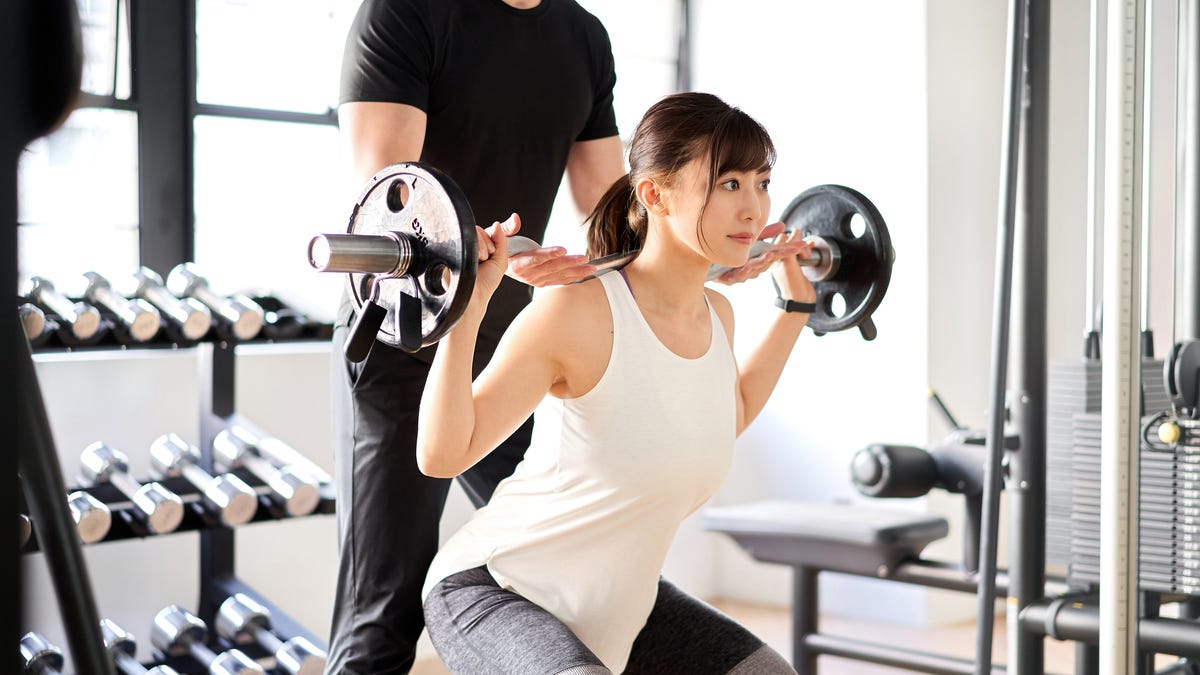
The traditional squat is an important exercise because it targets the muscles in your lower body, such as your glutes, quads, hamstrings, abdominals — even your upper body. You can load the squat using dumbbells, barbells, kettlebells and sandbags. “Not only is the squat a functional move that mimics everyday life, such as sitting and standing in a chair, it increases our anabolic hormones and is important for spine and core strength,” explains LA-based fitness trainer Natalie Yco.
There are also different squat variations such as squat jumps, single leg squats, barbell back squats, front squats, goblet squats, sumo squats and more. “Squats strengthen the muscle around the knee to help prevent knee injuries and may help improve flexibility while moving through a deeper range of motion,” says Yco.
If you’re new to squats and have yet to master the move, Yco suggests trying out wall squats with a stability ball placed between your back and a wall. Start in a standing position with your feet shoulder-width apart and back against the ball, and lower into a seated position by bending your knees at a 90-degree angle. The goal is to keep your lower back firmly against the ball. This modification takes stress off your lower back and makes it easier to squat down.
8. Kettlebell swing
Kettlebell exercises have become popular even beyond the CrossFit crowd. One exercise in particular that is a favorite among fitness experts is the kettlebell swing. The full-body exercise uses your hips, core, hamstrings, glutes and upper body to produce an explosive movement. It’s an excellent way to get cardio in while also strengthening your posterior chain (the back of your body).
“I love the two-handed kettlebell swing because it is an exercise that builds total-body strength and also improves your cardiovascular fitness,” says Jennifer Conroyd, a certified ACE trainer and USA Track and Field Coach. Before performing the kettlebell swing (or any other kettlebell exercise), you should have an expert with kettlebell training teach you the proper technique. Kettlebell training is all about mastering the technique first before swinging or snatching heavy kettlebells.
“It is truly a phenomenal all-in-one exercise and it’s important to focus on good posture and using your hips to generate the movement,” says Conroyd. If you’re just learning to swing, she suggests modifying the move by decreasing the weight of the kettlebell until you feel comfortable with the movement. If you have shoulder or lower back injuries, you may not be the best candidate for kettlebell swings and should consult your doctor or physical therapist before trying them.
Exercises like deadlifts and the inverted row target your lower back and upper back regions, respectively. Performing these regularly and gradually increasing the load over multiple training sessions will help strengthen your back.
Performing a squat or its variations is one of the most effective ways to strengthen your lower body. Its movement pattern mimics many daily activities, and it’s a no-brainer to use it to strengthen your lower body muscles. But be sure to focus on your form while performing it to maximize your gains and minimize any chance of injury.