“Billionaires? We don’t need friends. We have staff.” Perhaps if Byron Forst had friends, instead of just slaves — excuse me, staff — he might have anticipated some of the problems the Beauty would cause him.
Divided neatly into two sections, this week’s episode of The Beauty shows how the friendless Forst first turned his newfound super-handsome condition into a market colossus…then how a lowly lab technician hoping to improve life for himself and his closest work friend leaked the big secret, leading to all the chaos to come.
The episode opens in typically tasteful fashion: Ray, the scientist who invented the Beauty drug, is being forced to watch Byron have sex with a stewardess on his private jet (Maggie Tyma). The deed is already more or less done before Ray can explain that the drug, which works more like a virus, is likely sexually transmittable. Byron has the stewardess executed within seconds of stepping onto the tarmac when the plane lands.
To the four-on-the-floor strains of Tame Impala’s “Dracula,” Byron dances and glides his way back to the office, through a series of tests, going for a swim, and getting fitted for new clothes. It’s less a needledrop and more a full-fledged, choreographed musical number, one of many ways The Beauty tweaks the fabric of its reality.
Byron’s next order of business is to taunt his hated wife with his new stud status. She’s decidedly unimpressed, calling him “a vampire, a nosferatu,” eager to suck dry the savings accounts of people all over the world to sell them on the dream of eternal youth. In her voluminous orange and pink dress, its train draped across eight auditorium seats, she declares she wants nothing to do with his big plan. Maybe she’ll blow up his spot wearing 1888 Christian Laroix — now that’s beauty. “This ploy of yours, it doesn’t save us,” she says of the drug. “It ends us.”
She’s righter than she knows. Early testing — you know, the kind that normally gets done before you inject a drug into a billionaire client — has revealed that the drug lasts 855 days before “ignition ketosis” takes place and the infected overheat and explode. Byron nearly has Ray killed then and there, until Ray makes him realize he can now sell booster and stabilizers alongside the initial dose, all while Ray works to find a more permanent cure for Byron himself.
Only the mad billionaire no longer likes that name. “Byron Forst is no more,” he tells the cowering scientist. “You kneel before God.” It’s no more or less outlandish than shit Elon Musk says every day.
At the opposite end of the corporate food chain we join Mike (Eddie Kaye Thomas) and Clara (Rev. Yolanda), two of the many medical technicians who work in isolated laboratories preparing components for a final product the nature of which is kept hidden from them. If you’re thinking this sounds like Severance, you’re right: The work relationships, the labyrinthine and sterile med-tech office building, the over-the-top corporate propaganda and surveillance, weird flashing lights, an animal-testing wing — this feels like Ryan Murphy and Matthew Hodgson’s riff on the Lumon/severance concept.
While Mike and Clara’s easy friendship makes their work days a pleasure despite their ignorance of the work itself, neither is exactly happy with the lives they lead right now. Mike is nursing a serious crush on Jen (Laura Dreyfuss), one of the workers from the animal wing. Clara’s convinced his only real problem is his own lack of personal style and rizz, something he could compensate for with more confidence and a better haircut.
But when Mike finally does work up the courage to ask Jen out on a date, she reveals she has a fiancée. Clara is genuinely aggrieved for her friend, whom she feels Jen was leading on, and apologizes on behalf of women everywhere. It’s a funny little slice of office life, and a rare television depiction of dating foibles that doesn’t revolve around apps.
Clara’s problems are a bit more serious than those of an MIT grad who’s too timid to ask women out. A trans woman, she’s begun a course of hormone therapy, and is currently at the point where the exhausting side effects have not yet translated into the visible results she’s hoping to see. An empathetic Mike listens, clearly hurt on his friend’s behalf, as she talks about getting misgendered over and over. For all that he occasionally stumbles with terminology, it’s clear Mike really does see Clara as a woman, and a beautiful one at that, but she doesn’t feel her outside matches her inside in a way she can live with yet.
Everything changes when a deafening lockdown siren blares for a couple of hours one afternoon. Leaving the office, Mike runs into a distraught Jen, who reveals her favorite chimp went berserk and attacked several clinicians, herself included; guards killed it before it could do much more than bite her in the arm. (It seems she patched herself up and left rather than submit to an examination, which probably would have ended with her in one of the lab cages.)
What intrigues Mike is Jen’s report that the chimp had been transformed from his old, frail, ailing self into TV-ready specimen of male chimpanzee magnificence prior to his meltdown. When Mike mentions this to Clara, she’s angry that he doesn’t see how painful it would be to her to know of a drug that could potentially transform her physically to match the woman she’s always dreamed of being inside. So it’s for both of them that Mike cleverly sneaks his way past the security measures and steals a couple of doses.
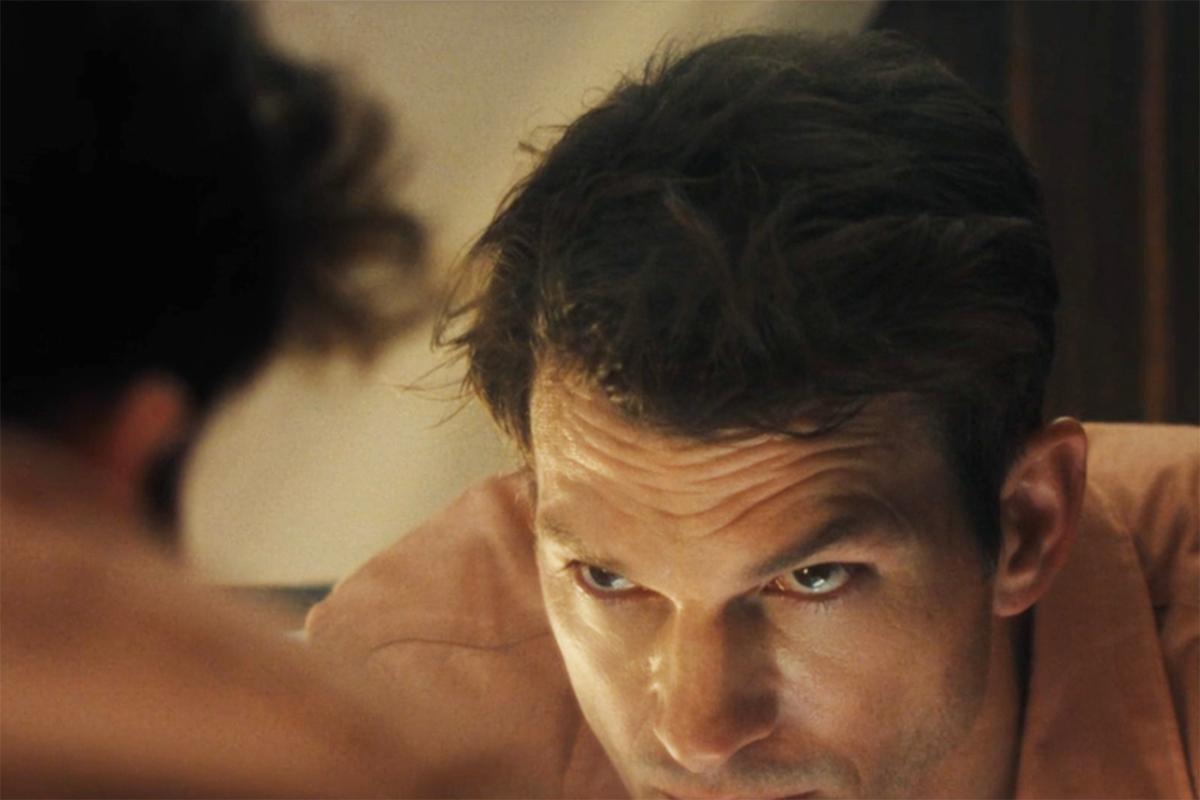
The rest is history. Mike transforms into the man (played by Joey Pollari) we saw get whacked by Antonio the assassin early on, at Byron’s orders, for leaking the drug. When he gives a dose to Clara, who overcomes her concern that her current, transitional hormonal mix might lead to disastrous results, she too wakes up transformed into her own new self (Lux Pascal), now young and gorgeous and, it’s implied, physically cisgender. (Note the way the medication smushes together the concepts of beauty, sex, and gender, just as it’s previously equated beauty, femininity, and youth.)
Mike may narrowly escape the assassin on his way to Clara’s in a dramatic shot of his building’s exterior, but of course it all catches up with him eventually, as we see in a re-run of the poison-dart murder that takes him out. But for all we know Clara is still out there. Jen, too, probably became infected with that chimp bite. The Beauty may be out of the bag for good.
While the episode looks and feels bifurcated, it’s really best considered as a whole. Byron Forst is a cautionary tale about the obsession with beauty — how in the hands of a vapid sociopath it’s just another weapon, a set of fangs that lets him sink his teeth even deeper into a world he’s already despoiled. He’s human Mar-a-Lago Face, if Mar-a-Lago Face didn’t make you look like a monster on the outside as well as the inside, that is. He’s an obsession with beauty as dominance, beauty as the currency of the world’s masters.
Mike and especially Clara, by contrast, illustrate that it’s not always vain or frivolous or shallow or incel to care about how you look. Mike’s not really that much of a schlub, he’s just kind of leading a low-effort life when he’s not at work. Clara’s spent decades living as a man, getting married, having kids, the whole nine; now she’s finally out and transitioning, but she can feel the wasted time hanging over her already, and the process itself is immiserating to her.
These people don’t want to bang stewardesses and then order their murder with their genitals still wet. They don’t want to deplete children’s college savings funds to overcharge for a miracle drug. They want to have the confidence that looking amazing, the way they want to look, will give them. Are they reckless, maybe selfishly so, given how little they know about the drug? Yes. But they care about each other before, during, and after their transformations. They’re friends. Their motives are not alien to us, as Byron’s are. Clara and Mike are fascinating books to read, but they get judged by their covers. It’s hard to begrudge them their redesign, even though we know that disaster follows.
Sean T. Collins (@seantcollins.com on Bluesky and theseantcollins on Patreon) has written about television for The New York Times, Vulture, Rolling Stone, and elsewhere. He is the author of Pain Don’t Hurt: Meditations on Road House. He lives with his family on Long Island.