Do you find yourself stiff and shuffling to the bathroom in the morning, even though during the day you move with relative ease? Do you feel creaky and old before your time in the first hour of the day? If so, you’re not alone. A recent study found 19 per cent of UK adults suffer from a stiff back in the morning and 29 per cent from creaky knees.
Morning stiffness has many causes — and one of them is sleep. The synovial fluid, the substance that lubricates the cartilage cushioning our bones, which declines as we get older, doesn’t circulate as effectively while we’re mostly inert in the night.
“And our joints, because they’re not moving, stiffen,” says Uzo Ehiogu, a clinical specialist physiotherapist at the Royal Orthopaedic Hospital Birmingham. Joint inflammation — caused by injury, overuse or conditions such as osteoarthritis — exacerbates the problem, as does the fact muscle, tendon and ligament tissue often become shorter and tighter with age.
• Read more expert advice on healthy living, fitness and wellbeing
Being physically fit can, perversely, make matters worse, as any runner who has hobbled out of bed with aching Achilles tendons will attest. “If you do a lot of exercise, the muscles associated with that activity become stiffer because they become shorter,” Ehiogu says.
Fortunately there are plenty of quick tricks, stretches and mobility exercises you can do in the morning to put the spring back in your step. Do them daily and, Ehiogu says, “over three to four weeks you’ll definitely notice a difference in your mobility, as muscle and connective tissues lengthen and you increase the range of motion in your joints”.
Here’s how to do it.
Take five deep breaths when you wake up
“Five slow, deep breaths can help to improve blood flow to the muscles, reducing the presence of inflammatory chemicals that can cause swelling around muscles and joints,” says Dr Steven Weiniger, a chiropractor and the author of Stand Taller Live Longer: Posture & Anti-Aging Strategy.

Deep breathing after you wake up improves blood flow
GETTY IMAGES
This year a meta-analysis in the Journal of Clinical Medicine found that “breathing exercises showed significant short-term effects in reducing pain and disability for persistent neck pain”.
Inhale slowly through your nose for the count of four, so your diaphragm (the muscle under your lungs) moves down, creating space in your chest and causing your belly to rise.
Hug your knees in bed six times
“Knee-hugs help with hip and knee flexibility and are good for those who sleep in the foetal position,” Ehiogu says. Lie flat on your back in bed, legs straight out in front of you. Lift up one knee and using both hands hold your knee towards your chest. Hold for 40 seconds, then slowly lower your leg, “reversing the posture” of the knees-bent foetal position, and repeat on the other side. Do this three times on each side.
• The key to healthy joints: less beer, more broccoli, better balance
Take a three-minute hot shower
While we’re all aware of the benefits of a cold shower, a hot one can reduce morning stiffness by relaxing the muscles and helping synovial fluid to circulate. “To maximise joint mobility and soft tissue flexibility, it’s always better to use heat first thing in the morning,” Ehiogu says, adding that subsequent stretching will be more effective as a result. If you can make the time, a hot bath is even better. “It warms the whole body,” he says. Research in the South African Journal of Physiotherapy found that twice-weekly hydrotherapy sessions in a heated pool significantly decreased pain in patients with knee osteoarthritis caused by the breakdown of cartilage.
• My routine for joints to protect your knees, hips and back
Rotate your ankles 60 times before you dress
Achilles and calf stiffness can be exacerbated by your toes being at a 45-degree angle to your heels overnight rather than extended at a right angle as when you are standing. This shortens the Achilles tendon and calf muscle. Sit on the edge of your bed, feet on the floor, and lift one foot off the ground. Rotate your foot in a clockwise motion then repeat in an anticlockwise motion. Repeat ten times on each foot, three times.
Make six lumbar rotations on the floor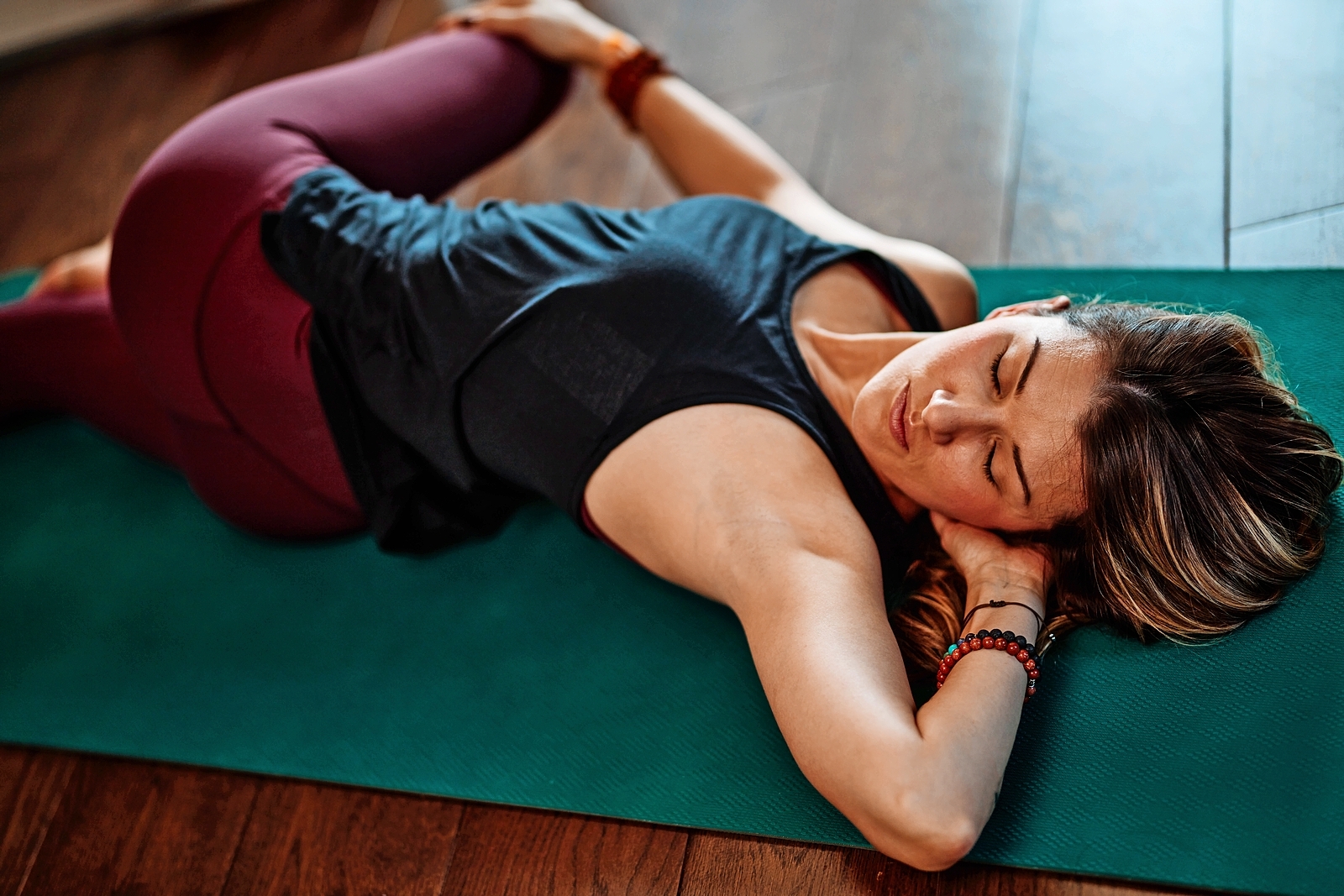
Lumbar rotations stretch spinal muscles and obliques
GETTY
Your back is particularly susceptible to stiffness in the morning, Ehiogu says, because it contains multiple joints. This move will stretch your spinal muscles and obliques. Lie on your back, lift up one knee and bring it across your body, pulling your knee down with the opposite hand. Turn your head away from your knee. Stay in this position for 40 seconds, then repeat on the other side. Do this three times.
Work through 60 shoulder circles on all fours
For achy shoulders, Ehiogu suggests shoulder circles. Kneeling on all fours, lift one hand off the ground, keeping your arm straight and body still, move your arm in a clockwise circle, then an anticlockwise circle. Do two sets of 15 on each side. “Being on all fours, rather than standing, engages your shoulder blades and core muscles,” Ehiogu says.
One minute of cat-cow
Remaining on all fours, inhale as you drop your belly towards the floor, arch your back and lift up your head and tailbone. As you exhale, round your back, tucking your chin towards your chest while drawing your navel to your spine. Repeat ten times, for about one minute. The flexion and extension in this yoga pose wake up the joints in your spine.
• Start the year stronger, fitter and leaner: my 12-week ‘superset’ plan
Do squat shoulder presses every other day
Lifting weights can be doubly effective at reducing stiffness because, provided you move the muscle through its full range of motion, you’re increasing mobility and flexibility while building strength that helps to protect joints, Ehiogu says. His favourite exercise for building all-over mobility and strength is the squat shoulder press.
Stand with your feet shoulder-width apart, a dumbbell in each hand, arms down, palms turned towards your thighs. Keeping your chest up, push your hips back and bend your knees into a squat. As you stand back up, press the dumbbells straight overhead until your arms are straight. Start to lower your weights as you begin your next squat. “I’d do three sets of 10-12 every other day,” Ehiogu says.
Buy a better pillow and sleep on your side
“The wrong pillow can lead to an aching neck,” Weiniger says. He recommends “a surgical pillow that has a hump under the neck and a dip under the head which supports the neck and takes away some of the load from the shoulders and torso that can cause neck ache in the morning”. It may seem the height of luxury, but “sleeping with multiple pillows pushes your head forward, which can lead to an achy neck by loading tiny joints called facets between each vertebra of the spine,” he warns. “Your head should be elevated so that it’s neutral with your spine.”
• Oof! Will Mick Jagger’s workout break me?
Sleep on your side with a pillow between your legs
Lying on your side is “generally the best way to sleep,” Weiniger says, because the spine is in the most neutral position. “Put a pillow between your knees so you maintain alignment of your legs with the hips, which takes away some of the stress on your lower back.” He says sleeping on your stomach is the worst position because you have to keep your head turned to breathe, creating muscle imbalances and unevenly loading the facets in the spine. Sleeping on your back can “cause lower back and neck pain”.
Drink plenty of water through the day
Drinking enough liquids is also key. Our muscles and cartilage are up to 80 per cent water, and ligaments and tendons up to 70 per cent water. As we get older we lose fluid in those tissues, “hence they become stiffer and shorter”, Ehiogu says. He adds that rather than aiming to drink specific targets of fluid a day you should ensure your urine is pale and you never feel thirsty. If you do feel thirsty “you’re already dehydrated”.