It was a nagging numbness in his left hand that changed everything for Faizal Kottikollon. The Dubai-based businessman had long been a yoga devotee with a penchant for headstands. And that, several concerned doctors eventually concluded, was the problem. Years of overzealous inversions had compressed his vertebrae, damaging his nerves so severely that risky, major surgery appeared to be the only solution.
Kottikollon, then in his late 50s, resolved to find another answer. He found it, he hoped, in Ayurveda, a holistic medical system practiced widely in Kerala, the Indian state where he was born and raised. There, he was prescribed brimhana, or tissue regeneration, using a bolus therapy made from goat meat mixed with rice, milk, and spices. “Through the skin pores, this goat protein goes inside the body—inside the nerves—and leaves the RNA of the goat protein, which regenerates our dead nerves,” he explains. Ayurveda, he adds, holds that the goat meat is the closest chemical analogue to human flesh. “Within three cycles of treatment, the cervical issue was solved. I had three M.R.I.s taken subsequently—it was completely gone.”

Renderings of Tulah’s interiors show airy, nature-connected interiors.
Courtesy of Tulah Clinical Wellness Sanctuary
That experience became the seed of the idea that will soon open to the world, and which Kottikollon is sharing exclusively with Robb Report: Tulah Clinical Wellness, his entrant in the booming longevity market.
Kottikollon’s approach diverges sharply from Silicon Valley’s model, often defined by prescription-heavy biohacking and evangelized by the likes of Bryan Johnson. Instead, Tulah emphasizes integration, pairing conventional diagnostics such as M.R.I.s and bloodwork with complementary therapies drawing from Ayurveda, Vedanta, and other traditional systems. “Longevity is becoming a buzzword, but today a lot of biohacking is happening at the top level without understanding the foundations correctly,” he says. “Everybody wants to live longer, but using chemicals to do it is not the right way of looking at life and longevity. We need to make sure that you’re mentally and physically both in good condition until you’re 90 to 100 years old.”
Founder Faizal Kottikollon has been intimately involved with every aspect of the project, from construction to programming, including these designs for its medical suites, which are more redolent of a five-star hotel than a hospital.
Courtesy of Tulah Clinical Wellness Sanctuary
He is aiming squarely at an ultra-high-net-worth clientele. When Tulah opens later this year, stays will cost up to $2,700 per person per night, inclusive of all treatments and meals.
More intriguing, though, is the strategy underpinning Tulah’s rollout, which upends the blueprint deployed by most operators in this sector. Kottikollon does not envision guests arriving for an annual weeklong retreat only to return to daily life unchanged. Rather, he wants the experience to offer an ongoing framework, woven into how people live, long after they leave the property. To support that ambition, he is investing heavily: The 30-acre 65-suite residential clinic in the hills of northern Kerala—an estimated $100 million project—will serve as the mother ship for a global network of satellite locations. He plans to open as many as 40 facilities over the next decade, beginning with Dubai later this year, followed by Tokyo and London.
A medical suite.
Courtesy of Tulah Clinical Wellness Sanctuary
He certainly has the experience—and the capital—to gamble on such a project. Kottikollon earned his fortune in 2011, selling a stake in his valve company, ETC, for $400 million. He later pivoted to construction with KEF Infra, a modular-building firm producing prefabricated schools, malls, and hospitals. One of those projects, the innovative Meitra Hospital in Kerala’s Calicut, helped inspire Tulah’s integrated ethos. “Today, health care is more of a reactive medicine,” he says. “Covid made me really go into the concept of prevention,” Kottikollon explains of the acute issues that afflicted India during the pandemic. It was hit, of course, not only by the first wave, but became the global epicenter of the second wave a few months later. This experience triggered his resolve to invest in what he believes is a truly effective new health-care model.
Health and discipline, he notes, were ingrained early. His father, Peekay, was an enthusiastic weight lifter who earned the title of Mr. Kozhikode in Kerala. Kottikollon says that he “inculcated, at a very young age, that I should be disciplined and work out. I don’t drink or smoke and have always been into health and wellness.” Still, the move to create Tulah was a bold departure from the mainstream industrial businesses on which he had built his fortune.
The rituals here combine wellness efforts—whether food or exercise—with allopathic medical testing, all in a design-forward setting.
Courtesy of Tulah Clinical Wellness Sanctuary
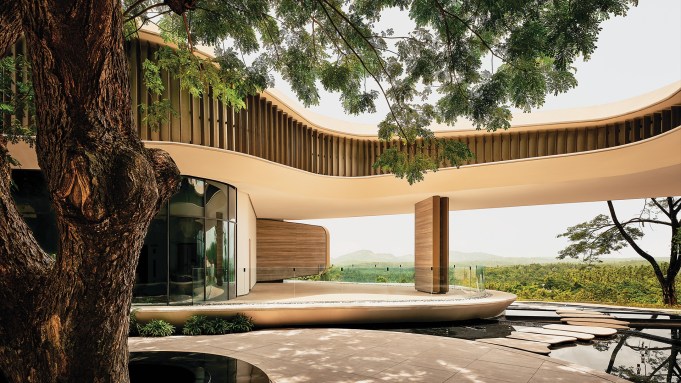
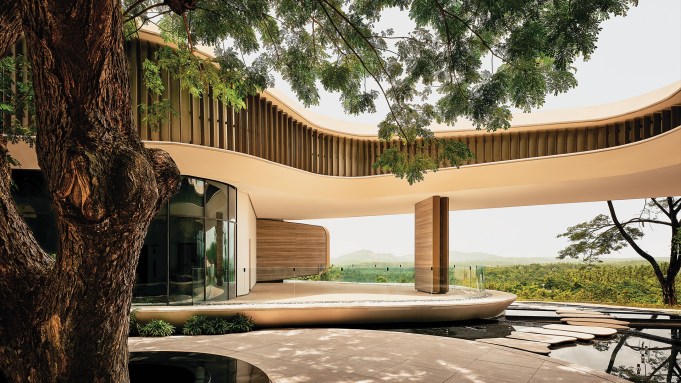
For the campus design, he hired architect Wisam Al Lami, emphasizing flowing, curved forms inspired by Zaha Hadid’s work. “You’ll never see a sharp corner in Tulah,” he says. “The mind is much calmer when you see a river flowing, and it’s like that.” He also spent five years developing a custom water-cooling technology that keeps interior temperatures at 70 to 72 degrees Fahrenheit without chemical coolants. The campus is densely forested, and the anchor of the complex is the Sonorium, which Kottikollon claims is the world’s largest sound-healing dome.
Clinically, Tulah will be formidable. The facility will house M.R.I.s, C.T. and M.T.I. scans, I.C.U. beds, and operating rooms. Blood-work results will be ready within hours rather than days, and endogenomic testing will be conducted both at intake and discharge to demonstrate measurable health impact. Tulah will adhere to the same protocols as the F.D.A.—exozomes will be available, for example, but not stem-cell therapy—and the chief of medical services is Dr. Ravi Parihar, an orthopedic surgeon who trained in India as well as the U.K.
The world’s largest sound-healing dome will be located here.
Courtesy of Tulah Clinical Wellness Sanctuary
“All the investigation will be done by modern science,” Kottikollon explains. “But the solution will mostly come from the Eastern way of doing things.” Was it harder to persuade Eastern practitioners to embrace allopathic protocols or vice versa? “Western-medicine doctors,” he laughs, “because their ego is higher.” At Meitra, he notes, he trained doctors in both systems. He also touts a 2023 study of 50 patients treated there, comparing integrative care with purely Western protocols over a 12-week period. Among other findings, total cholesterol markers for the integrative group fell by 28 percent.
Tulah will also offer its own signature practices. “Clinical yoga,” developed by B. K. S. Iyengar, functions as a musculoskeletal discipline. “It’s where we work on the spine, because the spine is where our seven energy centers are lying, the seven chakras,” Kottikollon says. “So once the spine is aligned, what clinical yoga does is, if your body is aligned correctly and strong, your mind works much clearer.” The clinic has also patented its Vichy shower bed, which uses heat, sound, vibration, and pressure to apply 40 different Ayurvedic therapies. It is, he says, the ideal shorthand for Tulah’s hybrid approach. Follow Ayurvedic principles closely enough, he adds, and a healthy lifespan of 120 should be achievable.
Everybody wants to live longer, but using chemicals to do it is not the right way of looking at life and longevity.
Patients must stay for at least one week, though longer visits are encouraged. After 48 hours of intake testing, personalized programs are designed and shared. Most guests, he expects, will arrive with persistent lifestyle-related issues like his own, such as diabetes or musculoskeletal pain. Kottikollon is careful to stress what Tulah is not: He isn’t creating a haven for anyone keen to dismiss Western treatment for, say, cancer and instead opt for an entirely alternative plan. He says his focus remains on rehabilitation for lifestyle diseases and musculoskeletal issues. “And it’s clearly demarcated what we can and cannot do.”
The imagined interior of the sound-healing dome is emblematic of the open-plan style, which is more than simply a palace of pampering.
Courtesy of Tulah Clinical Wellness Sanctuary
The real differentiator may be what happens after guests leave Tulah. The clinic has developed a proprietary algorithm, the Tulah Life Index, which aggregates metrics ranging from gut health to muscle mass into a single score out of 100. Sixty and above, he says, is solid. The accompanying app integrates with wearables like the Oura Ring and Apple Watch, providing tailored recommendations and continuous monitoring. The data will be supported by the network of Urban Tulah hubs that will replicate most services offered in Kerala, other than overnight accommodation. The first Urban Tulah, a hybrid social club and wellness center, will open in Dubai later this year on a membership model (monthly dues are yet to be determined). Members will come in for checkups, healthy meals, and talks from experts in various fields. London, Germany, and Singapore could be next. “I’ve been to all the major wellness resorts in the world,” Kottikollon says. “You feel better when you’re there, but you go back to the old lifestyles. Tulah tech was developed for the follow-up to happen.”
The strategy has drawn plaudits from leaders in the longevity space. Dr. Sabine Donnai, founder of London-based Viavi, lauds Tulah’s integrative protocols while noting that many conventional wellness retreats are often effective simply because guests disengage from stress. “The impact I see for most people? It’s the being away,” she says. “You do not reset your physiology during a week, and there is no follow-through. We’ve looked for that everywhere, and nobody actually has that hub and the spokes where you can keep on going for remeasuring, redoing, follow-up treatments.” She does sound a note of caution around herbal treatments, where Ayurveda typically insists on just-picked freshness for maximum efficacy. (“Clinical protocols follow Ayurveda’s yukti principle, using dried or extract-based equivalents when effective,” a Tulah spokesperson told Robb Report. “And each Urban Centre includes a micro-apothecary to prepare treatments requiring genuinely fresh botanicals.”)
An artful dish served at the property.
Courtesy of Tulah Clinical Wellness Sanctuary
California concierge physician Jordan Shlain, founder of Private Medical, is cautiously optimistic. “We’re at the peak of the hype cycle for longevity,” he says, while welcoming Tulah’s emphasis on continuity of care. “Longevity centers help you recognize there’s hard work to do, not while you’re there but every day, or most days.” Still, he warns against “performative wellness,” citing flashy diagnostics that lack clinical grounding. “It’s not proven tech, but big fancy machines [that] spit out colorful graphs, maybe saying you gotta stop eating this or that. But based on what?” Ayurveda, he notes, is different. “There’s proof it lowers your inflammation while you’re there, but a lot of it is psychological in nature. It’s a window of what your life could be like if you created the habits around it.”
Others are more skeptical. Brad Inman, the real-estate entrepreneur–turned–longevity guru who founded Livelong Media questions whether Kottikollon’s resources can sustain a global network. He argues that franchising would be more be more viable. “These high-end clinics are harder to sell and harder to service. But considering how hot longevity is… some smart, well-financed people in venture capital or private equity could make this happen.” He also doubts the appeal of major city locations like London. “It’s not like we’re all living the longevity dream every day, even if we try to,” he adds, suggesting that resort destinations such as St. Barts would more readily lure guests with both the time and the inclination for follow-up checkups.
A lounge area complements the radiant interior.
Courtesy of Tulah Clinical Wellness Sanctuary
Kottikollon, though, remains undeterred. He believes that once guests see, feel—and clinically verify—the results, they will commit. Days at Tulah, he explains, begin and end with communal rituals: a dawn gathering in the forest, where guests ring a small bell as the sun rises, and an evening lamp-lighting ceremony at sunset. “People have to be taught about longevity, that it’s not just about biohacking,” he says. “It’s about looking inwardly, you know, a holistic approach to the body and mind.” Just don’t overdo the headstands.
Top: You’ll struggle to find a sharp edge or hard corner here—Tulah’s approach to architecture is distinctly sinuous and organic, as this rendering shows.
Authors

Mark Ellwood
British-born, NYC-based Mark Ellwood is Robb Report’s editor-at-large. He has lived out of a suitcase for most of his life, covering luxury in all its forms across the world. Among his favorite…