by Ha Shun-kuen, Greenpeace campaigner
Hong Kong’s mountains and seas undergo “stress tests” every holiday. In recent years, the city’s natural areas have suffered significant environmental damage; the East Dam, Sharp Island, and Ham Tin Wan were seen thronged, trampled, and trashed by holiday crowds during the Golden Weeks and on New Year’s Eve. The government has failed every one of these “stress tests”.
Before the previous chaos has even been settled, another “stress test” is approaching. The government expects 1.43 million mainland visitors during the nine-day Chinese New Year holiday, in addition to tourists from other countries. This raises concerns: at which ecologically sensitive sites will overtourism knock next?
 A visitor stepping on corals at Sharp Island, Sai Kung, on October 1, 2025. Photo: Greenpeace.
Overcrowding at Sharp Island – a UNESCO Global Geopark promoted by the Hong Kong Tourism Board as one of the “best snorkelling areas” in the city – has already sounded the alarm on overtourism. On the first day of the October 1 Golden Week, the site recorded over 4,000 visitors. Crowds were seen trampling coral and damaging the marine environment, providing stark evidence of the crisis.
Following the ecological havoc and public outcry over the overwhelmed beauty spots last year, Chief Executive John Lee announced that the government would study the capacity issues facing “popular nature spots” and consider expanding the boundaries of marine parks. This marked a crucial first step in evaluating overtourism in ecologically sensitive areas.
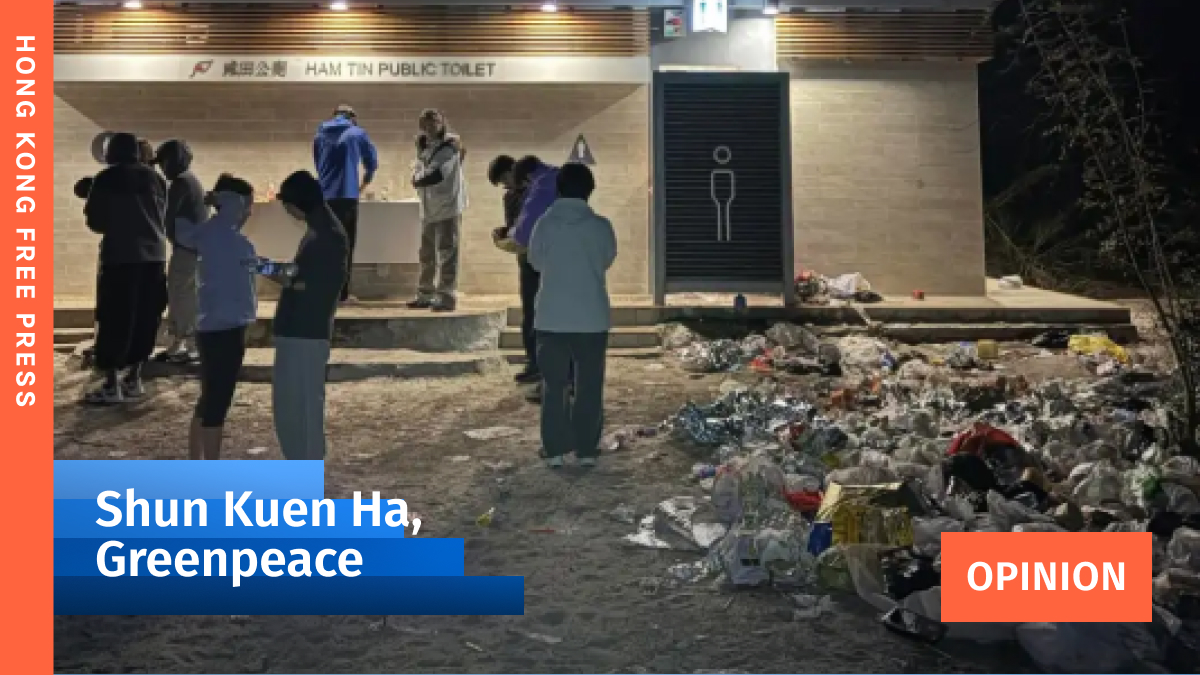
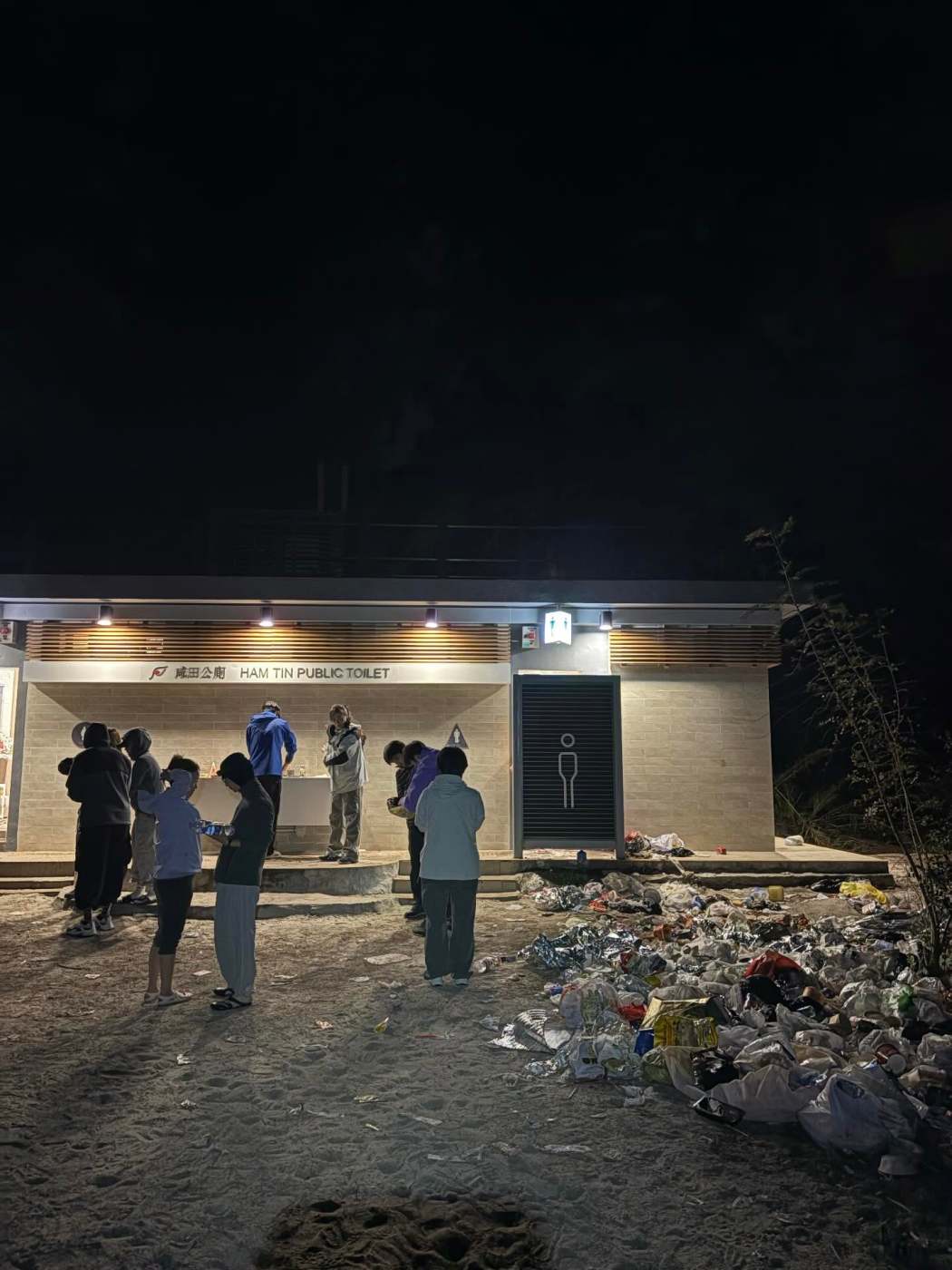 This photo circulating on social media platform Threads shows litter filled the area in front of Ham Tin Public Toilet in Sai Kung on New Year’s Eve in 2025. Photo: via bill,kolder on Threads.
However, time waits for no one. Before the authorities could translate that study into tangible action, the influx of visitors again choked the natural site of Ham Tin Wan on New Year’s Eve.
The Culture, Sports and Tourism Bureau (CSTB), as the primary body driving green tourism in Hong Kong, should have stepped up. Amid these overtourism incidents, it should be proactively coordinating with different departments to formulate ecotourism policies. Ironically, it has consistently fallen to other departments -including the Environment and Ecology Bureau (EEB) and the Agriculture, Fisheries and Conservation Department (AFCD) – to handle the chaos and follow-up. Meanwhile, the CSTB has remained passive, as if abdicating its responsibility and passing the buck to others.
Indeed, departmental actions have so far been ineffective: visitors at the East Dam were still seen littering despite joint-departmental crowd control, and leafleting at Sharp Island failed to reverse the ecological damage already sustained.
Only days ago, the CSTB suggested that AFCD officials would have to “work overtime” by stationing at Ham Tin Wan to ensure hygiene, implement crowd control, and put up notices. Given that these stopgap measures have already proven ineffective in tackling overtourism, why would the government expect them to miraculously work now?
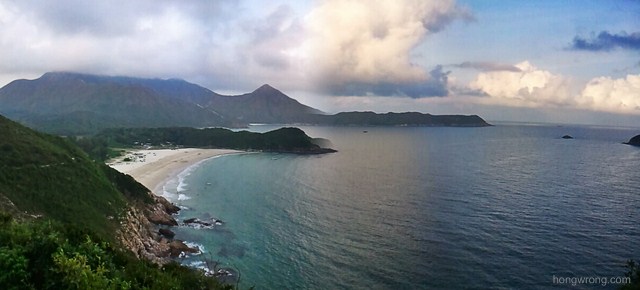 Tai Long Sai Wan. Photo: Tom Grundy/HKFP.
We can learn from the “National Ecotourism Development Plan (2016–2025)” published by China’s National Development and Reform Commission and the Ministry of Culture and Tourism. It defines ecotourism as “tourism on the premises of sustainable development, ecological protection, and human-ecological symbiosis.” The Plan established a “conservation-first principle” to defend the “ecological red line,” offering a solid reference for the CSTB and EEB.
Every second that a formal ecotourism policy framework is delayed, the threats to Hong Kong’s nature grow. The recent Greenpeace report, “Conservation Before Chaos: The Crisis of Hong Kong’s Unprotected Ecotourism Hotspots and Policy Recommendations,” found 22 ecotourism hotspots in Hong Kong currently lying in a regulatory vacuum.
These spots include a wide range of precious habitats, such as wetlands, freshwater marshes, mangroves, and mudflats. In the absence of comprehensive policy and statutory regulation, these sites remain vulnerable to the same irreversible havoc wrought at Sharp Island last year.

No one – whether they are Hongkongers, mainlanders, or international visitors – wants to see Hong Kong’s precious and internationally recognised ecology damaged. Our finite natural areas are not theme parks or carnivals, nor are they festive disposables.
The CSTB, leading the formulation of a conservation-first ecotourism policy alongside the EEB and AFCD, should draw lessons from national and international best practices. Only with appropriate policies in place can the government truly tell “good ecological stories” of Hong Kong and honour the promise of making the city a world-class destination that tourists wish to revisit.
Ha Shun-kuen is a campaigner at Greenpeace Hong Kong. His work focuses on city development and ecotourism, hoping to push for a conservation-first ecotourism policy in Hong Kong.
HKFP is an impartial platform & does not necessarily share the views of opinion writers or advertisers. HKFP presents a diversity of views & regularly invites figures across the political spectrum to write for us. Press freedom is guaranteed under the Basic Law, security law, Bill of Rights and Chinese constitution. Opinion pieces aim to constructively point out errors or defects in the government, law or policies, or aim to suggest ideas or alterations via legal means without an intention of hatred, discontent or hostility against the authorities or other communities.
Support HKFP | Policies & Ethics | Error/typo? | Contact Us | Newsletter | Transparency & Annual Report | Apps
Safeguard press freedom; keep HKFP free for all readers by supporting our team