Hyper-Personalized Fitness Market
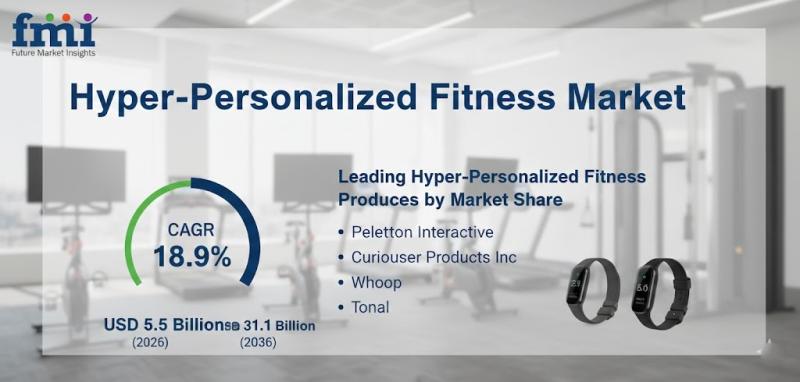
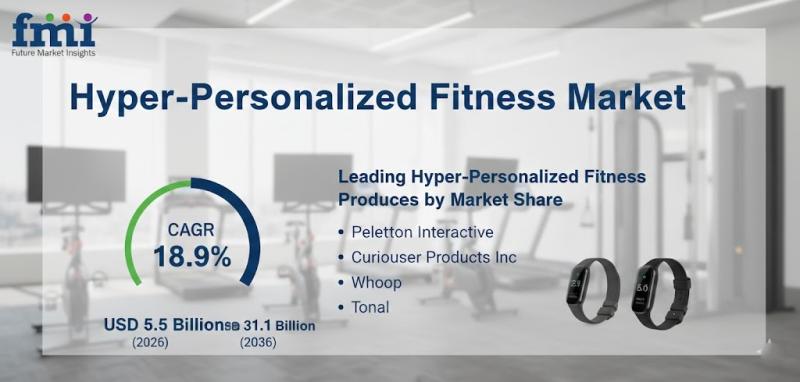
The global hyper-personalized fitness market is forecast to grow from USD 5.5 billion in 2026 to approximately USD 31.1 billion by 2036, reflecting a compound annual growth rate (CAGR) of 18.9%, according to analysis by Future Market Insights (FMI). The expansion is driven by rapid advancements in wearable biometric tracking, AI coaching engines, and standardized data frameworks that connect consumer wellness platforms with clinical health ecosystems.
Industry momentum accelerated following the January 2026 merger announcement between EGYM and Playlist, backed by USD 785 million in new equity investments. The transaction signals a broader industry shift toward large-scale, integrated platforms that combine hardware, software, coaching intelligence, and community access into unified wellness ecosystems.
Phillipp Roesch-Schlanderer, CEO of EGYM, described the strategy as the integration of smart training equipment, studio access, management software, corporate wellness solutions, and AI-driven personalized training into one connected system – highlighting how competitive dynamics are moving away from single-purpose tools toward full-stack platform ecosystems.
Discover Growth Opportunities in the Market – Get Your Sample Report Now https://www.futuremarketinsights.com/reports/sample/rep-gb-19939
Market Context: From Fitness Tracking to Clinical-Grade Personalization
According to FMI, the hyper-personalized fitness sector is entering a phase where operational success depends on embedding clinical-grade insights into everyday fitness experiences. Major industry developments reinforce this transition:
WHOOP launched Advanced Labs in December 2025, integrating wearable metrics with external lab results.
Peloton introduced its Pro Series in October 2025 with AI-powered Peloton IQ features.
Apple expanded Fitness+ to 28 new markets in December 2025 with AI-generated custom plans.
iFIT acquired Reform RX in May 2025 to expand personalized connected training.
These launches confirm that hyper-personalization is transitioning from a niche wearable feature to a mass-market capability integrated across digital and physical fitness environments.
Key Market Takeaways and Structural Trends
FMI identifies the hyper-personalized fitness market as increasingly platform-controlled, where value concentrates among integrated providers that manage the full data pipeline – from biometric data capture to AI-driven personalization delivery. Leading platforms benefit from subscription-based revenue models that scale efficiently, while hardware manufacturers face margin pressure and fitness operators confront rising software licensing costs.
Additional strategic dynamics shaping the market include:
Growing reliance on wearable sensor supply chains and semiconductor availability.
Rising compliance and liability considerations as consumer wellness data intersects with clinical health frameworks.
Migration toward standardized API systems enabling wearable-to-electronic health record integration.
Geographically, North America continues to lead platform adoption and funding activity, Europe benefits from equipment-software integration initiatives, Asia Pacific – particularly India and China – is driven by smartphone-based fitness app adoption, and the Middle East is gaining traction as a corporate wellness hub.
Data-Backed Growth Drivers
Consumer demand for personalization remains a primary growth catalyst. Industry surveys indicate that 73% of fitness users preferred personalized workout and nutrition plans in 2023, rising significantly from 58% in 2020. Wearable technology adoption further supports market expansion; global wearable shipments reached 533.6 million units in 2023, with more than 60% integrated into personalized fitness ecosystems.
Hybrid and virtual fitness models continue to shape demand patterns. By 2023, more than 65% of fitness enthusiasts engaged in virtual or hybrid training formats, reinforcing the role of AI-driven coaching and mobile-first fitness platforms.
Emerging opportunities also include genomic-based fitness insights, where personalized genetic data informs training and recovery strategies. Market studies suggest that approximately 35% of consumers are willing to pay a premium for genetically tailored fitness recommendations.
Regional Outlook and Country-Level Momentum
The United States remains the largest national market due to high venture funding concentration, mature digital infrastructure, and early adoption of wearable-clinical integration models. India is expected to record one of the strongest growth trajectories, supported by rising disposable incomes, rapid smartphone adoption, and a growing middle class prioritizing health and wellness.
China’s market expansion is driven by urbanization and strong government-backed health initiatives, while the United Kingdom continues to show high wearable adoption rates, supported by widespread consumer engagement with digital fitness metrics.
Segment Analysis: Wearables, Direct Sales, and Residential Fitness Lead
Wearables represent the dominant product category, projected to hold a 47.3% value share by 2035. Advances in heart rate tracking, sleep monitoring, oxygen saturation analysis, and AI-powered insights make wearable devices central to personalization strategies.
Direct sales channels are expected to account for a 58.1% value share by 2035, as brands increasingly leverage direct-to-consumer ecosystems to maintain control over user data and improve personalization accuracy.
Residential fitness remains the leading end-use segment, projected to hold 61.3% of market value by 2035, driven by home-based training preferences, remote work trends, and AI-powered virtual coaching experiences.
Competitive Landscape
Tier-1 companies command approximately 50% of total market share, driven by strong brand recognition and innovation investments. Key players include Peloton Interactive, Garmin Ltd, Fitbit Inc., and Nike Training Club, while mid-tier and niche players focus on specialized segments and personalized recovery or training solutions.
Find Out More-Read the Complete Report for Full Insights! https://www.futuremarketinsights.com/reports/hyper-personalized-fitness-market
FAQ – Hyper-Personalized Fitness Market
What is the projected growth outlook for the hyper-personalized fitness market?
FMI projects the market to grow at a CAGR of 18.9% from 2026 to 2036, expanding from USD 5.5 billion to USD 31.1 billion.
How do analysts expect the market to evolve?
Analysts anticipate a shift toward clinically integrated wellness platforms combining wearable biometrics, AI coaching, and electronic health records within unified systems.
Which country holds the largest market share?
The United States holds a significant share due to strong connected fitness adoption, investment activity, and wearable-clinical integration.
How large will the market be by 2036?
The global market is expected to reach approximately USD 31.1 billion.
What defines the hyper-personalized fitness market?
It includes AI-driven fitness platforms, wearable biometric devices, connected gym equipment, personalized coaching software, and integrated wellness solutions using individual physiological data.
What are the key global trends shaping this industry?
Major trends include standardized APIs bridging consumer and clinical data, integration of blood biomarkers with wearables, and consolidation of hardware, software, and community access into unified platforms.
Why FMI: https://www.futuremarketinsights.com/why-fmi
Browse More Insights
Laptop Accessories Market Share Analysis: https://www.futuremarketinsights.com/reports/laptop-accessories-market-share-analysis
Custom T Shirt Printing Share Analysis: https://www.futuremarketinsights.com/reports/custom-t-shirt-printing-share-analysis
Smart Lock Market Share Analysis: https://www.futuremarketinsights.com/reports/smart-lock-market-share-analysis
Contact Us:
Future Market Insights Inc.
Christiana Corporate, 200 Continental Drive,
Suite 401, Newark, Delaware – 19713, USA
T: +1-347-918-3531
For Sales Enquiries: sales@futuremarketinsights.com
About Future Market Insights (FMI)
Future Market Insights, Inc. (FMI) is an ESOMAR-certified, ISO 9001:2015 market research and consulting organization, trusted by Fortune 500 clients and global enterprises. With operations in the U.S., UK, India, and Dubai, FMI provides data-backed insights and strategic intelligence across 30+ industries and 1200 markets worldwide.
This release was published on openPR.