
A climber dangles from a limestone cliff above the turquoise waters and golden shoreline of Krabi, Thailand. Courtesy of Tourism Authority of Thailand
Thailand is refining its appeal to Korean travelers as it pivots toward higher-value, wellness-oriented tourism, aiming to restore arrivals to pre-pandemic levels by 2026 under its new global branding strategy of “Healing is the New Luxury.”
The Tourism Authority of Thailand (TAT) has set a target of 1.89 million Korean visitors in 2026, matching the pre-COVID peak and underscoring Korea’s role as a top-five source market.
“Before the pandemic, Korea was already one of our most important neighbors,” Siriges-a-nong Trirattanasongpol, TAT’s executive director for the East Asia Region, said during a media gathering in Seoul’s central Itaewon area on Feb. 11. “By 2026, we are determined not only to recover those numbers, but to welcome Korean visitors back with better, more meaningful experiences.”
TAT explained its Korea strategy as reframing luxury as inner recovery and value-based experiences rather than conspicuous consumption.
“Luxury today is the joy of returning home with a fuller inner life,” Siriges-a-nong said, adding that Thailand wants to be where visitors “recharge, learn and grow, not only where they consume.”
Vachirachai Sirisumpan, a 25-year TAT veteran with experience in Dubai and New Delhi and the new director of their Seoul office, said Thailand now aims to curate trips that leave travelers feeling they have gained deeper meaning and gone beyond simple satisfaction.
“Thailand may feel familiar to many Koreans, but each season and each destination offers a distinct sense of experience,” he said. “Our diversity and what we call ‘Thainess’ allow travelers to rediscover Thailand in new and meaningful ways every time.”

From left, Tourism Authority of Thailand Seoul office’s former director Pattanapong Pongthongcharoen, Siriges-a-nong Trirattanasongpol, TAT’s executive director for the East Asia Region, and the new director of the Seoul office, Vachirachai Sirisumpan, pose during a media gathering in Seoul, Feb. 11. Korea Times photo by Lee Hae-rin
“In recent years, Korean travel behavior has evolved significantly. Independent travel continues to grow, driven by digital platforms and information accessibility,” Trirattanasongpol said. “Travelers increasingly prioritize safety, reliability, flexible travel planning and experiences that offer personal value — particularly wellness, local culture and authentic connections.”
Recent outbound data shows Thailand remains one of Koreans’ favorite overseas destinations, even as Japan and Vietnam dominate rankings. According to a 2024 Yanolja Research brief, Korean travel to Thailand rebounded to 98.8 percent of 2019 levels, putting it in the top tier for post‑pandemic recovery, although more recent analyses suggest demand is now growing at a slower pace as currency and safety concerns persist.
Separate industry surveys and airline polls also place Bangkok and Phuket among the top 10 city-level choices for Korean travelers, especially for short breaks focused on food, massage and beach time.
Korean visitors are considered high-value guests, with Thai and Korean travel agencies estimating average spending in the tens of thousands of baht per trip, especially among golfers and repeat visitors.
Koreans clearly tend to return to places they love, and Thailand is at the heart of this pattern, TAT officials explained, noting that such behavior aligns with their emphasis on repeat, longer-stay guests.
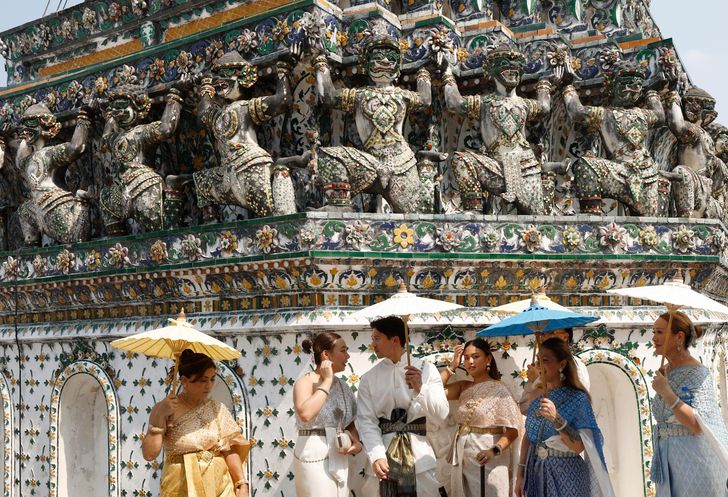
Tourists dressed in traditional Thai attire visit the Temple of Dawn in Bangkok, Thailand, Jan. 19. The Tourism Authority of Thailand aims to attract 36.7 million foreign visitors in 2026. EPA-Yonhap
The Seoul event is part of a broader 2026 roadmap where Thailand promotes its new “Healing is the New Luxury” branding, pivoting from discount package tours to purpose-led storytelling, gastronomy and culture, sport and outdoor lifestyle, wellness retreats and sustainable regional destinations as core pillars.
While Korean travelers may think of Songkran in April or Loy Krathong in November, Trirattanasongpol said, “Thailand is a country where festivals continue all 12 months of the year.” She emphasized that the country’s calendar is filled with diverse seasonal events, featuring local festivals and cultural events.
The TAT is also moving to carry out a “regional dispersal strategy” that expands the tourism map beyond traditional hot spots such as Bangkok, Pattaya and Chiang Mai to destinations across the country. Former Seoul office director Pattanapong Pongthongcharoen said low-cost carriers such as Thai Vietjet, Thai Lion Air and AirAsia are organically connecting Bangkok with major regional cities.
“This has greatly improved access not only to southern resort areas like Trang and Krabi, but also to northeastern regions including Udon Thani’s Red Lotus Lake, which recently drew attention after a visit by K-pop star Lisa,” he said.
Blackpink’s Lisa, who has fronted multiple tourism and branding campaigns for her home country, has helped boost Thailand’s image among K-pop fans by featuring in promotions and drawing global attention to lesser-known destinations.

A Thai tourism promotional image featuring K-pop star Lisa at Red Lotus Sea in Udon Thani, Thailand. Courtesy of Tourism Authority of Thailand
Thai officials promoted new destinations such as Krabi, known for its saltwater hot springs, Phang Nga, Khao Lak and Similan in the south, and Chiang Rai in the north, encouraging visitors to Bangkok to extend their trips to nearby cities.
Moreover, they said the country has “fundamentally raised the quality of tourism services” by expanding the government’s Safety and Health Administration (SHA) certification program, which labels businesses that meet hygiene standards and gives an SHA Plus logo to those with fully vaccinated staff.
They also highlighted the “Trusted Thailand” initiative, which designates hotels, shops and tourist attractions that meet strict standards for transport accessibility, multilingual staffing, transparent payment systems and overall service quality, as well as security measures such as surveillance cameras. The program is intended to provide travelers with clear, verifiable assurances of safety and reliability.
The goal, they stressed, is to create an environment where Koreans “can focus solely on their trip wherever they go in Thailand,” and to cement the Southeast Asian country’s status as a trusted destination through visible, verifiable safety standards.