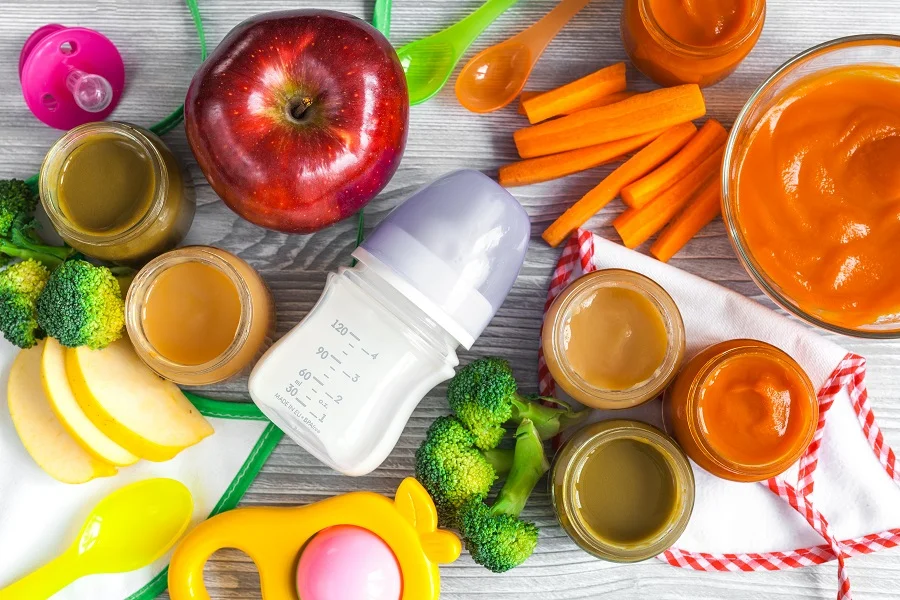
While updated nutritional guidance in the US tightens its reins on highly processed foods, nutritionists recommend specific guidelines for infant formulas as these will likely always be considered an ultra-processed food (UPF) under the Nova classification system.
Nutrition Insight speaks to Dr. Elizabeth Dunford, research fellow at The George Institute, about the nuances of strictly classifying certain baby foods as UPFs and the implications this could have for brands. Dunford was the lead author of a study identifying 71% of all US baby foods as ultra-processed.
“I am not certain if US dietary guidelines advising limits of highly processed foods would have a significant effect in the infant category,” she says. “But I would love to see foods containing additives with known negative health effects to require a mandatory warning label.”

“The recent move to change how the claim ‘no artificial colors’ is used is one example of a move in the right direction.”
Assessing infant sector impact
Industry professionals and nutritionists have previously critiqued the Nova system for broadly classifying foods as ultra-processed without considering their specific nutritional profiles or metabolic impacts. Dunford argues that the average consumer may find the classification process complex, as do some researchers.
“The general public likely can easily agree on some foods being classified as UPFs, regardless of how they came to that decision, such as a sugar-sweetened soda, potato chips, or a granola bar, but there are certainly some food types that can cause debate. For instance, flavored yogurts, dairy products with additives, and ready meals.”
Although infant formula manufacturers may seek to distance themselves from the UPF category, Dunford questions whether this is possible.
“They are all ultra-processed. Under the current way that the Nova definition works, for example, I am not sure that it would be possible for infant formulas (powdered) to move out of the UPF definition.”
“The infant sector would likely benefit from its own guidelines (compared to the rest of the packaged food categories), and this makes sense given infant foods are usually not included when developing nutrient profile models for the broader food supply.”
Balancing functionality amid evolving health standards
The analysis in the journal Nutrients published last week examined 651 infant and toddler food products from The George Institute for Global Health’s FoodSwitch database, which were sold in the top ten US grocery store chains. According to the study, 71% of grocery store baby food products can be considered UPFs.
 While infant formula manufacturers may seek to distance themselves from the UPF category, Dunford questions whether this is possible.
Flavor enhancers, thickeners, emulsifiers, and colors were the main factors triggering the classification of being a UPF. According to the paper, these additives were found in 71% of all baby products tested.
Nearly all snack-size packaged products (94%) were ultra-processed, with full-size packages (86%) and pouches (73%) following close behind. As US consumers increasingly shift toward more convenient infant and toddler foods, pouch sales have grown nearly 900% since 2010, detailed the study.
“We’re seeing a growing body of evidence that certain additives may harm health,” says Dunford. “With emulsifiers, thickeners, and stabilizers potentially altering gut function, and synthetic colors affecting behavioral outcomes in children, the high use of ‘cosmetic’ additives found in US baby foods is particularly concerning.”
However, baby foods also rely on emulsifiers and thickeners for safety, texture, and shelf life. Dunford notes that many additives have multiple functions.
“Personally, what I would love to see is manufacturers ensuring specific additives used do not have known negative health effects, and for regulators to require the function of each additive to be listed in the ingredient list so that the average consumer has complete transparency,” she suggests.
Salt and sugar limits
Meanwhile, public health policies are suggesting to limit the intake of UPFs. For example, the Trump administration recently released its Dietary Guidelines for Americans 2025–2030, which include recommendations to avoid highly processed foods for the first time, along with advice to limit added sugars and refined carbohydrates.
However, the US baby food study found that UPF formulas contained twice as much sugar as their non-UPF equivalents (14 g versus 7.3 g per 100 g), with added sugars only present in ultra-processed products.
Meanwhile, sodium content was consistently higher among UPFs than non-UPFs (70 mg versus 41 mg/100 g). UPFs were also typically more calorie-dense, in part due to added sugars and refined ingredients that lack essential nutrients like fiber.
Dunford says that it was not surprising that UPFs had higher levels of these nutrients and additives, as previous research has clearly outlined that. “From a regulatory standpoint, both nutritional values and level of processing are important to consider for any definition of ‘less healthy’ foods and beverages.”