By Mira W. – Editor: Louka Sakkas
Interview by Louka Sakkas, Isadora Cossari, Anna Hoangova at Ferrari Fashion School, Milan Educational coordinator + fashion director: Riccardo Carrapa
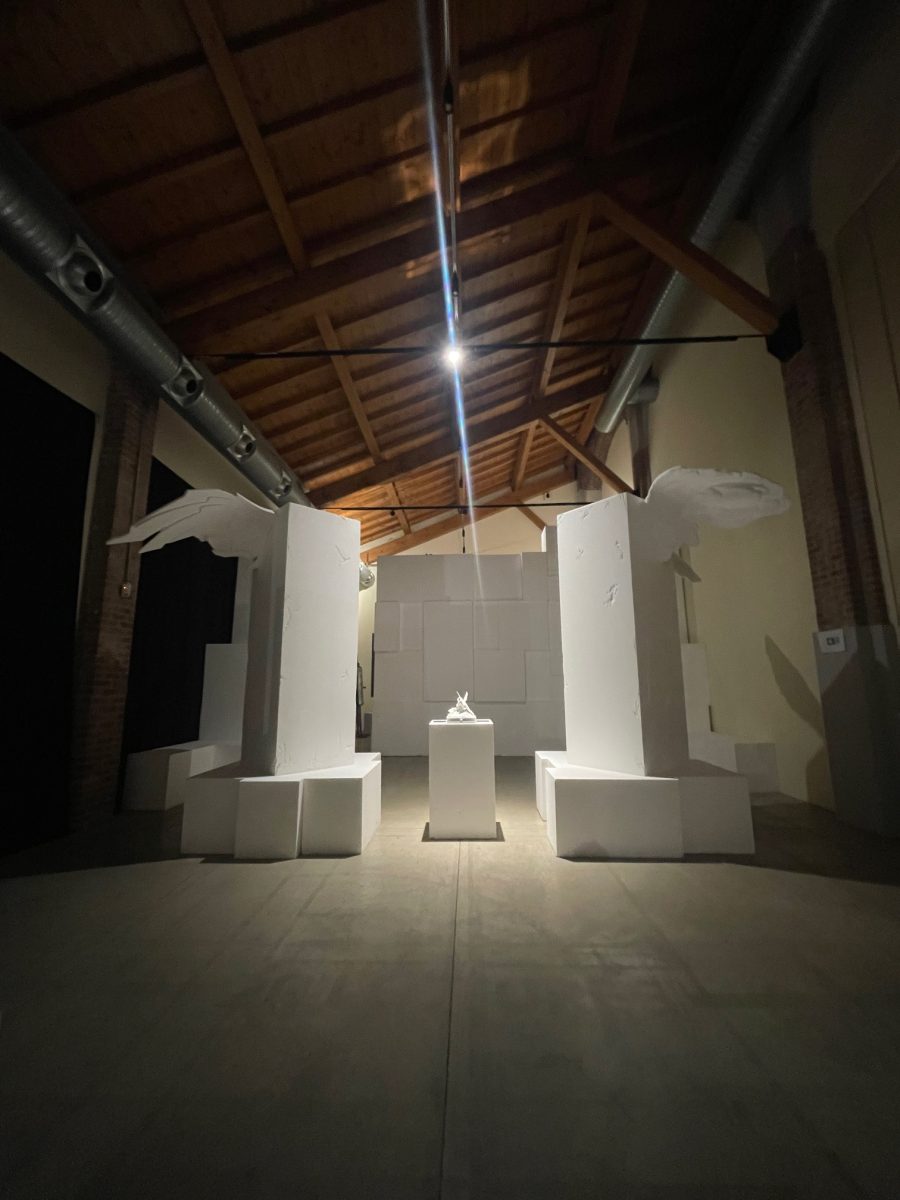
As part of their exploration of contemporary artistic practices, students from the Ferrari Fashion School had the unique opportunity to interview renowned artist Andrea Crespi in conjunction with his groundbreaking exhibition, Artificial Beauty: Aesthetics in the age of algorithms, between classical memory and computational visions. Showcased from October 23, 2025, to January 25, 2026, at the Fabbrica del Vapore in Milan, this exhibition marked Crespi’s first major institutional showcase in the city, curated by Alisia Viola and Sandie Zanini.
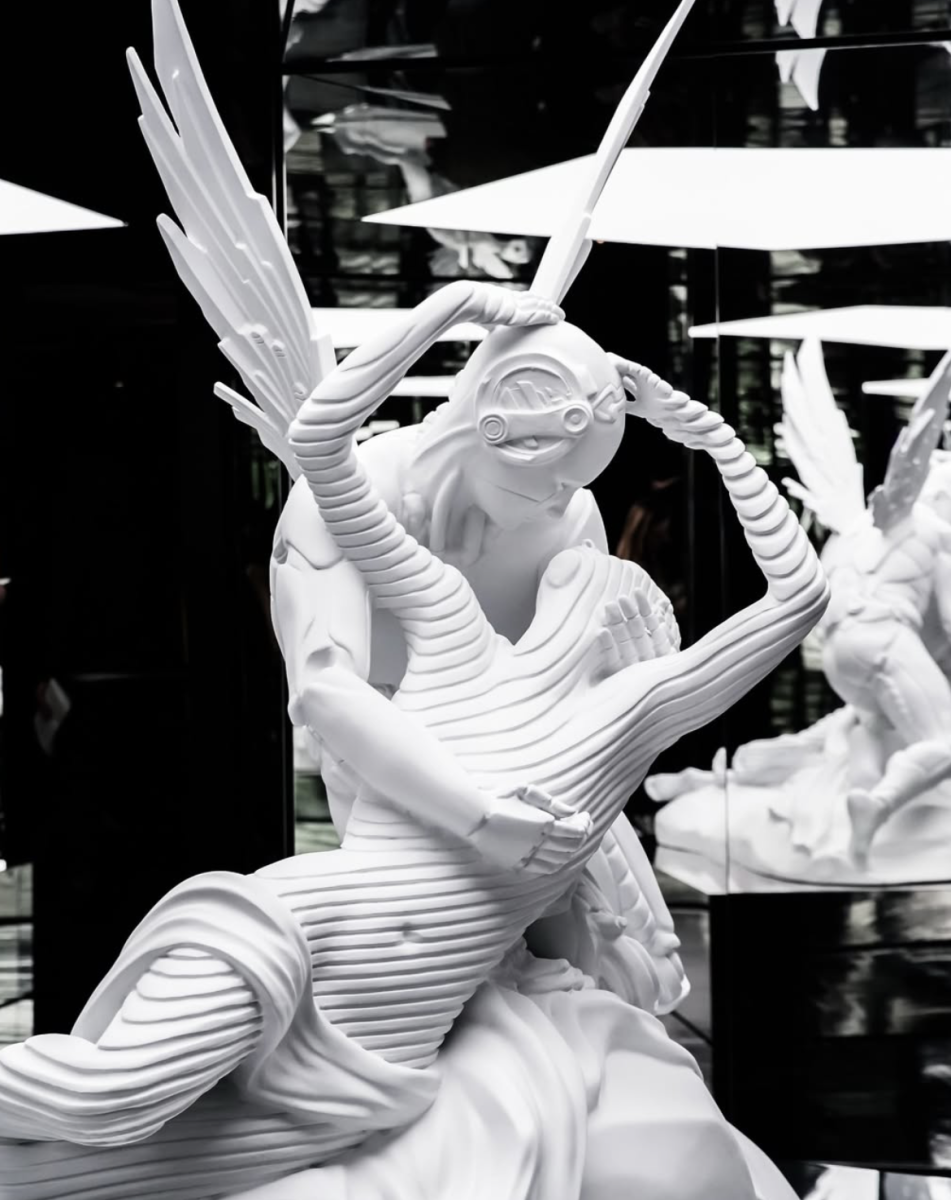
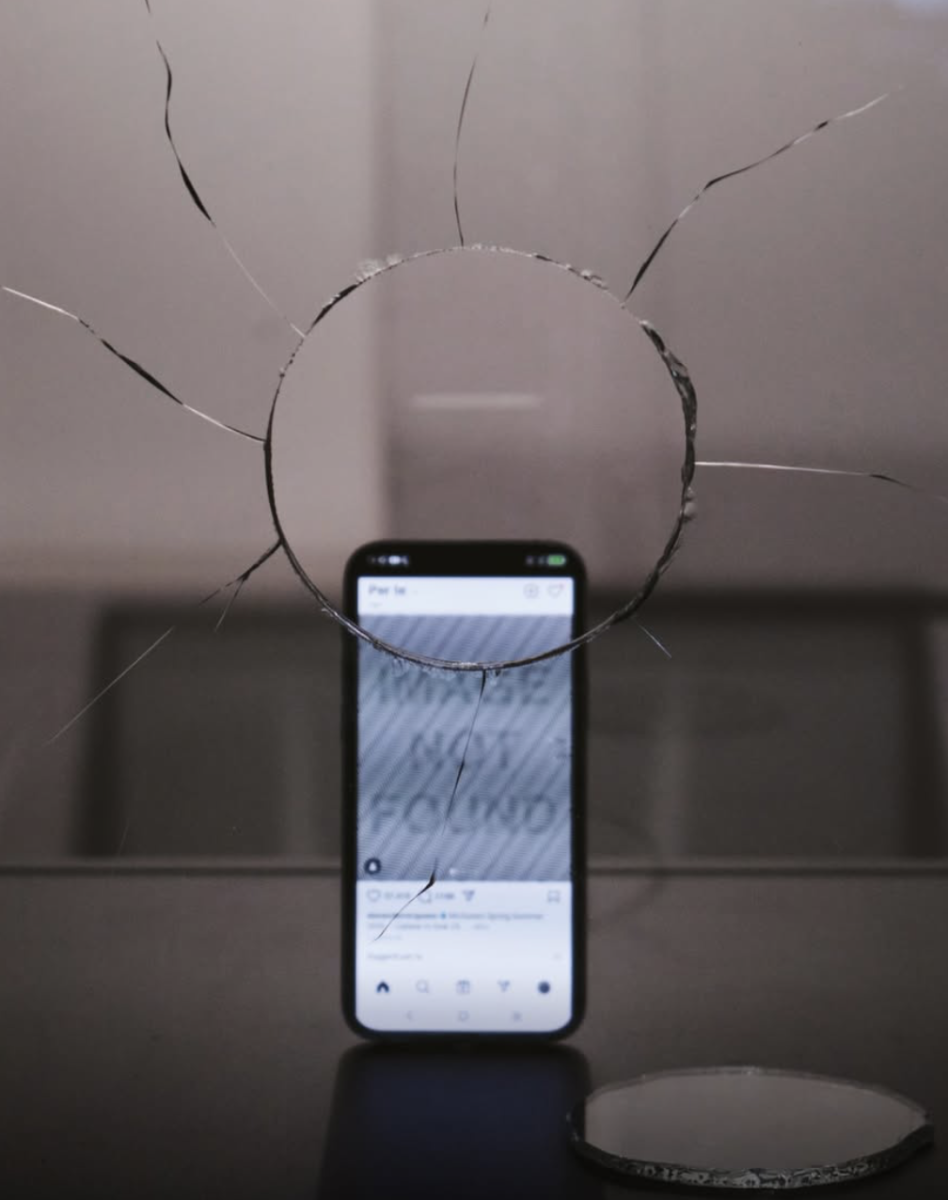
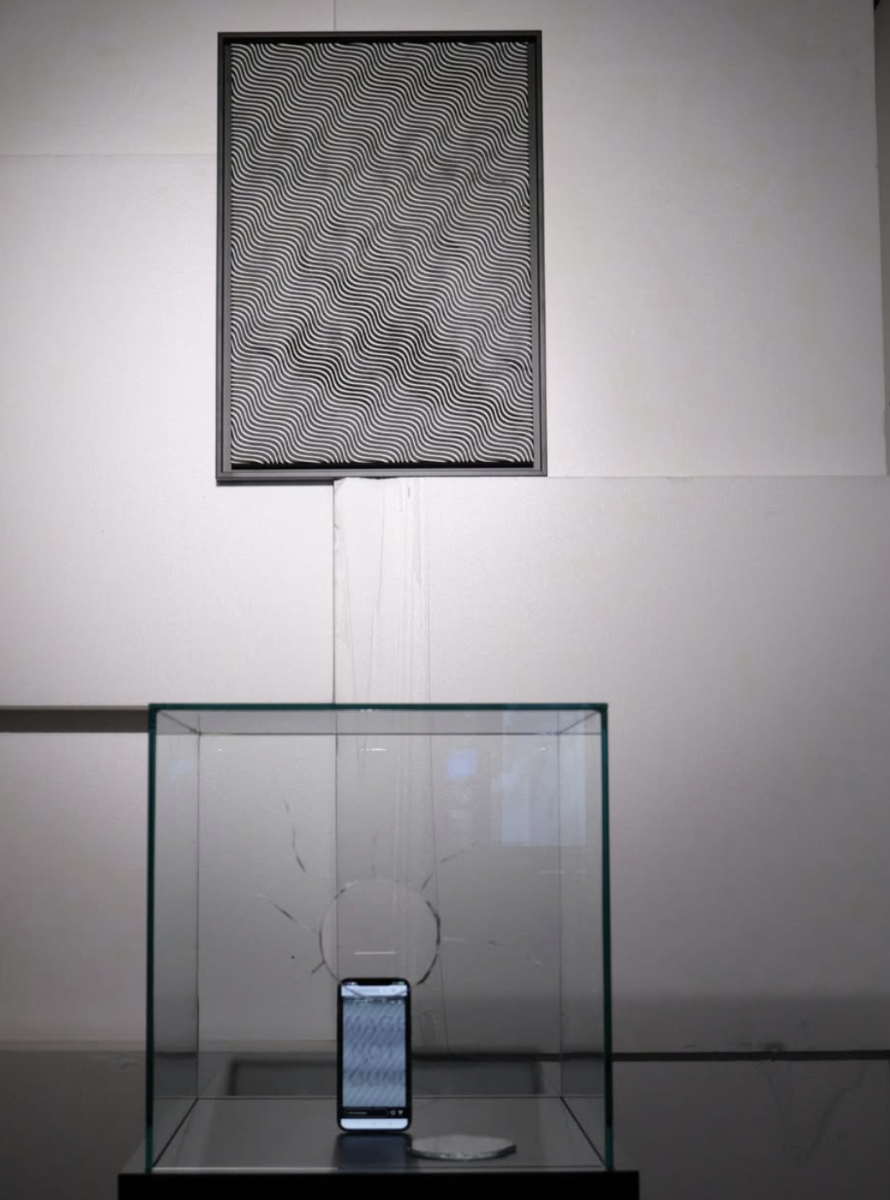
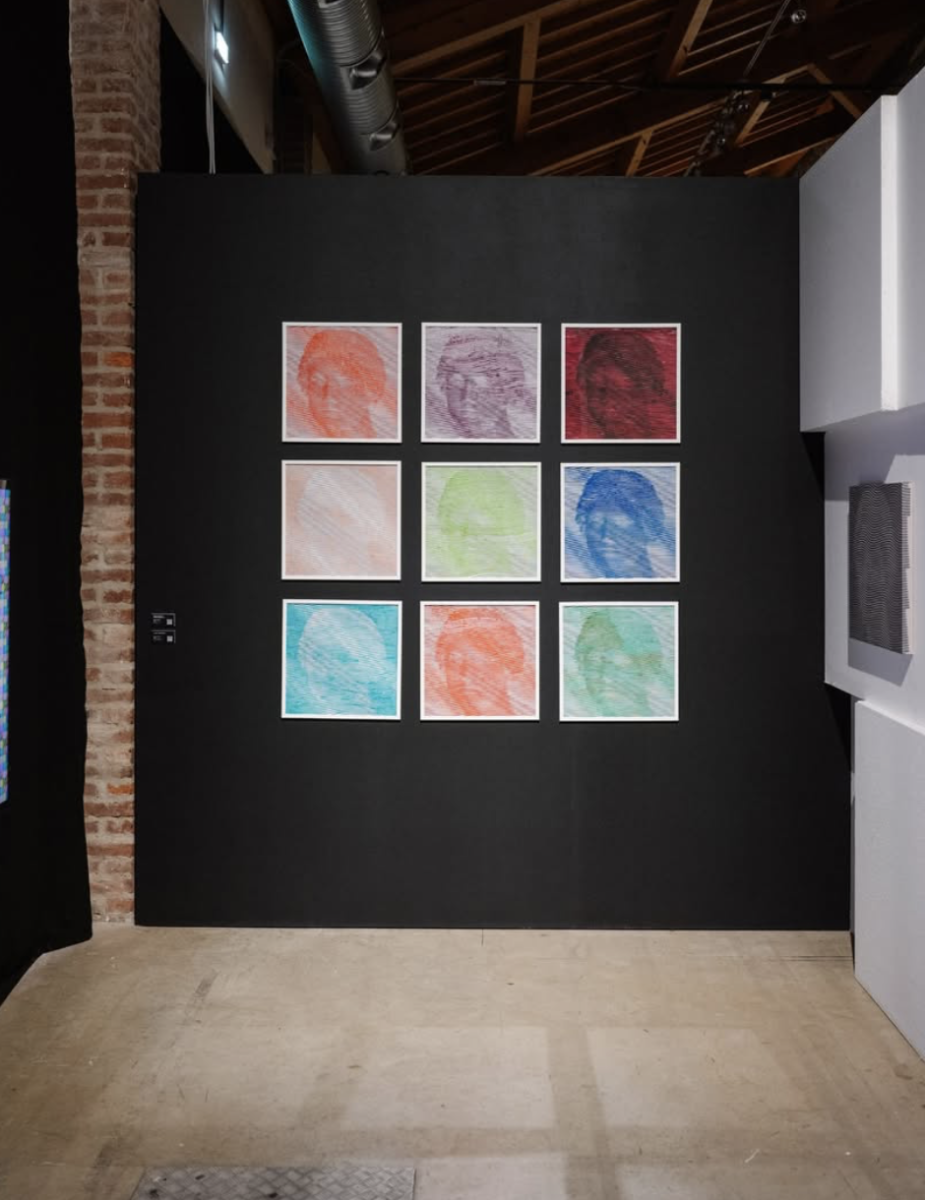
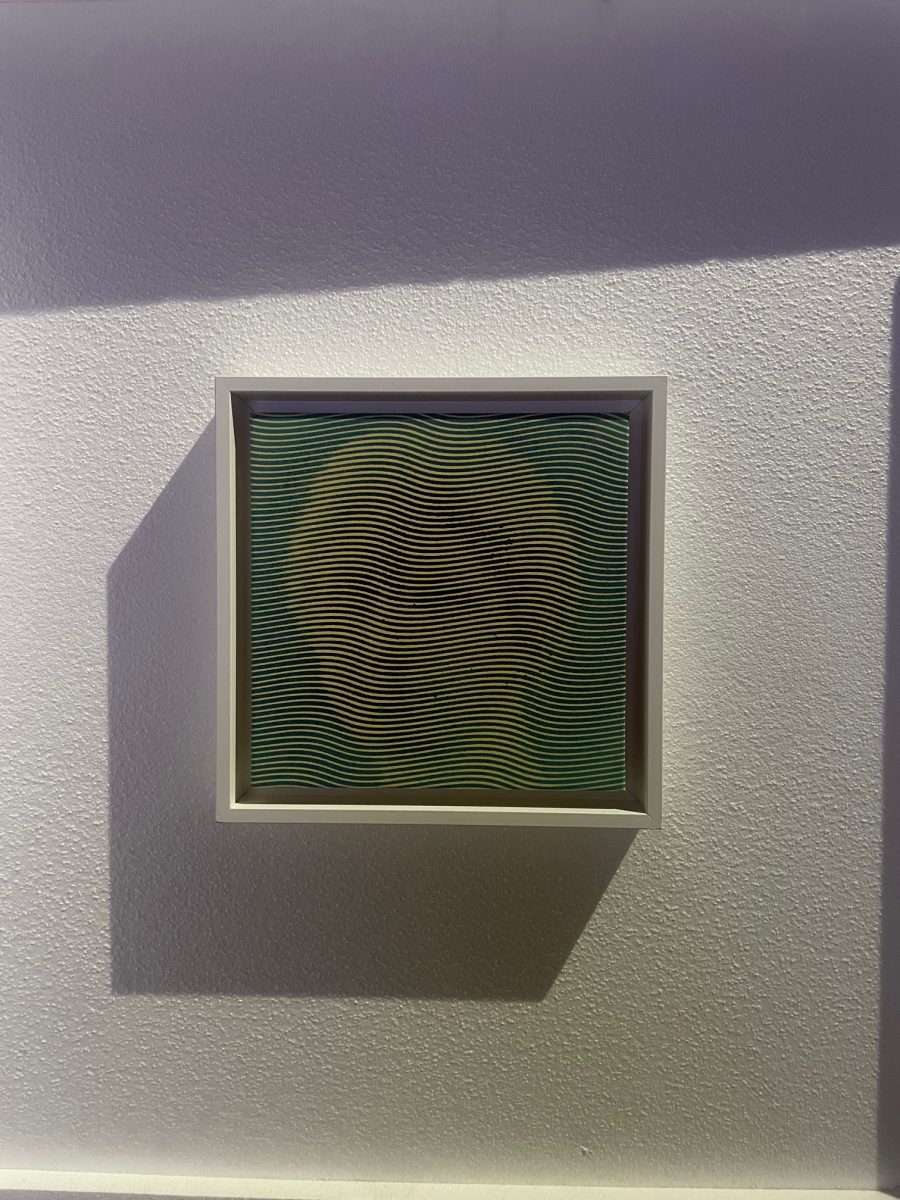
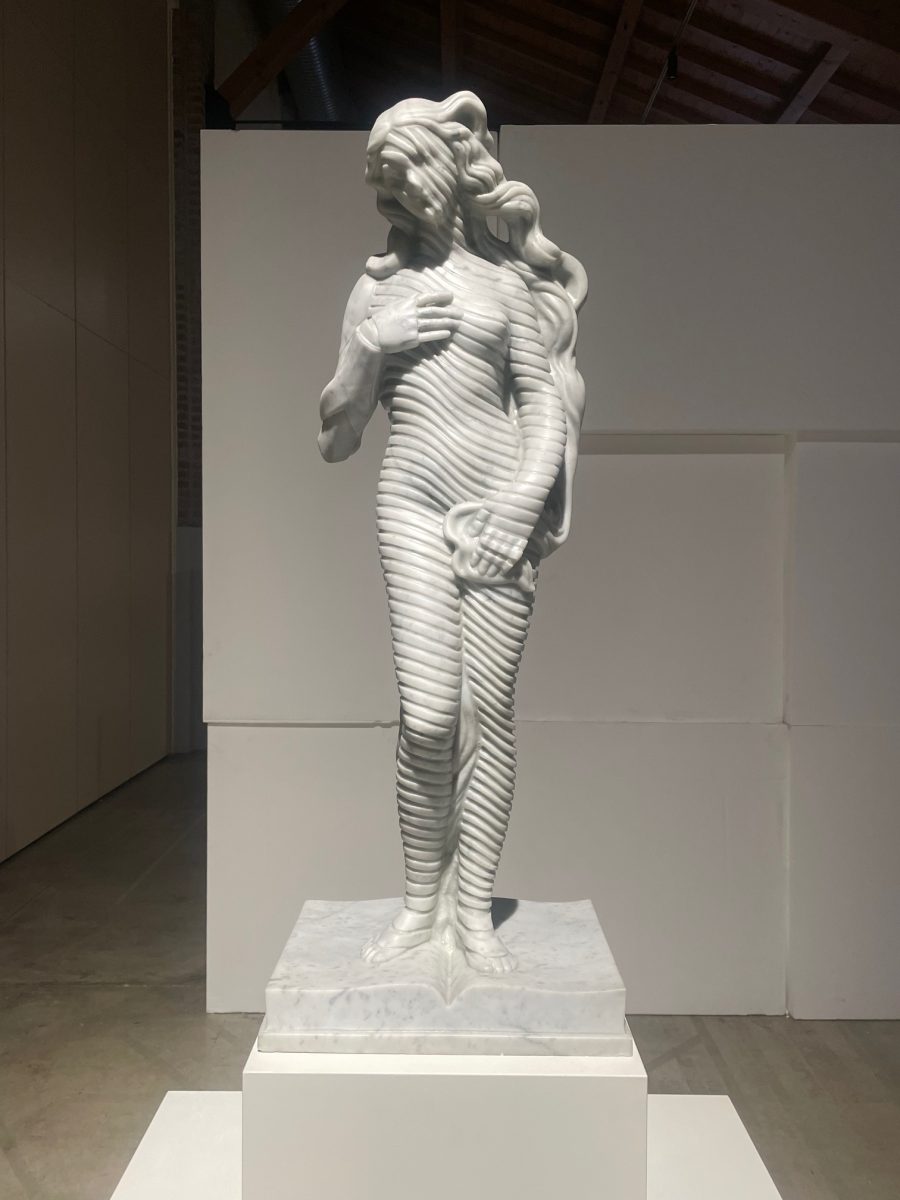
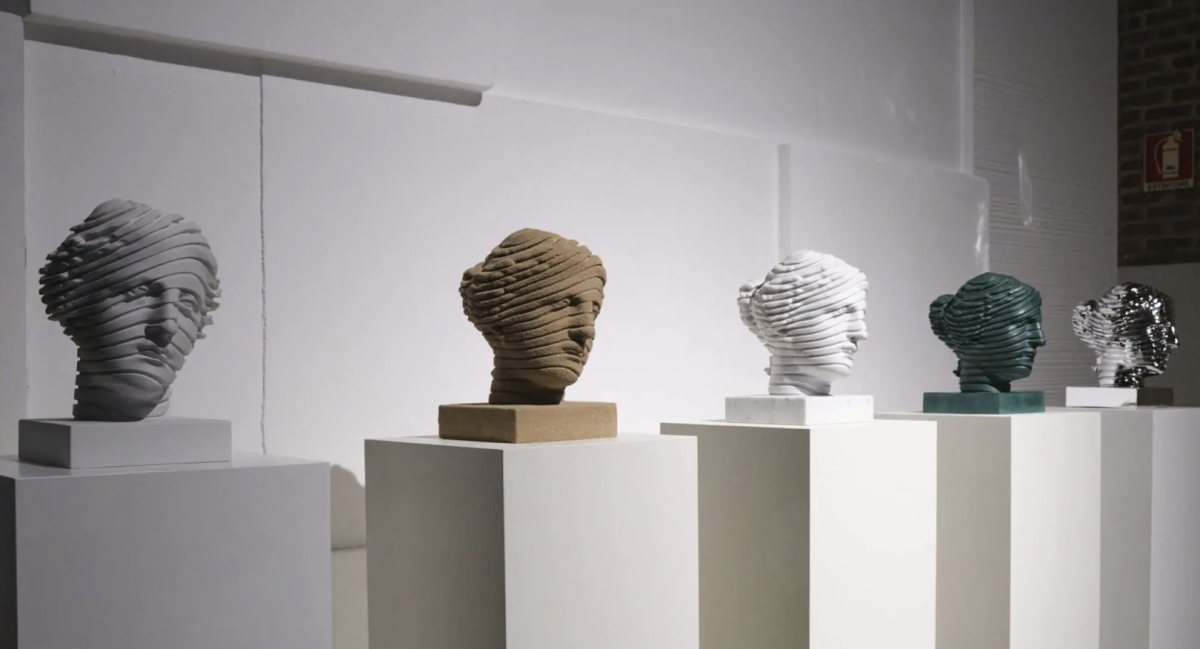
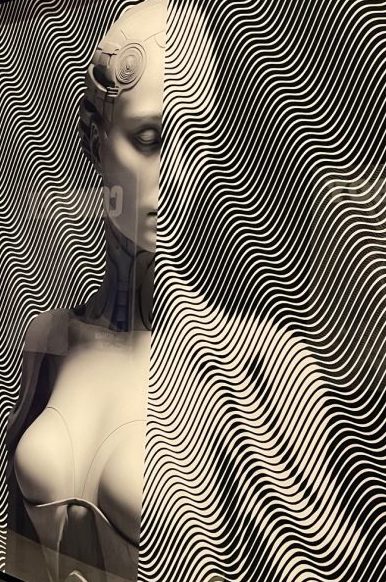
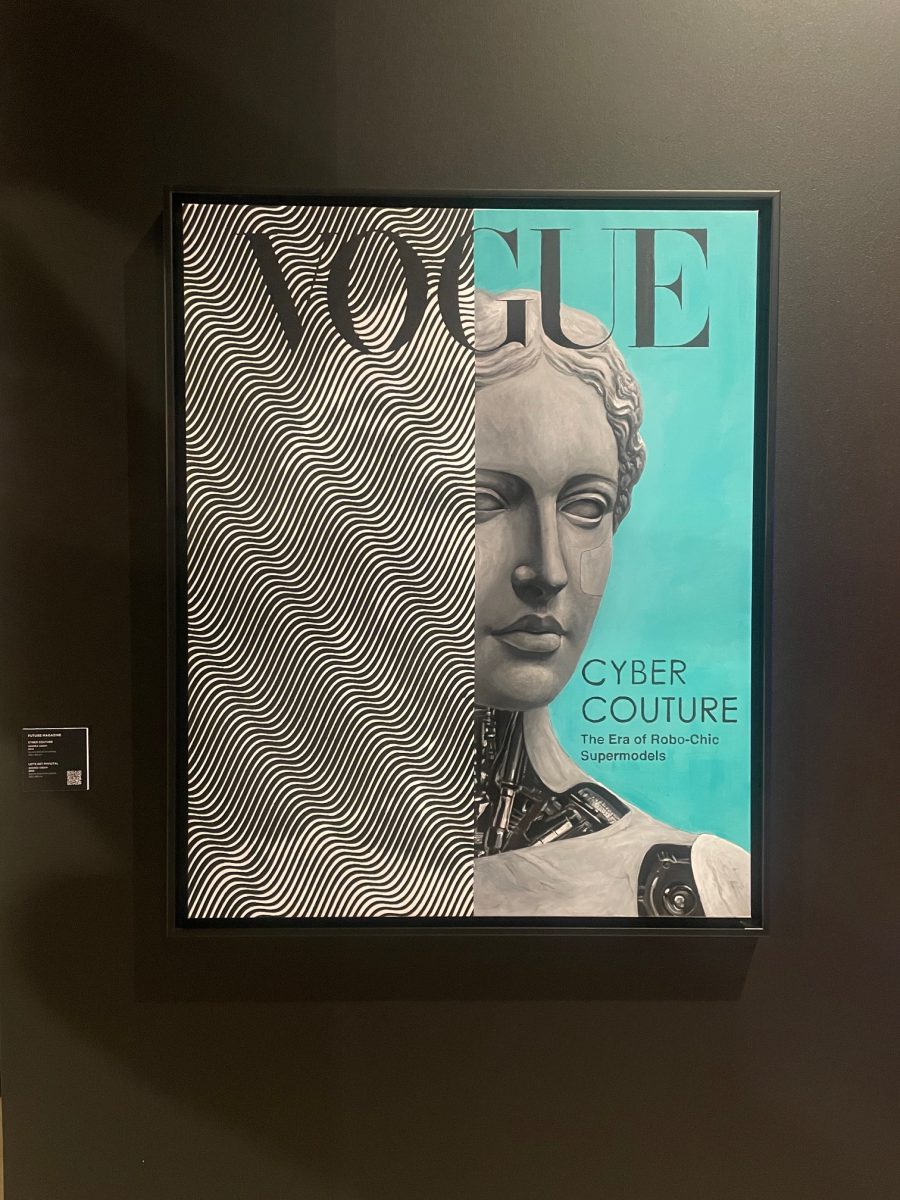
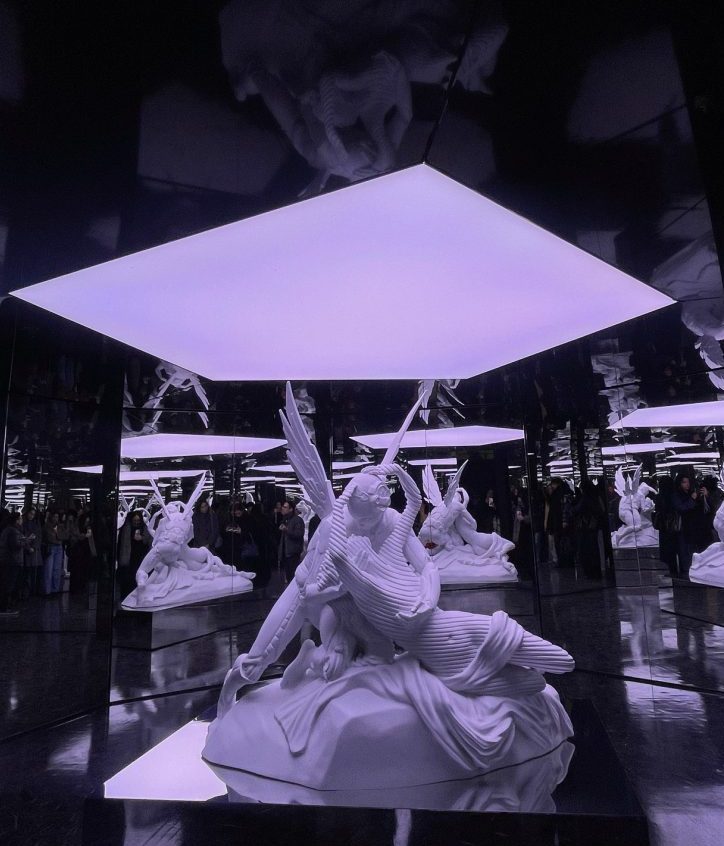
Artificial Beauty is a fragile interplay between classical aesthetics and digital innovation, challenging conventional notions of beauty in the modern age. Through mesmerising artworks—including paintings, sculptures, and immersive installations—Crespi invites visitors to engage with the evolving definitions of art, technology, and identity. The exhibition juxtaposes classical forms with synthetic entities, provoking questions about the human experience in a world increasingly shaped by algorithms and artificial intelligence. Crespi invites viewers to reflect on how this timeless dialogue shapes our daily lives, urging us to consider not only our historical legacies but also the paths we forge as we venture into an uncertain future.
Andrea Crespi’s art acts as a mirror, reflecting our contemporary struggles and aspirations while provoking thought about our collective consciousness. Each piece serves as a catalyst for introspection, challenging us to examine our beliefs and preconceptions. His powerful art encourage a dialogue that transcends time, merging classical themes with futuristic visions—a fusion that prompts us to question the very nature of progress and innovation.
If art possesses the transformative ability to open minds, then Crespi undoubtedly harnesses this potential to inspire action. His works resonate with urgency, calling upon art lovers and the broader public alike to engage actively with the ideas and challenges he presents.
In this interview with Andrea Crespi, the students from MA in Styling and Art Direction of Ferrari Fashion School engaged in the conversation with the artist at his solo exhibit, “Artificial Beauty,” hosted at Fabbrica del Vapore:
L: I noticed your NFT works—what was it like being part of that bubble before it “popped”?
Andrea Crespi: At that moment, everything was very connected, and it was nice.
L: I can imagine. I mean, how many years ago was that now?
Andrea Crespi: 2022… yeah, it was one of the best moments.
L: Now it’s kind of over… I guess you can still do things with it?
Andrea Crespi: Now I still do, but only because I don’t want to lose the connection with that world. Before, you could easily make a profit and grow, but that specific wave has passed. Now, you have to stay for the right reasons, not just for a “rug pull”; you must be consistent. You never know—maybe in a year it’s going to explode again. If you keep one foot in the door, it’s okay, but if you enter just for a “money grab,” it won’t work out. You should do this for the opportunity.
R: I can see that, and compliments to your art because it’s amazing. I think it isn’t just something commercial because it is very artistic—it’s your thoughts, your ideas, and your vision. This connection between art and visual communication itself is probably the best path for a young artist.
Andrea Crespi: You have to try to find the balance between the artistic side and the core topic of the work, but also find a balance with sustainability and the commercial side. For me, if you are pushing your art, you need support from brands and collectors, so finding that balance is essential. I don’t want to be just a designer at my core… I wanted to be recognized as an artist. I studied product design—that was the commercial side—but I wanted to move toward the artistic side. Of course, the commercial part is still important.
L: To grow and increase your chances, right?
Andrea Crespi: Yeah, it’s important to be smart and to have a vision. You shouldn’t change your vision or create something that isn’t aligned with your research just because they pay you. If you are able to find a balance, you are also able to preserve your credibility.
I: What was the creative process like to reach the point where you could connect Artificial Intelligence and classical art? How did you put it all together?
Andrea Crespi: I’m Italian, so I grew up in an environment where you find classical art everywhere; it’s part of my DNA. This is also something deeply connected to the concept of beauty. If you think about it, classical art is the best lens through which to view the world, and I love it. However, I was also born in an era where technology is part of our society, so I want to express myself with the tools of this era. I can paint, but it’s not my primary tool. I mean, it’s good if you are able to use that tool, but as a communicator—and because I think art is a powerful way to connect with people—I want to express myself using the tools of my generation: smartphones, digital cameras, software, and technology. I love the contrast and the dichotomy between the visible and invisible, black and white, past and future, technology and tradition. I love the tension you create when you put complete opposites together. I love merging the ancient with the contemporary; it might feel futuristic, but the future is now.
Take the butterfly, for example. It is a metaphor for how technology changes so fast, much like the life of a butterfly. If you see something in technology that is “cool” or beautiful, in a short while, it’s going to “die” because something else will replace it. The butterfly embraces this topic of technological cycles. It is beautiful, but it is also fast-paced. Everything changes, society changes, and the medium changes; the artwork expresses this.
A: You said you had a background in design?
Andrea Crespi: I studied product design for three years and then started working at an agency in Switzerland as an art director. I worked for seven years in this field with private companies in various situations, which allowed me to cross-contaminate and work across different sectors. After about seven years, I felt the need to do something for myself, without the “block” of a creative brief. So, I started with social media. I started to post—I’m not sure if I could call it “art” back then, but it was related to creativity. For three years, I did it without any expectations; it was just to feel good. I needed to express something more than just my professional work; I needed to express my soul. After three years of receiving feedback and people sharing my work, more people started to recognize my style, my digital art, and my brand work.
I thought, “If I invest a small part of my time and my journey into this, what’s the worst that could happen?” If I quit everything and focused entirely on this—maybe I won’t buy a Ferrari, but who cares? At least I’m doing something I love. So, I quit. When I left my job, I started taking on small projects but focused all my energy on my personal art, and things started to go faster and faster.
The more you do… Well, at the end of the day, social media can be a trap. You see others and think, “Oh, it’s easy,” or “I discovered this yesterday, I can create it in a day.” That is an illusion. You have to build day by day—maybe for ten years, maybe less, but definitely not in one or two years. You grow daily and learn to trust the project and enjoy the journey. When I look back, I can see how I’ve aged and grown. Today, you can make a TikTok and blow up in two minutes, but the next day, you disappear. If you move step by step and enjoy the process, it’s more consistent. It’s the best way to do it because it gives you time to think about what you are doing. If you are speaking to someone, it isn’t just luck—it’s something you built, so you know how to explain it. As a creative, the biggest challenge is defending your ideas. You deserve to fight every day. Even when you fail, you develop the vision to create something that people won’t just dismiss, because you’ve already explored all the angles.
Not everything can be perfect, right? If you are liked by everybody, you are liked by nobody.
R: Our students deal with this every day. They are studying for a Master’s in Fashion Styling and Art Direction, so they are constantly trying to manage clients, advertising, and fashion research. In a way, that research is part of the business vision. It’s interesting to hear your similar approach: defending your ideas and being part of a system while maintaining your own vision and creativity.
Andrea Crespi: If I hadn’t spent seven years in an agency where I did everything—photography, websites, graphics,copywriting—I wouldn’t have these skills. I took everything I learned at university and through collaborations and said, “Okay, now I know how to apply these skills to my own project.”
R: That’s the best way, I think.
Andrea Crespi: As you grow, you find other people to support you, but at the beginning, you are alone and have to do everything yourself. The more you grow, the more you find people who believe in you, and eventually, you can afford a team. But it’s a step-by-step process. Now I have my sister helping me—she just graduated—as well as Simone, Sandy, and Elisia. It’s a very good team; they’re the best.
R: And what’s next for you?
Andrea Crespi: A lot of things. I’m trying to finalize a new studio space close to where I live because I need more space. Because of bureaucracy, it takes time! Project-wise, I have a collaboration with a major medical brand to create a collection starting in February. I have a project in Venice, and this week I’m working on two others. In a way, I don’t have a “real life” because I’m so focused on my work. I enjoy it, but it’s not for everyone. I have a girlfriend, so I try to focus one week entirely on her!
R: Well, that’s normal; you have to take time for yourself as well.
L: It’s a bit like juggling.
Andrea Crespi: It’s not easy. Since art is something you love, it can take everything from you. For me, that’s okay, but for the people around me.
R: You have to manage it the right way.
L: It can be hard for the people under your “spell.”
M: Many students are deeply into art, while others use art as a medium to speak through rather than pursuing it as a primary profession.
R: Especially now, with everything becoming so much more commercial. Any other questions?
L: Do you still handle the production yourself, or do you have assistants for that?
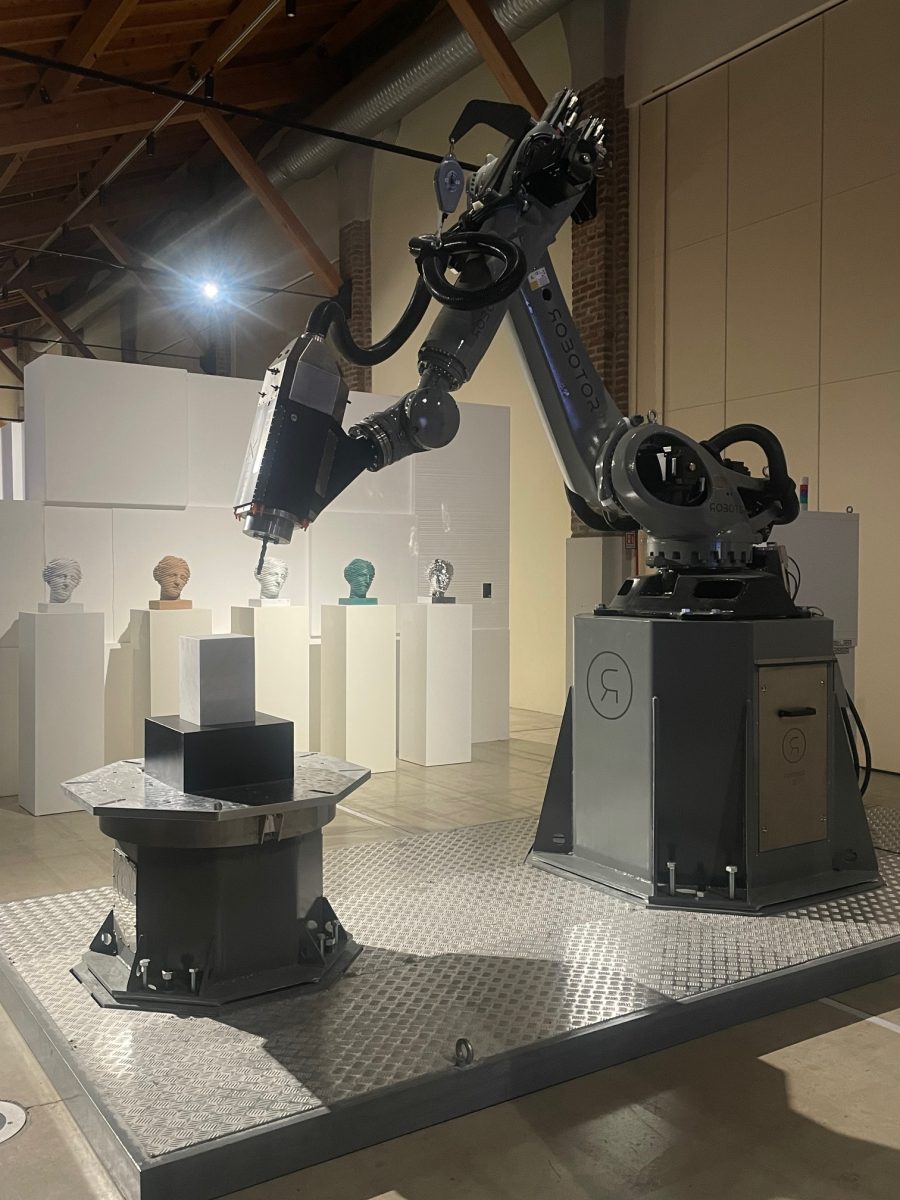
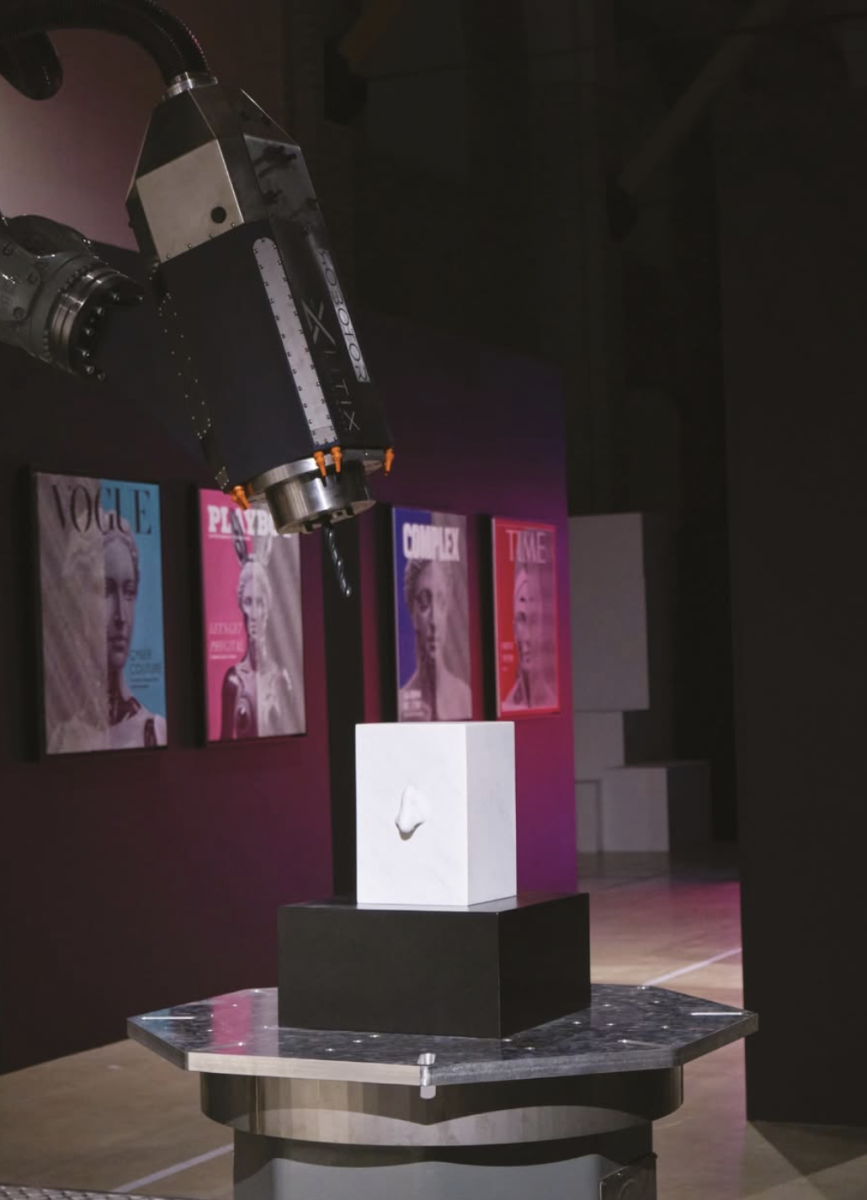
Andrea Crespi: I have assistants. I focus on the vision and the concept. For example, I don’t physically touch the sculptures; if I did, I might ruin them! I work on the digital side, and then I give the files to the production company—like the robotic arm you see here. Of course, I visit and make adjustments if needed, but I want to focus on curating the vision and the final result.
In the future, I hope to paint more, but the work can be very stressful. Sometimes I just want to lie back and relax. In the beginning, though, nobody was allowed to touch what I was doing. But over time, you realize you have to choose: do you want to paint, or do you want to think? If I focus on the thinking, I can move faster and create more. I need to create—not just in a physical way, but in a mental way.
L: Maybe at some point, you’ll just plug wires directly into your head!
R: Why not? That’s the future. In the future, perhaps you can come to our school and talk with the students to share your point of view? We could even arrange a project where students give you some kind of input.
Andrea Crespi: For example, last year for Design Week, we did a project with another University. I involved a brand and created a brief where the students had to connect with that brand. It could be very nice.
Andrea Crespi’s art becomes at this point a call to reflect, a constructive provocation, daring us to confront our fears and hopes for what lies ahead. With each artwork, installation, or digital exploration, he beckons us to imagine a future where art continues to be a vital force for change and enlightenment.
 STUDENTS CONSIDERATIONS:
Andrea has used his art to build a school in Tanzania and support women’s rights foundations. Many artists struggle with the idea that art is ‘useless’ in the face of real suffering. How should we cross that bridge from creating aesthetic beauty to creating tangible social change, and would that responsibility weigh on your creative process?
I think every artist creates with a different purpose. Some focus on personal expression, others on social impact, and both are valid. But Andrea’s work shows that art is not useless, it can be both aesthetically powerful and socially impactful. By turning creative work into real action, artists can also show others, including non-artists, that art has value beyond beauty, and that art can serve multiple roles. For me, this responsibility wouldn’t limit creativity, but give it more meaning and direction.
Would you still view modern art as a ‘product’ designed to solve a visual problem? Why?
I see modern art as a product of the artist’s inner world; if the world requires art that tests political views and expresses our freedoms as humans, then it should exist as so. With a world as fast-paced as the one we find ourselves in, art needs to persist and be colorful, fun and stay magical. And if it does become a product – it should inspire others to create and express themselves.
‘Future Reflections’ by Andrea uses mirrors to fragment the viewer’s reflection, questioning the solidity of our identity. In an era where we curate our ‘digital selves’ on social media, do you think we are losing the ability to know who we are in the physical world, or is this ‘fluid identity’ simply the next stage of human evolution?
I think that with the obvious acceleration of social media, people have become less connected with themselves. Our social networks shrink naturally over time, but we need to remind ourselves that ‘we are enough. You are not defined by your followers, how many likes your latest reel has, or the views on TikTok, at the same time I think it means more in this age to have 20k followers on Instagram than it did 10 years ago.
We no longer have natural experiences, we harvest them for content. If having 20k followers ‘means more’ today, it’s only because we’ve allowed technology to define our human worth. We’ve reached a point where if a moment isn’t ‘posted,’ we might fear it didn’t actually happen. To find ourselves again, we don’t need to look into a digital screen – we need dream again.
Andrea has used his art to build a school in Tanzania and support women’s rights foundations. Many artists struggle with the idea that art is ‘useless’ in the face of real suffering. How should we cross that bridge from creating aesthetic beauty to creating tangible social change, and would that responsibility weigh on your creative process?
Art should be created from what the artist believes in personally; it’s another layer added when the artist directs their expressions into the field of societal commentary or political criticism. Someone like Banksy is a street artist at heart, that’s how his art is expressed at the ‘core’. To me, how much art may weigh on you depends on how many times you say ‘yes’… ‘Does the color make sense?’, ‘Do I want to offend people with this expression?’. If an artist has a platform and chooses to paint flowers while the world burns, they aren’t just making art, it’s a distraction from the fire. The bridge to tangible social change is crossed the moment an artist stops asking ‘Is this beautiful?’ and starts asking ‘Is this useful?’.
True artistic mastery today isn’t found in the brushstroke, but in the courage to use that brushstroke as a voice.
’Questions and answers from MA Fashion Styling and Art direction cohort, Ferrari Fashion School, 2026.
Educational coordinator + fashion director: Riccardo Carrapa
Interview by Louka Sakkas,Isadora Cossari, Anna Hoangova at Ferrari Fashion School, Milan