Toothpaste is one of the most predictable products in personal care: a minty paste in a tube, designed for efficacy over experience. But as Gen Z increasingly looks to upgrade every part of their daily routines, and as GRWM-style content spills into non-beauty categories — see: granola — oral care is entering a cute new era.
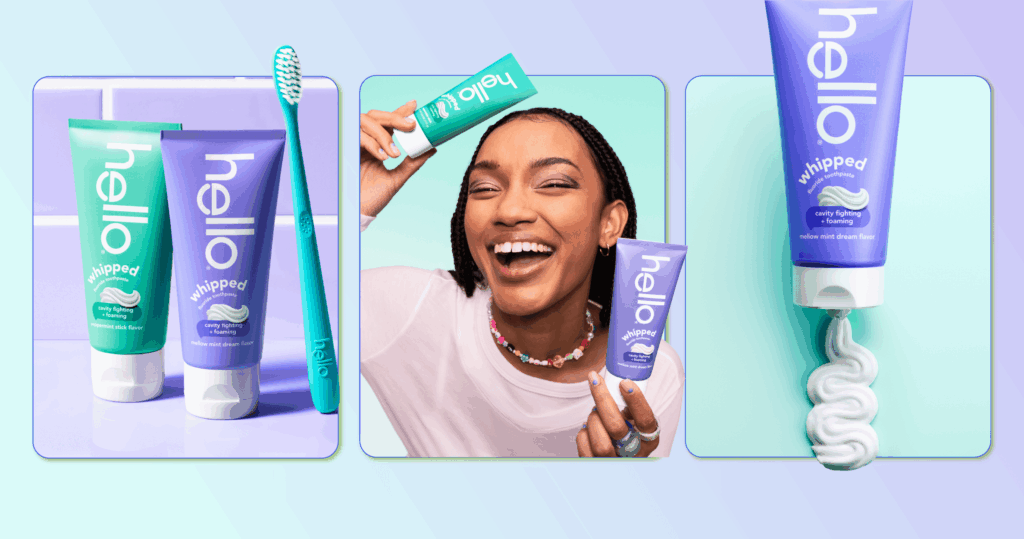
Hello, the oral-care brand founded in 2013 and acquired by Colgate-Palmolive in 2020, is among the brands driving the trend. To start, it’s taking a texture-first approach: In December, it launched Whipped toothpaste, a velvety foam that dispenses in a swirl-shaped “nurdle” and lathers as you brush. Available in Mellow Mint Dream and Peppermint Stick, with more flavors to come, the product was engineered with Gen Z in mind.
“We’ve done our best to take a category that can feel a bit stale and boring, and bring a little bit of magic and disrupt that category,” said Diana Haussling, Hello’s CEO.
Hello already over-indexes with Gen Z, Haussling said, attributing it to the brand’s “clean aesthetic, thoughtful ingredients and sensorial experience, which is something that we know Gen Z is attracted to.” According to Nielsen, Gen Z’s spending power is expected to grow to $12 trillion by 2030, and the demo makes up 25% of the global population. Gen Z, made up of 14- to 29-year-olds, likes purchase from brands that connect to their personal identities, Haussling said. And they’re willing to shop multiple channels, take product recommendations from varying sources and endure more friction when it comes to sourcing products from various places to curate the desired mix.
A first for the brand, Hello debuted the product on TikTok Shop. Haussling cited September 2025 data from Numerator, which found that 44% of Gen Z had made a purchase on social media in the prior month, and the cohort is 82% more likely than the average consumer to say social media and digital advertising influence their purchases.
The product itself took three years to develop, according to Mohammad Aziz, Hello’s principal scientist, who was tasked with bringing “everyday yay” to consumers’ oral care routines. It was a combined effort of creating the whipped texture and the swirl-shape dispenser.
“It was just an idea on a piece of paper, but then [we had] to take that and to build it into a prototype that’s aesthetically pleasing and also effective — it was a combination of different hurdles and challenges we had to overcome to bring this idea [to fruition],” Aziz said.
“[It has] a foamy, velvety texture, and the taste is really pleasant — it doesn’t have a really strong mint taste, but it has a very delightful flavor. And, not only does it taste great and deliver on fighting cavities, but it also looks pretty cool and gives you that countertop flex,” Haussling said, emphasizing that her team considered every detail in “making something that would connect with Gen Z, but also [anyone] who loves a really effective product that looks great.”
Performance is table stakes, and the experience, Haussling said, should play into users’ beauty regimens. The brand wanted the Whipped experience to feel as indulgent as the most enjoyable parts of one’s “Everything Shower” or their most luxurious skin-care routine. This, Haussling said, already reflects how Gen Z views oral care. “Gen Z looks at their regimens and routines as [connecting] back to their identity — we know that about them. So [we were looking to] create and leverage a lot of the cues we’ve seen in beauty and bring that to the oral-care experience,” she said.
The launch of Whipped reflects a broader shift: Categories once defined by clinical function are increasingly borrowing from beauty’s playbook, ensuring texture, visual delight, “shelfie” appeal and content-worthiness.
The Whipped Toothpaste is already for sale, and, Haussling said, she has been “blown away” by the response on TikTok Shop so far. The brand will escalate its marketing efforts beyond TikTok in March.
On March 16, Hello will unveil a “Chief Aura Officer,” a Gen-Z macro-creator who will serve as both ambassador and cultural consultant. The person in this role will serve as the brand’s “official Gen-Z voice,” helping Hello understand culture, trends and “vibes,” in real time, said a brand representative. This partnership will also mark a new approach for the brand, as it has historically lacked a singular “voice” to represent it.
Then, at the end of March, the brand’s more traditional campaign will kick off, with two spots. One, dubbed “The Robe,” will roll out across premium CTV placements as well as across TikTok, Instagram, Snapchat and YouTube. The brand aimed to use visual cues — velvet, foam, clouds — to signal the sensorial experience of using Whipped.
In tandem with the official campaign’s debut, Hello has tapped a fleet of creators to promote Whipped, including 3D digital artist and animator Ginevra Grigolo (@ginnijoie; 84,000 TikTok followers), lifestyle creator Celine Tran (@jellybean.celine, 1.5 million TikTok followers) and comedian Lukas Battle (624,000 TikTok followers), to name a few.
In the oral care space, Colgate-Palmolive also owns Tom’s of Maine and its namesake brand, in addition to Hello. In its most recent earnings report, on January 30, the company stated that it owned 41.3% of the toothpaste category globally. According to Nielsen data, Hello has been the fastest growing toothpaste brand in stores for the past three years. And according to Numerator Shopper Metrics for 2025, it is the second-fastest-growing toothpaste brand in household penetration.
Hello is not the only oral-care brand currently courting Gen Z or attempting to make toothpaste marketing more culturally relevant. In November 2025, Boka debuted its own Erewhon smoothie, while brands like Cocolab and Moon have leaned into buzzy collaborations to help inject novelty into the category. Colgate itself made a Gen-Z play in 2021 with a sub-brand dubbed Co. by Colgate, which launched exclusively at Ulta Beauty. The collection is not currently available on Ulta’s e-commerce site, potentially leaving runway for Hello to capture its target Gen-Z shopper base.
Collabs of the week
Crown Affair, which has seen success with its small clips and signature green silk hair ties, introduced “The Big Clip” ($62) in partnership with jewelry designer Jennifer Fisher. “The Big Clip” is rendered in “dimensional” black acetate, according to the brands, and intended as a “modern objet d’art.”
Madewell partnered with veteran denim designer Benjamin Talley Smith on an extra-limited seven-piece capsule priced well above its usual $148 denim — the collection’s prices range from $88-$398, with jeans selling for $285. The collection includes two matching jacket-and-jeans sets plus elevated takes on basic crewneck sweatshirts and T-shirts. The capsule launched on Thursday, and many items are already nearly sold out. “Madewell has always been a destination for denim, and [it is] a brand that takes the category seriously. I wanted to bring my decades of expertise in design, approach to fit and focus on construction to a wider audience. Madewell’s customer understands those nuances. They notice stitching, hardware, proportion and fabric choice. This partnership felt like the right way to offer something elevated without losing the ease and accessibility that Madewell is known for,” Talley Smith said of the partnership.
Inside our coverage
Exclusive: Audrey Hobert’s relatable lyrics land her an Ilia partnership
Reading list
The complicated politics of Rama Duwaji’s style
Ulla Johnson just teased her new fragrances at NYFW
LVMH explores sale of Make Up For Ever in beauty restructuring