BRENTWOOD, Tenn. — The call to pastoral ministry is both a privilege and a weight. Despite frequent strain, data reveals very few pastors step away each year.
The 2025 Lifeway Research study, sponsored by Houston’s First Baptist Church and Richard Dockins, an occupational medicine physician concerned about pastoral attrition, surveyed more than 1,500 current Protestant pastors and more than 700 former Protestant pastors.
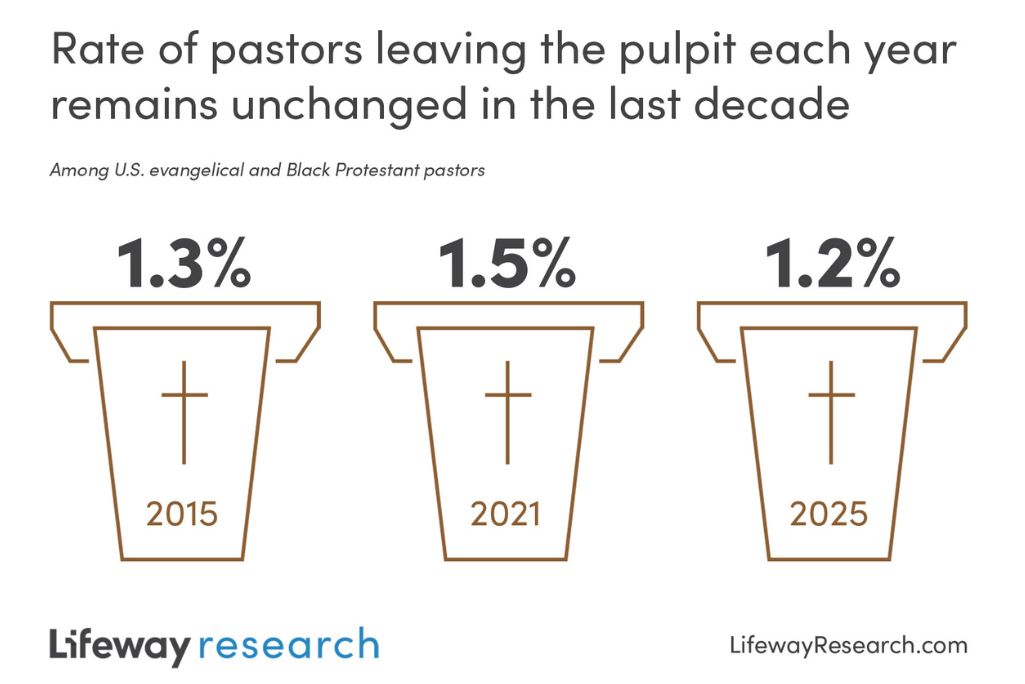
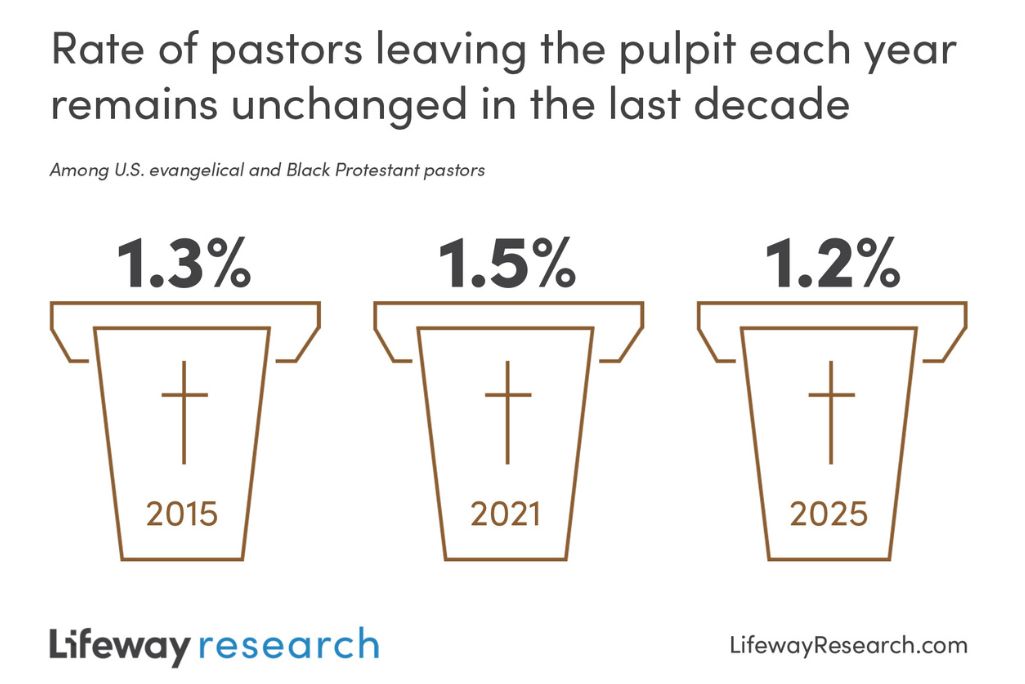
Only around 1 in 100 pastors leave the ministry each year, according to a Lifeway Research study of evangelical and Black Protestant pastors. The percentage of pastors who leave for reasons other than retirement or death has remained statistically unchanged over the past decade: 1.3% in 2015, 1.5% in 2021 and 1.2% in 2025.
“The rate of pastors departing the pastorate is steady and quite low given the demands of the role,” said Scott McConnell, executive director of Lifeway Research. “Many of those leaving feel they are moving at God’s direction to another role of ministry. However, it’s easy for both those outside and inside the church to fixate on those who leave because of conflict, burnout or moral failure. Speculation always overstates these cases, yet these are the outcomes churches can seek to prevent.”
Lifeway Research’s Beyond the Pulpit Insights Report explores key findings on pastoral resilience, burnout, family dynamics, counseling trends and factors that most influence long-term ministry health. Based on this research, the report uncovers insights to better support and strengthen ministry leaders in churches.
Pastors and their families
The pastor’s role can compete with their family for attention. When that happens, however, pastors say they choose home life over church life.
Among married pastors, 9 in 10 (%) say their spouse is enthusiastic about their life in ministry together.
“Overall, pastors are very positive about their family life and report that their spouse is as well,” McConnell said. “They are not describing a utopia — in fact, almost half give a rating lower than strongly agree when saying their spouse is enthusiastic about their life in ministry together — but pastors are saying that in most cases, both they and their spouse are fully committed to this work despite its difficulty.”
For evangelical and Black Protestant pastors, 4 in 5 (80%) consistently put their family first when they have time conflicts, while 18% disagree and 2% aren’t sure.
Pastors and counseling
Compared to a decade ago, pastors have less training in counseling but are more hesitant to refer church members to professionals.
Most pastors follow best practices and refer a member to a professional counselor if the situation requires more than two sessions. Almost 3 in 4 (72%) say they refer someone after a couple of visits, but that’s down from 2015 (76%) and 2021 (77%).
Additionally, the number of pastors maintaining a list of counselors to whom they can refer people has steadily dropped over the past decade. In 2015, 2 in 3 pastors (67%) had such a list, but that fell to 60% in 2021 and down to almost half (52%) in 2025.
Compared to 10 years ago, churches are also less likely to have a lay counseling ministry. In 2015, 34% of congregations had this. That dropped to 28% in 2021 and remains at 27% today.
Despite being less likely to send people to professional counselors beyond their church and have lay counselors within their church, evangelical and Black Protestant pastors have less counseling training than they did a decade ago.
Few pastors (9%) have a graduate degree in counseling, a percentage that has remained steady over the past decade. But fewer pastors are gaining counseling knowledge in other ways.
In 2015, around 2 in 3 pastors (64%) attended a counseling conference. That fell to 58% in 2021 and less than half (48%) in 2025. The percentage of pastors who have read several books or articles on counseling has dropped from 90% in 2015 to 87% in 2021 and 81% in 2025.
“We are seeing a simultaneous decline in pastors developing their counseling skills, having lay counseling ministries and being ready to refer people to counselors they trust,” McConnell said. “If only one of those were down, we would say pastors’ methods were changing, but counseling appears to be getting less attention in general.”
Evaluating why pastors leave the pulpit
Few pastors leave the pulpit each year, but those who do mostly say it was a personal decision.
Among pastors from four denominations who stepped down, 2 in 5 (40%) say it was related to a change in their calling.
Other leading causes are conflict in a church (18%), burnout (16%), family issues (10%) and personal finances (10%). Some point to an illness (6%), being a poor fit with a church (6%), not being able to find a church that was a good fit (4%), denominational issues (4%) or the church closing or issues related to the pandemic (3%). Only 1% blame a lack of preparation for the job. While pastors stepping down for a moral or ethical issue garners the most headlines, only 3% are connected to that. Some say another reason (6%) or none of these (3%).
“Because social media tends to spread current stories that are far from normative, we run the risk of becoming convinced of falsehoods about pastors today,” McConnell said. “This research study provides uncommon access to a reliable sample from four denominations of those who left the pastorate early, and the most frequent reason for stepping away from the senior pastor role is them claiming God’s leadership to do so.”
Despite leaving the pastorate, half (53%) of former pastors are still working in the ministry, just in a role other than pastor. A third (32%) work in a non-ministry role. Few took early retirement (7%), disability (3%), are currently looking for work (2%) or have some other employment situation (2%).
Next steps for pastors and churches
The research illuminates the realities pastors and church leaders face, offering a nuanced understanding of what sustains ministry over time and what threatens its continuity. Ultimately, the data clarifies that pastoral wellness isn’t just a personal matter; it’s a shared responsibility. Thus, the research invites both pastors and their churches to take steps toward pastor health and wellness.
In the latest Lifeway Research report, insights based on the 2025 pastor wellness data equip pastors and church leaders to take steps toward long-term ministry health. This report will challenge pastors and leaders to clarify expectations, invest in family, maintain rhythms of rest, cultivate transparent relationships and engage trusted counseling experiences.
(EDITOR’S NOTE — To explore the complete findings, download Beyond the Pulpit: Keys for Resilient Ministry Leadership from Lifeway Research.)