It seems unlikely that anyone else has ever acquired a Mark Rothko painting to match the trademark hue of their namesake company. But that’s precisely how Terry de Gunzburg, founder of French make-up line By Terry, came to hang the Colour Field masterpiece “Untitled (Black on Purple) 1969” in her pied-à-terre on New York City’s Upper East Side. “The signature colour of my brand is deep purple,” says de Gunzburg in her lively French staccato. “Our friend [gallerist] Dominique Lévy said, ‘I have the perfect match.’ And I replied, ‘Oh, it’s so chic, Dominique, to have a Rothko matching my packaging.”
The doors of the private elevator open to de Gunzburg’s Parisian-proportioned apartment with its Left Bank chic. Ornate crown moulding, ceiling roses and parquet flooring frame a four-bedroom home, filled with the curves of art-deco furniture and the colour and energy of contemporary art by names more commonly found in a museum. Just one of the unexpected twists includes a steel Richard Serra piece, more usually found outside, leaning under the living-room windows. A neon-yellow abstract sculpture of a head by Georg Baselitz is mounted on a cabinet in the far corner.
 In the living room: Alexander Calder mobile (est $5mn-$7mn); ‘Concetto spaziale, Il cielo di Venezia’ (1961), by Lucio Fontana (not for sale) over the fireplace; purple armchairs (c1931) by Jean-Michel Frank ($70,000-$100,000); abstract sculpture by Georg Baselitz (not for sale); guéridon (1939) by Marc du Plantier ($70,000-$100,000); sideboard (1933) by Eugène Printz ($300,000-$500,000); carpet (c1925) by Émile-Jacques Ruhlmann ($150,000-$200,000) © 2026 Calder Foundation, New York/DACS, London © 2026 Lucio Fontana/SIAE/DACS © Damien Hirst and Science Ltd. All rights reserved, DACS / © Estate of Richard Serra / DACS
Come spring, that violet, featheredged Rothko is to be auctioned by Sotheby’s auction house; it’s one of nearly 200 art and design pieces going under the hammer from the collection de Gunzburg has built with her husband, Jean. The first sale is Design Masters on April 22; the second is the Modern and Contemporary Art sale in May. The estimate for the Rothko alone is between $10mn and $15mn. Some 130 ceramics, lamps and furnishings by celebrated artists, designers and architects, including Zaha Hadid and Jean Royère, are together valued at between $30mn and $40mn.
De Gunzburg is a grande-dame of the beauty world. Born in Cairo, she was brought up in Paris, where she launched her eponymous brand in 1998. This was following an influential role as creative director of beauty at Yves Saint Laurent, where she invented the click-brush concealer Touche Éclat. Her By Terry Baume de Rose lip balm is often pulled out of the make-up bags of famous faces. The company, headquartered in Paris, remains family-owned, with her husband and their eldest daughter, Marion Assuied, as shareholders.
 De Gunzburg at her London home; her wardrobe comprises crisp white shirts and statement shoes © Kasia Bobula
“The art on these walls is not from lipsticks,” de Gunzburg clarifies with disarming directness. Jean, a prominent molecular biologist, now the chief scientific officer of the French biopharmaceutical company Da Volterra, hails from a historic French family, and their marriage in 1994 took Terry’s ability to collect to an elevated plane. The couple still has an endearingly newly-wed vibe, at once lightly teasing and complementary as they switch between French and English.
We are more amateurs than collectors. We were never looking for ‘acquisitions’. With each piece, it was a coup de foudre
“We are more amateurs than collectors,” Terry demurs. “We were never looking for ‘acquisitions’. With each piece, it was a coup de foudre.” Mad passion, maybe, but there is no sense of a scattergun approach. She and Jean have amassed an extraordinary collection of Museum of Modern Art-calibre paintings and design. But she’s quick to credit her London-based daughter Eloise Margoline, the family art adviser. With pedigree from Almine Rech gallery and Gagosian, Margoline has introduced her parents to 21st-century painters, including Anselm Reyle and Mark Grotjahn.
Just as Terry’s wardrobe is full of crisp white shirts and statement shoes, the apartment reflects an eclectic mix and match. A huge, ethereal white Alexander Calder mobile (est $5mn-$7mn) moves almost imperceptibly throughout my visit, hanging from the ceiling in the main living room. A Paul Dupré-Lafon low coffee table, circa 1930 ($200,000-$300,000) skews art-deco industrial with its leather, parchment, oak and bronze. Pops of yellow and By Terry purple reign supreme.
 Desk (c1931) by Eugène Printz (est $150,000-$200,000); ‘Curule’ stool (c1923) by Jules Leleu ($20,000-$30,000)
  ‘Untitled (Black on Purple)’ (1969) by Mark Rothko (est $10mn-$15mn); sculpture (c1950) by Alexandre Noll ($50,000-$70,000) © 1998 Kate Rothko Prizel & Christopher Rothko ARS, NY and DACS, London © 2026 ADAGP, Paris and DACS, London
“I’m a compulsive buyer and I can never stop,” says Terry. “We’ve assembled this apartment piece by piece,” adds Jean. “We would go on weekends to art shows and antique shops we liked.” A counterpart to the grandeur of the living and dining rooms, the de Gunzburgs’ library is intimate. A pair of simple, mid-century Paul Dupré-Lafon armchairs ($60,000-$80,000) is cocooned among floor-to-ceiling bookcases, stacks of Gagosian Quarterly, vases and vessels and an old-school television. Above the marble mantle hangs Picasso’s “Buste de femme” ($3mn-$5mn).
Purchased in 2000, the apartment is among five properties the couple own; the others are in Paris (their primary base), London, Saint-Rémy-de-Provence, in the south of France, and Herzliya, Tel Aviv. Each contains an equally knockout assemblage of objets d’art. Manhattan holds a prime position in the family’s life — a central hub of comings and goings for her seven children (two of whom live in the US) and 17 grandchildren. With a rotating cast of characters, it sometimes feels like a “hotel suite”, Terry laughs.
 In the library: ‘Buste de femme’ (1955) by Pablo Picasso (est $3mn-$5mn); screen (c1925) by Alexandre Noll ($30,000-$50,000); armchairs (c1946) by Paul Dupré-Lafon ($60,000-$80,000); carpet (1940s) by Jean Lurçat for Myrbor ($7,000-$10,000) © 2026 Succession Picasso/DACS, London
That is no accident. Designed by fellow Frenchman Jacques Grange — known for the world’s finest boutique interiors, from Francis Ford Coppola’s Palazzo Margherita to the nearby, neo-deco Mark Hotel — the space channels a Saint-Germain-des-Prés meets Madison Avenue spirit. An enfilade of windows flood the two main rooms with sunlight. “When we first opened the door to this apartment, we fell in love with the parquet Versailles,” says Terry of the wood inspired by the Parisian palace. “The floors are like a piece of art itself.” Paris inside, New York outside: the Upper East Side mid-rise, through-street view also had her smitten. “I even love the noise of the traffic. It’s incomparable New York energy,” she says.
Grange insisted they start bold, with a carpet by early 20th-century French furniture designer Émile-Jacques Ruhlmann ($150,000-$200,000). A composition of radiant, interlocking bands of pinks and purple, it lends an unexpected, textured kick, setting the stage for the de Gunzburgs’ time-spanning taste. Both love a quirky juxtaposition: a blue-chip Damien Hirst painting beside a blue Alberto Giacometti vase that once belonged to Karl Lagerfeld ($200,000-$300,000). “It’s not a defined collection of a certain period or a certain type of art,” says Jean. “We find works of great quality go together.”
 Painting by Beauford Delaney (not for sale); pair of wall sconces (1925) by Armand-Albert Rateau (est $100,000-$150,000); cabinet (1926) by André Groult ($600,000-$800,000); ‘Footballeur’ sculpture (1965) by Pablo Picasso ($20,000-$30,000) © 2026 Succession Picasso/DACS, London
 Armchairs (one of a pair, c1924) by Jean Dunand (est $150,000-$200,000); table (c1924) by Pierre Chareau ($120,000-$180,000); vases (c1925) by Jean Dunand (from $7,000); low coffee table (c1930) by Paul Dupré-Lafon ($200,000-$300,000)
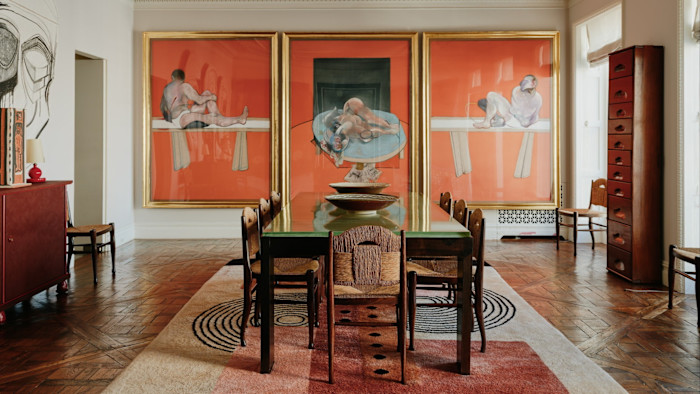
Yes, “it all began with the large Ruhlmann carpet in the living room”, says Grange. But “our friendship did the rest. For more than 25 years, every acquisition and every relocation of work was a conversation.” In the dining room, for example, three extraordinary paintings of semi-nude male figures against a bright orange background fill an entire wall, visible through the set of living room doors from nearly every vantage point in the adjoining room. “Terry called one evening to tell me they had just acquired a triptych by Francis Bacon,” recalls Grange. “I immediately reconsidered the entire space.”
He had just been offered an antique Saint-Gobain glass slab, designed a simple base for it, and paired it with woven-rush Ruhlmann chairs, to create a warm, urban-rustic ensemble. The chairs and table are up for auction. The Bacon, however, is staying. “It’s part of the architecture now,” Terry explains. “I think if you asked my husband to sell the Bacon, he would sell me. Keep the triptych or keep your wife?”
But why auction hundreds of items from their home? “I am 70,” answers Terry. It’s time, she says, “to give our children the opportunity to build their own collections”. Children shouldn’t have to wait until their parents die to inherit everything, she says. Most of all, the couple plans to donate to philanthropic organisations, giving directly to grassroots charities — cultural, educational and science institutions — to have the greatest impact, says Terry.
 ‘Gartenfigur’ (1932) by Paul Klee (est $2mn-$3mn); armchair (1920s) by André Groult ($25,000-$35,000); guéridon (c1914) by André Groult ($30,000-$50,000); vase (c1914) by Jean Dunand ($20,000-$30,000); floor lamp (c1937) by Eugène Printz ($50,000-$70,000); doors (1929) by Jean Dunand (not for sale)
They also increasingly want spaces in their homes for kids to be kids. “The furniture is so fragile now. I hate to say to the grandchildren, ‘Don’t touch this’,” says Terry. “Each time I would come back to the apartment, I found a disaster. I said, ‘No way’.” Durability led the decision process in selecting what made it to auction; the more valuable and fragile an item, the easier it was to part with. She also wants more space to support emerging artists — “I need walls.”
The furniture is so fragile now. I hate to say to the grandchildren, ‘Don’t touch this’
While Sotheby’s is certainly accustomed to estate sales following a death, those by living individuals are lively exceptions. Last year, the sale of patron Pauline Karpidas’s cache of surrealist art and custom furniture garnered $136mn; over the years, high points have seen sales of the personal collections of Peter Brant, Stephanie Seymour, as well as Jacques Grange, in 2017.
Jodi Pollack, chairman of 20th-century design and chairman of major collections, Americas for Sotheby’s, is excited by this sale. In particular, she highlights a set of 15 hand-fabricated Claude Lalanne mirrors created for Yves Saint Laurent and Pierre Bergé, which she describes as, “without question, the triumph of the design collection. Not in my wildest dreams would I have dreamt of the opportunity to handle these, let alone see them reassembled within one room as they were originally conceived.”
Recommended

De Gunzburg bought the mirrors at the “legendary” auction of the couple’s estate. But she admits that, “believe it or not, we never found a place to hang them — never”.
This is a clearout on an epic scale — time, not only, for her to move on, but for pieces to be showered in new affection.
www.sothebys.com
Find out about our latest stories first — follow @ft_houseandhome on Instagram