I was in the gift shop of a small art gallery the other day when I bought a postcard depicting a bunch of different keys. The postcard turned out to be a reproduction from the six-volume dictionary and encyclopedia Larousse du XXe siècle (me neither) and the keys come in a gorgeous range of shapes and sizes. The Roman key is broad and boot-shaped. The Merovingian looks like part of a crank.
I love a good key, obviously, and yet I wasn’t thinking of that as I bought the postcard. I wasn’t thinking of the many keys I’ve owned and lost over the years, or the acquaintance of mine who is a locksmith. I wasn’t thinking of the junk shop I’d once visited on a Greek island where I spent a happy twenty minutes looking through a trunk filled with rusted keys whose locks had clearly long-since crumbled, or a friend who is a caretaker at a church and once showed me the huge long-stemmed key he uses to get in each evening. I didn’t even think of church keys, the colloquial name for a flat-edged tool that is used to open human skulls – hopefully only during autopsies.
Instead, I thought of a single word: Zelda.
Oh man, Zelda and its keys. The boss keys, with their villainous, intimidating shapes. The little silver keys collected and portioned out in dungeons, each one a gamble. And that moment, a few weeks ago, when I spent much longer than I should in some shrine deep in Tears of the Kingdom, watching a stone ball rolling around a concave semi-circle in the ground before it settled into the centre. This mesmerising thing was a key of sorts: once in the centre, the stone ball certainly triggered a nearby gate. But it was also just a wonderful thing in and of itself. The rolling ball, the lazy, beautiful, ideal physics that kept it in motion, the lovely grating chunk as it finally found its resting spot.
Zelda is keys, in a way: locks and doors and chests and the urge to find out what’s inside things and behind things. But in a crucial way, as I watched that stone ball roll around, I realised that I had no key at all for the two most recent Zeldas, Breath of the Wild and Tears of the Kingdom. I think I love these games. And just watching the ball made me realise they’re clearly beautiful, and capable of conjuring wonder. But I don’t understand them. They haven’t fully come into focus for me or made sense of themselves to me. A brilliant friend once wrote that the Zelda games are clockwork fairy tales. Clockwork often needs a key. So are these recent Zeldas still clockwork, now that they’ve gone open-world? And where’s the key I’m after?
Our Tears of the Kingdom review in video form.Watch on YouTube
I struggle to do what I’m told in games, but this never used to be the case with Zeldas. Back in the day, whether slipping between dimensions, pushing through the mineral veils of time, or simply messing around in a boat that came with a head, I did exactly what I was told. The land was in danger, so a hero in green had returned. Time to battle through dungeons, collect cherished items, and give Ganon a showing at the end of it all.
These games were discursive – god those little stones you had to collect and clip together in The Minish Cap, that brass and wood camera from Wind Waker – but their discursions, how to put this, always left me facing in the right direction afterwards. Hyrule field was dauntingly vast in Ocarina of Time, or so it seemed, but I always found the dungeons in the right order and I always made it to the final credits. My favourite of these games, Link to the Past, is a single puzzle box from start to finish – I appreciate this is not an original thought – and I wandered through it, got lost, found my way again, despaired and tasted triumph and almost gave up, all without feeling, really, that I had wandered even for a second where I was not meant to go.
Then came Breath of the Wild. And I think I was lost from the start. I emerged into that bright green and blue world, right at the top of a hill, and I duly collected all my new powers, but did I ever really understand what they were for? Moving stuff around, messing with time, bringing ice blocks out of the earth! Reader, I am ashamed to say that it took me a week or two of playing before realising I was even meant to be applying these powers outside of the shrines, those collectathon fragments of old Zelda dungeons that were suddenly my only guide through this expansive, panoramically broad and emphatically hands-off world I was dumped into.
Image credit: Nintendo / Eurogamer
Tears of the Kingdom was much the same, except by now I had seen about a billion TikToks that showed me that the game was really about using the skills I was given in ways that hopefully nobody else had thought of. I saw people using the time powers from Breath of the Wild to travel everywhere on trees they’d felled and then filled with pent-up kinetic energy. As for the building tools from Tears of the Kingdom, I saw someone who had made the DeLorean from Back to the Future, right down to the gull-wing doors, which opened and shut automatically. Anything was allowed here. Everything was allowed.
So that was it! Forget about Zelda and Ganon and the curse that had fallen across the land. Just enjoy the sandbox. Live for the lark of it.
Yeah, but that’s not quite right either. Hyrule is a great toybox, but the more I screwed around with the bits and pieces the more I realised that the game has all these subtle ways of reminding a dutiful, slightly plodding person like me that there is a central quest. There are the people you meet, and their manias and tragedies. There are the derelict castles and flying dragons and the Blood Moon or whatever it’s called, everything reminding you, just enough, that things are kind of serious here really.
More than that, there’s a sadness laced into the landscape of Hyrule itself. One of my favourite painters is Eric Ravilious, master of watercolours, visual poet of the South Downs, and apparently one of the most cheerful people who ever lived. He knew war and he died mysteriously near the North Pole (I think) but he also ricocheted from one love affair to another and was known, I gather, for his habit of whistling to himself wherever he was and whatever he was doing, probably even when he was conducting those love affairs.
Image credit: Nintendo / Eurogamer
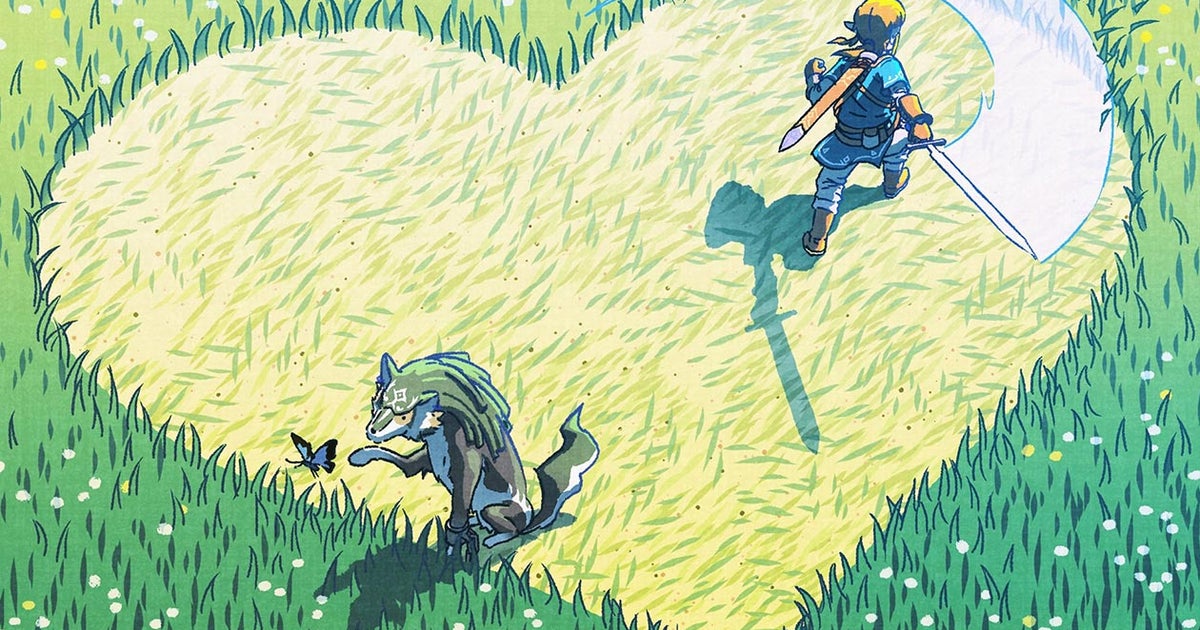
His paintings? Well, they have me in total conflict. Pleasing rounded shapes and simple colours, but they also move me so much! Is that a tear in my eye? What a contradiction. Anyway, Hyrule in the two recent Zeldas feels like Ravilious to me, and that’s not just because of the watercolour skies and cross-hatching of bright green grass. It’s because it feels like a melancholic landscape drawn into being by someone who was disproportionately upbeat.
And this quiet collision of opposite moods is everywhere in the games. Once again (twice again?) that ancient evil has returned and the princess is missing. Yet some unseen someone with great influence over the land is clearly feeling pretty good about things. Winds are playfully abroad in the grasses. The night are often clear and cool and bright with opportunity. Trigger a battle and the game busts out the old Joanna. What is injury when it’s accompanied by a jazzy cat walking splay-footedly across the keys? What’s life and death when it’s met with a glissando?
Yes. Quite. And to all of this, throw in scale. I’m going to abuse that word a little bit. It’s not just that the land is vast and rolls away in every direction, that the mountains are tall and the valleys are deep. It’s that there’s so much here to do: those seeds to find, people to help, those guys with the signs, those towers to climb, all of those hundreds of shrines.
And your powers! Breath of the Wild again with its initial brace of tricks, and then Tears of the Kingdom with its ersatz modding tools: bodge together weapons, build anything you can think of, clip through the geometry. (It was only with Tears of the Kingdom’s arrival, incidentally, that Breath of the Wild suddenly felt complete to me. Why? Because all of a sudden I could be in one game and feel that sweet sadness of conceiving a perfect solution to a puzzle, but a solution that would only work if I had the powers that I had in the other game and not this one.)
Image credit: Nintendo
And Hyrule as we know it is just the start of it. In Tears of the Kingdom it goes up, to those windblown archipelagos of skyminded rock with their rail carts and turning orbs and sad, winter trees. The puzzles here are often completely brilliant, and the very feeling of wandering through the wild blue is magic too. It’s a feeling, for me, of being off from school on a term-time weekday, exploring where I shouldn’t and messing with things out of sight of grown-ups.
And it goes down, too. Slope downwards to thy depths, O Link! Down in the darkness, Zelda suddenly feels nothing like Zelda. Shadows and horror and sticky red gore everywhere. You have to light your way through the darkness, moving from one pool of vision to the next. I’ve suspected at times that in the Depths under Hyrule we see that game that the developers of Zelda have wished they could make for years, something chaotic, under-imagined and disturbing.
Is that true? I have no idea, but I do believe that the power of the Depths, and I love these places, is not what they contain but what they might contain. It’s rubble and stone mushrooms for miles and then you hit a huge, sharp edged structure that feels, for all the world, like a DLR station visited at two in the morning on a Tuesday. There’s the same sense of dormant purpose, of capturing a busy, useful place in a rare moment of absence. Games, it’s said, are about possibility space. The Depths feel like a way of giving shape to the very idea of possibility space: what else is out there?
Image credit: Nintendo
There’s so much I haven’t mentioned. We haven’t visited the dungeons and their guardians or so much as saddled up a horse, or even that cool skeletal horse I found in the Depths the other day. But that’s the point. Whenever I try to write about these recent Zeldas I feel like I should be trying for completeness. But it never seems to be possible. I know there is deep harmony here, in themes and systems and art and all that jazz, but I have my most fun when it feels like I’m playing against that, or tripping over myself, or getting lost and distracted and absolutely not trying to save the land or anybody in it.
And perhaps that’s where I’m meant to end up. From my own experience, the defining quality of the open-world Zeldas is that you can write about them forever, but you can only capture them in parts. And for writing, I mean play, explore, think about, approach. The wholeness of these games, if such a thing even exists, always eludes me and I end up in distractions and discursions, all of them wonderful but all of them somehow disconnected from one another, connected and disconnected from the very idea of Zelda. In this world of hills and mountains and parapets, there is simply no vantage point, real or metaphysical, where absolutely everything can be glimpsed at once.
And I should add, this is not a criticism. In fact, it’s the absolute opposite. As the physics system that sent my stone boulder in motion freed the shrines from having a right or wrong solution, the open world has freed the games from standing for one specific thing. Back to keys, I reckon? Everything is a potential key now. Everything is a potential lock. You just have to decide where you’re going for and what you’re looking for and what you value in your experience. It’s overwhelming and ingenious and sweet and detailed and broad strokes and kind and terrifying. Zelda’s no longer an adventure. It is adventure.