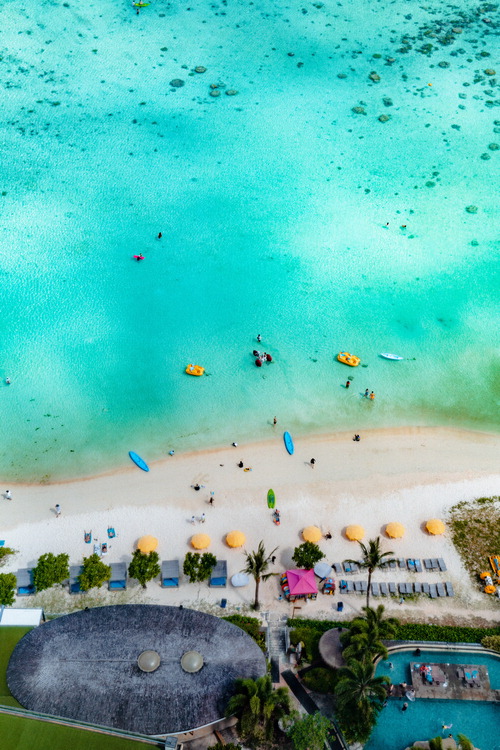
 사진 확대 Tumon Beach, Guam. Guam Government Tourism Authority
Recently, the topic of the travel industry is ‘sportscreation’ that combines ‘wellness’ and ‘sports’. An increasing number of people are trying to regain their daily vitality by moving their bodies in the local nature, away from travelling to stay and consume in resorts.
In this trend, Guam, which was considered the epitome of a resort, is also facing a new wind of change. It is a wellness island that heals the body and mind of travelers around the world with its natural resources of clear air and blue sea.
In an interview with Travel Plus, the head of Guam’s government tourism agency, Resin Biscory, who visited Korea to attend the Guam Government Tourism Agency’s New Year’s event in Seoul on the 5th, presented a new travel paradigm that Guam aims for. Now, he emphasized that Guam is not just a place to stay for recreation, but a space where travelers actively recover according to their rhythm.
Commissioner Lee first paid attention to common changes in the global travel market, including Korea. In the past, if resort-oriented static breaks were preferred, travelers recently began to ask more specific and active questions about what new experiences could be had in Guam this time.
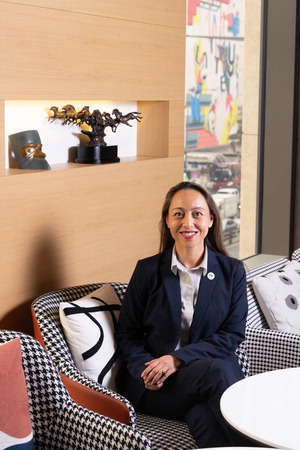
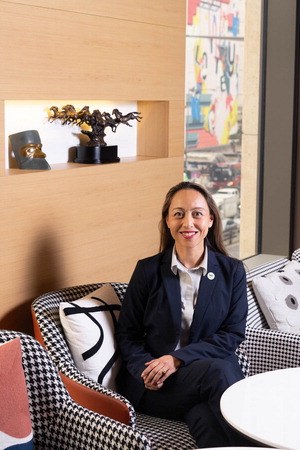 사진 확대 Regin Biscory, Director of Government Tourism, Guam
In response, Commissioner Lee said, “The biggest change is that travelers no longer want to travel passively,” adding, “Now, the direction of Guam tourism is also changing into a flexible structure that can be designed to suit each traveler’s interests and tastes.”
Referring to an example of a grandfather who recently visited Guam from Japan, he said, “I heard that my grandchild, who saw a dolphin in Guam, left such strong memories that he cried every day that he wanted to go back to Guam,” adding, “Regardless of generations from children to senior citizens, Guam is a place that gives both comfort and excitement like ‘another house to meet away from home.’”
In particular, Commissioner Lee analyzed that Guam’s geographical strengths have unrivaled value as a wellness destination.
He cited the fact that flight fatigue is low and natural recovery is possible without breaking the rhythm of daily life even after arrival due to the distance from Korea in four hours and a slight time difference of one hour. In fact, referring to Guam’s excellent air quality, Commissioner Li emphasized that a clean environment without noise or light pollution provides immediate comfort to travelers.
“Guam is not a ‘wellness that has to leave far away’, but has optimal conditions for natural recovery while maintaining the rhythm of daily life,” he said.
Wellness as defined by Guam is not limited to contrived programs. Running, cycling, yoga, as well as everyday sports such as jiu-jitsu, are already deeply embedded in Guam’s lifestyle. “Gamdown wellness is not a grand concept, but more of a process of sharing activities that locals enjoy on a daily basis with travelers,” Director Lee said, adding, “Through this connection, travelers experience deeply permeating Guam’s life.”
The start of the Coco Road Race and Tour of Guam’s representative wellness and sports integration events in April plays an important role in building the image of Guam as an island to move and enjoy. Furthermore, the yoga festival ‘Inna Wellfest’, a representative icon of wellness, will also be held around June.
As an alternative for those who want to take a real rest, Commissioner Lee also proposed a tour of the southern part of the country. The process of walking or running outside the bustling Tumon area with the sea by your side in a quiet place such as Merrizo Pier is the best wellness to relieve stress. In particular, he recommended the “Natural Swimming Pool” as a place with personal affection, and said this place is more special because it is his grandmother’s hometown. Local playgrounds such as these Korean grasses are now the best wellness spots for travelers.
“The southern region is generally quiet and quiet, so it’s a good place to move according to your rhythm even when traveling,” he said. “The unique food culture of Guam and the hospitality of local people help travelers recover their bodies and minds at their own pace.”
Commissioner Li said that Guam remains an island where you can still rest comfortably, but it is now evolving into a place where travelers themselves can find a balance between rest and movement. “It is now Guam where the body and mind naturally recover without being busy,” he said. “In the future, we plan to continue to introduce original content unique to Guam so that travelers can design new stories that suit their taste.”
After all, Guam’s future is not an artificial island for tourists, but an island where locals and travelers breathe the same air. When numerous resorts tempt travelers with provocative content, Guam rather chose to share the healthy daily lives they originally had. If Guam’s geographical advantage, called the “America closest to Korea,” is added to this local-centered wellness philosophy, it is expected to be firmly established as a “rest place that can be found at any time for my resilience” beyond a simple resort.
[Kang Ye Shin’s trip + Reporter]