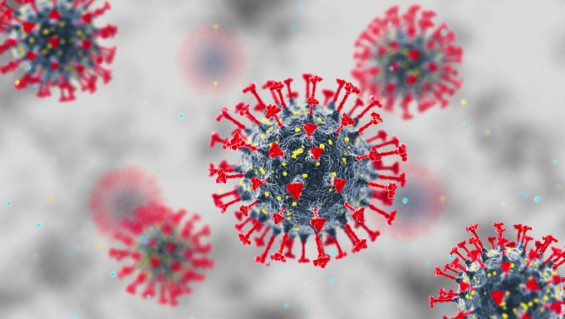
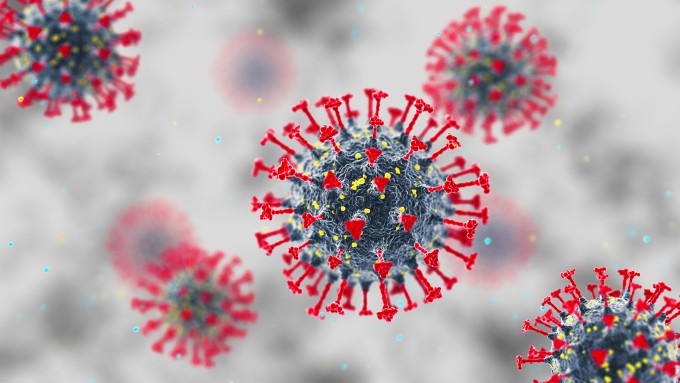
An illustration of a coronavirus. The protrusions on its surface are spike proteins. While existing vaccines target specific parts of specific pathogens, like the spike protein of the coronavirus, the new vaccine activates the immune system itself, regardless of the pathogen. Provided by Getty Images Bank (1456843465)
A vaccine that could block a wide range of respiratory threats at once—from the common cold and coronaviruses to bacterial infections and even allergies—has shown promise in animal experiments. Unlike existing vaccines, it does not target specific pathogens, which is expected to make it effective against new variants and novel viruses.
A team led by Bali Pulendran, a professor of microbiology and immunology at Stanford University School of Medicine, developed a nasal spray vaccine that protects against various respiratory viruses, bacteria, and allergens (allergy-causing substances). They confirmed its effectiveness in mouse experiments and published their findings in the international journal *Science* on the 19th (local time).
● The limitations of vaccines that must be redesigned for each pathogen
Vaccines work by introducing a detoxified pathogen into the body, prompting the immune system to produce antibodies that can fight it. When the actual pathogen attacks or infects the body, these pre-made antibodies combat and overcome it.
Some vaccines are designed to target specific parts of a pathogen. A prime example is the COVID-19 vaccine, which targets the ‘spike protein’ that the virus uses as an entry pathway. The problem is that when a virus mutates, the target of the vaccine changes, reducing its effectiveness. This is why we need a new flu shot each year for the anticipated influenza virus strain, and why new vaccines must be developed for COVID-19 as new variants emerge.
● A ‘universal vaccine’ nasal spray to block COVID and flu
To overcome the limitations of traditional vaccines, the research team chose a method that does not target specific pathogens. Instead, they incorporated a substance into the vaccine that mimics the signals exchanged between immune cells during an infection.
The human immune response is broadly divided into adaptive immunity and innate immunity. Adaptive immunity is characterized by creating immune cells like T-cells or antibodies to precisely target specific pathogens and retaining a long-term memory of them. Traditional vaccines utilize adaptive immunity. Innate immunity, on the other hand, activates within minutes of infection and attacks pathogens non-specifically. While its range is broad, it typically fades within a few days, so it has not been a major focus in vaccine development.
The team focused on a 2023 paper published in the international journal *Nature Immunology* by Stanford researchers. According to that paper, in the lungs of mice given the tuberculosis vaccine, T-cells secreted signaling molecules that stimulated innate immune cells. This kept the innate immune system active for several months, protecting against even viruses unrelated to tuberculosis. The team determined that if they could replicate this process, they could create a universal vaccine that works regardless of the pathogen type.
The research team developed a vaccine that artificially replicates the innate immunity activation process identified in the earlier Stanford study. They created the vaccine by mixing a substance that directly stimulates sensors on the surface of innate immune cells with a harmless egg protein to draw T-cells into the lungs. When sprayed into the nose, the stimulant first awakens the innate immune cells, and T-cells responding to the egg protein gather in the lungs. These T-cells in the lungs continuously secrete signaling molecules to maintain the active state of the innate immune cells, which in turn stimulate the T-cells. This mutual activation of the two immune systems sustains a prolonged defensive state.
To confirm the vaccine’s performance, the team administered it by dropping it into the noses of mice. After three doses administered at one-week intervals, the mice were exposed to various respiratory pathogens. Unvaccinated mice infected with a coronavirus experienced significant weight loss, their lungs filled with the virus, and many of them died. In contrast, vaccinated mice showed less weight loss, the viral load in their lungs was reduced to 1/700th, and all of them survived. The protective effect lasted for at least three months.
The team also tested the vaccine against Staphylococcus aureus and Acinetobacter baumannii, two common bacteria that cause hospital-acquired infections. In both tests, the protective effect lasted for about three months. Furthermore, when vaccinated mice were exposed to dust mite proteins that cause allergic asthma, their airways remained clear. This was in stark contrast to unvaccinated mice, which showed an allergic reaction with airways full of mucus.
This research is praised for demonstrating the possibility of preventing various respiratory infections by simultaneously activating both innate and adaptive immunity without targeting specific pathogens. “With sufficient investment, it could be commercialized within five to seven years,” said Professor Pulendran. “The goal is a vaccine that you spray in your nose once in the fall to prevent COVID-19, the flu, bacterial pneumonia, and even allergies all at once.”
Copyright ⓒ DongA Science. All rights reserved.