
What is Vitamin Water?
Vitamin water is a functional, non-carbonated beverage that is created by the fortification of purified water with a combination of vitamins, minerals, and sometimes electrolytes, along with natural or artificial flavors and sweeteners. It is placed in a category between bottled water and carbonated soft drinks, providing hydration with a functional twist. Typically, fortification may include B-complex vitamins, vitamin C, and sometimes vitamin D, zinc, or magnesium, depending on the functional category of the product. From a processing perspective, vitamin water is made by a process of blending, micronutrient stabilization, pasteurization (if required), and aseptic packaging to maintain the stability of the product throughout its shelf life.
Key Applications Across Industries:
Vitamin water is a product that has a variety of applications in the hydration, wellness, and lifestyle consumption categories. Primarily, it is a functional hydration drink that provides hydration replenishment along with added micronutrients that have a metabolic, immune, or cognitive role. Products fortified with B-complex vitamins are typically positioned for energy metabolism support, while products containing vitamin C and zinc are positioned for immune system support. Electrolyte-fortified variants are positioned for active consumers who require post-exercise hydration replenishment without the added sugar content of traditional sports drinks.
In terms of consumption behavior, vitamin water is a substitute for carbonated soft drinks and calorie-rich beverages. Health-conscious consumers would choose vitamin water as a lower-calorie alternative that still offers variety. The corporate office, gym, airport, and convenience stores are important consumption points where portability and health attributes drive purchase.
In an institutional setting, some variants of vitamin water are used as a supplementary hydration solution for people with mild micronutrient deficiencies, but not as a substitute for supplements. Vitamin water also has applications in the restaurant and fast-food industry as a part of the premium beverage offerings. The industry also uses vitamin water as an innovation platform to introduce plant extracts, antioxidants, adaptogens, and natural sweeteners to enter new functional beverage categories. The versatility of vitamin water enables it to be positioned in energy, immunity, detox, beauty from within, and wellness categories.
What the Expert Says: Market Overview & Growth Drivers
The global electrolyte and vitamin water market reached a value of USD 9.8 Billion in 2025. According to IMARC Group, the market is projected to reach USD 17.6 Billion by 2034, at a projected CAGR of 6.52% during 2026-2034.
The major driving factor for the global vitamin water market is the shift in consumer preferences towards functional and healthier beverages. The most important structural driver is the reduction in the consumption of traditional carbonated soft drinks due to increasing health concerns about sugar, obesity, and metabolic disorders. Consumers are actively looking for beverages that offer hydration benefits along with functional benefits, making vitamin water a desirable alternative in the non-alcoholic beverage category.
The increasing awareness about health, especially in the post-pandemic period, has led to an accelerated demand for immune-boosting and energy-boosting beverages. Vitamin water products with vitamins such as vitamin C and vitamin B complex are well-positioned in the preventive health and self-care categories. Urbanization and busy lifestyles also drive demand, as consumers are looking for convenient and ready-to-drink beverages that can be easily consumed without any preparation.
Another important driving factor is the innovation and premiumization of products. Beverage companies are focusing on developing clean-label products, natural flavors, reduced sugar content, and zero-calorie sweetening systems to meet the pressures of regulations and consumer demands. The inclusion of functional ingredients such as antioxidants, botanicals, and adaptogens helps in product differentiation and enables the company to command a premium price.
Expansion of distribution also plays an important role. Wider reach in supermarkets, convenience stores, online, fitness clubs, and foodservice channels enhances impulse buys. In emerging countries, increased per capita disposable income and development of modern retailing infrastructure contribute to category adoption.
From a governmental standpoint, more defined guidelines on sugar reduction and nutritional content labeling facilitate manufacturers to innovate responsibly, thereby enhancing consumer trust. Moreover, improvements in beverage processing and micronutrient stabilization technology enhance operational efficiency. Individually and cumulatively, lifestyle changes, health prioritization, innovation, and distribution expansion drive the global growth trend of the vitamin water industry manufacturing sector.
Case Study on Cost Model of Vitamin Water Manufacturing Plant:
Objective
One of our clients reached out to us to conduct a feasibility study for setting up a medium scale vitamin water manufacturing plant.
IMARC Approach: Comprehensive Financial Feasibility
We developed a comprehensive financial model for the setup and operation of a proposed vitamin water manufacturing plant in India. This plant is designed to manufacture 10 million litres of vitamin water annually.
Manufacturing Process: Vitamin water production is a processed beverage formulation and packaging process that combines water treatment, micronutrient blending, flavor addition, stabilization, and aseptic filling. The process begins with water purification, which may include multi-step filtration, reverse osmosis, activated carbon processing, and UV sterilization to provide microbiological safety and mineral content consistency. The purified water is then transferred to blending tanks, where pre-weighed vitamin and mineral premixes are dissolved under controlled agitation. However, since many vitamins, especially vitamin C and some B vitamins, are heat, light, and oxidation-sensitive, manufacturers often resort to using stabilized or encapsulated vitamins to maintain their potency during processing and storage.
After micronutrient addition, flavor ingredients, natural or artificial sweeteners, acidulants (such as citric acid), and functional ingredients such as electrolytes are added based on the formula design matrix. The mixture is then homogenized to provide uniform distribution of soluble ingredients. Depending on the product formulation, the beverage may then be pasteurized using high-temperature short-time (HTST) processing to provide microbial safety with minimal nutrient loss. Alternatively, in some high-end or heat-sensitive products, aseptic processing and cold filling may be used.
Following thermal or aseptic processing, the final product is quickly cooled and packaged using automated filling lines. Bottling takes place in hygienic or sterile environments with PET packaging or in recyclable packaging configurations. Real-time quality control parameters include pH, total dissolved solids, vitamin potency activity, microbial content, and sensory properties. The final processing steps involve capping, labeling, date coding, and secondary packaging. Strict quality assurance procedures are followed to ensure regulatory requirements, label statements, and product quality before distribution through retail and institutional markets.
Explore in-depth findings for this market, Request Sample
Raw Material Required:
The basic raw materials required for vitamin water manufacturing include:
Water
Vitamins
Minerals
Flavors
Sweeteners
Packaging Materials
Machine Section or Lines Required:
Water Treatment
Mixing
Carbonation
Filling
Capping
Labeling
Packing
Techno-Commercial Parameter:
Capital Expenditure (CapEx): Capital expenditure (CapEx) in a manufacturing plant includes various investments essential for its setup and long-term operations. It covers machinery and equipment costs, including procurement, installation, and commissioning. Civil works expenses involve land development, factory construction, and infrastructure setup. Utilities such as power, water supply, and HVAC systems are also significant. Additionally, material handling systems, automation, environmental compliance, and safety measures are key components. Other expenditures include IT infrastructure, security systems, and office essentials, ensuring operational efficiency and business growth.
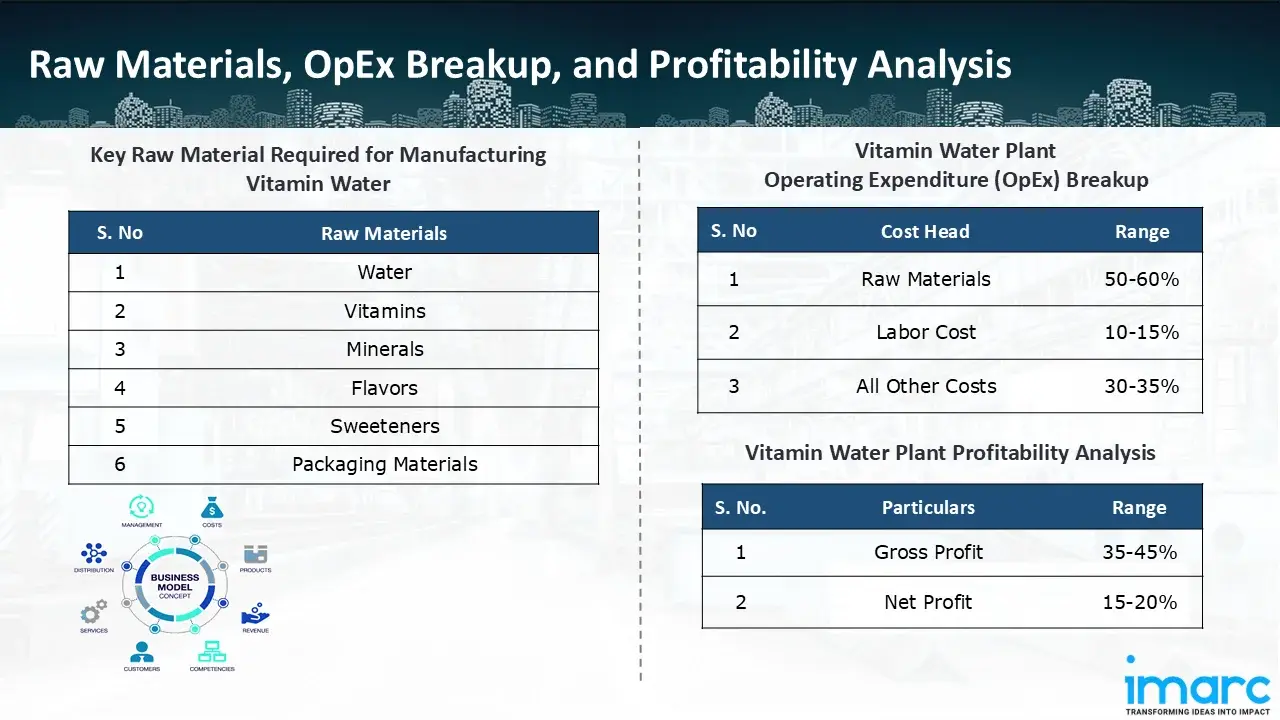
Operating Expenditure (OpEx): Operating expenditure is the cost incurred to operate a manufacturing plant effectively. OpEx in a manufacturing plant typically includes the cost of raw materials, utilities, depreciation, taxes, packing cost, transportation cost, and repairs and maintenance. The operating expenses are part of the cost structure of a manufacturing plant and have a significant effect on profitability and efficiency. Effective control of these costs is necessary for maintaining competitiveness and growth. Furthermore, raw material cost in vitamin water manufacturing plant ranges between 50-60%, labor cost ranges between 10% to 15%, and all other costs ranges between 30-35% in the proposed plant.
Profitability Analysis Year on Year Basis: We assisted our client in developing a detailed cost model, which projects steady growth, with revenue rising throughout the projected period. Moreover, gross profit margins lie between a range of 35-45%, and net profit lie between the range of 15-20% during the income projection years, highlighting strong financial viability and profitability.
Conclusion & IMARC’s Impact:
Our financial model for the vitamin water manufacturing plant was meticulously developed to meet the client’s objectives, providing an in-depth analysis of production costs, including raw materials, manufacturing, capital expenditure, and operational expenses. By addressing the specific requirements of manufacturing 10 million litres of vitamin water annually, we successfully identified key cost drivers and projected profitability, considering market trends, inflation, and potential fluctuations in raw material prices. This comprehensive financial model equipped the client with valuable insights into strategic decision-making, demonstrating our commitment to delivering high-quality, client-focused solutions that ensure the long-term success of large-scale manufacturing ventures.
Latest News and Developments:
In November 2025, Vitaminwater by Coca Cola launched a new packaging design and two new flavors to make the brand more distinct in the growing market of enhanced water. The new packaging design, which began to hit shelves in March, boasts a new, more vibrant label design with prominent colors, a larger and stacked logo with new typography, and flavor descriptions that reflect the playful personality of the brand, which was born in New York. The new flavors are blue raspberry limeade flavor with multivitamins, and re-hydrate zero sugar with pineapple passionfruit and electrolytes.
In July 2025, Sappe Public Company Limited (SAPPE) introduced two new flavours under the “B’lue” brand: Muscat Grape and Strawberry, further solidifying its position in the vitamin water industry. Vitamins C, B3, B6, and B12 are added to the drinks to meet the many needs of today’s health-conscious consumers.
Why Choose IMARC?
IMARC’s Financial Model Expertise: Helping Our Clients Explore Industry Economics
IMARC is a global market research company that offers a wide range of services, including market entry and expansion, market entry and opportunity assessment, competitive intelligence and benchmarking, procurement research, pricing and cost research, regulatory approvals and licensing, factory setup, factory auditing, company incorporation, incubation services, recruitment services, and marketing and sales.
Under our factory setup services, we assist our clients in exploring the feasibility of their plants by providing comprehensive financial modeling. Additionally, we offer end-to-end consultation for setting up a plant in India or abroad. Our financial modeling includes an analysis of capital expenditure (CapEx) required to establish the manufacturing facility, covering costs such as land acquisition, building infrastructure, purchasing high-tech production equipment, and installation. Furthermore, the layout and design of the factory significantly influence operational efficiency, energy consumption, and labor productivity, all of which impact long-term operational expenditure (OpEx). So, every parameter is covered in the analysis.
At IMARC, we leverage our comprehensive market research expertise to support companies in every aspect of their business journey, from market entry and expansion to operational efficiency and innovation. By integrating our factory setup services with our deep knowledge of industry dynamics, we empower our clients to not only establish manufacturing facilities but also strategically position themselves in highly competitive markets. Our financial modeling and end-to-end consultation services ensure that clients can explore the feasibility of their plant setups while also gaining insights into competitors’ strategies, technological advancements, and regulatory landscapes. This holistic approach enables our clients to make informed decisions, optimize their operations, and align with sustainable practices, ultimately driving long-term success and growth.