The U.S. Supreme Court on Wednesday unanimously rejected a private prison company’s effort to grant it an expansive new authority whenever it is doing work for the government.
GEO Group was asking the justices to establish that “derivative sovereign immunity” protects government contractors — necessary here so that GEO Group could immediately appeal a ruling that it lacked that so-called “immunity” in a case challenging the company’s treatment of people in a facility in Colorado that it used for immigration detention via contracts with U.S. Immigration and Customs Enforcement.
On Wednesday, the justices dealt GEO Group a loss — not only rejecting the company’s appeal but, more centrally, rejecting the company’s “derivative sovereign immunity” argument altogether.
It is a technical, but important, decision — especially as the Trump administration spends billions of dollars on immigration enforcement, with large sums going to contractors like GEO Group.
In Justice Elena Kagan’s opinion for the Supreme Court, she explained that the protection for federal contractors at issue — derived from a 1940 Supreme Court decision — is a defense, not an immunity.
The distinction matters here because, as Kagan explained, a Supreme Court case from a few years later, in 1949, laid out the rule for when a party can appeal a ruling in a case before the end of that case. And, Kagan detailed, a decision rejecting immunity can be appealed immediately, but not a decision rejecting a defense.
Ultimately, the decision will allow lawsuits to proceed more quickly when federal contractors are alleged to have acted unlawfully or outside of their authority.
There were no dissents, although Justice Clarence Thomas did not join all of Kagan’s opinion and Justice Sam Alito agreed for a slightly different reason.
That’s both a good question — and why this case matters — so let’s look more closely.
The general rule that you can only bring an appeal at the end of a case is the final-judgment rule, and the exception laid out in the 1949 case — the times when a party can bring an appeal before the end of the case, known as an interlocutory appeal — is known as the collateral-order doctrine. One of the conditions to bringing an interlocutory appeal under that case, Cohen v. Beneficial Industrial Loan Corp., is that the decision would be “effectively unreviewable on appeal from a final judgment.“
To that, Kagan got into the difference between a defense and an immunity:
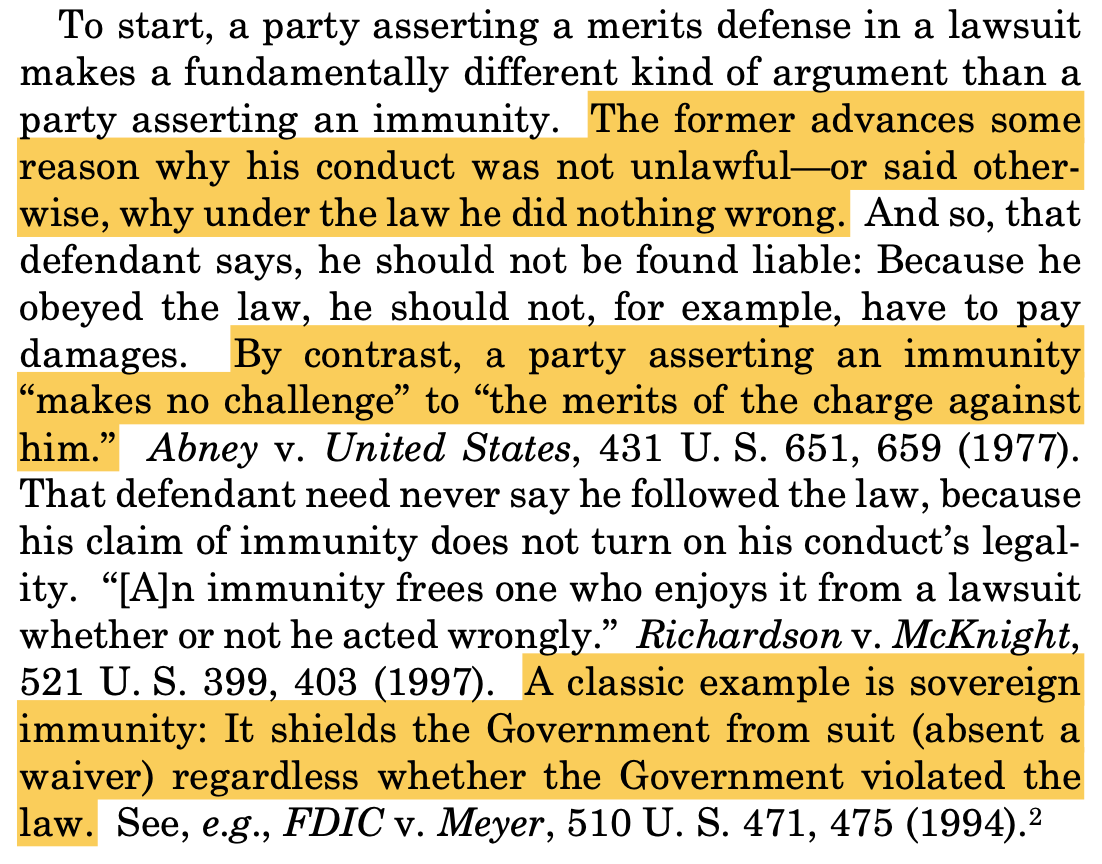
That difference is key to seeing why an immunity is “effectively unreviewable” at the end of a case. As Kagan put it, “Because an immunity applies irrespective of the merits, the protection it offers is not a simple finding of non-liability. Rather, the immunity ensures that the defendant need not ‘answer for his conduct’ in court at all—that he avoids, in addition to liability, all the usual ‘burdens of litigation,’ including a trial.“
Applying that here and deciding whether a defense or immunity was at issue, then, essentially resolved the current case.
Kagan explained that in the 1940 case, Yearsley v. W. A. Ross Constr. Co., the court held that “a federal contractor cannot be held liable for conduct that the Government has lawfully ‘authorized and directed’ the contractor to perform.”
GEO Group argued that Yearsley established an immunity — “derivative sovereign immunity” — for those contractors and that, as such, under the 1949 case, a court’s decision rejecting Yearsley protection should be immediately appealable.
Notably, not only did the former detainees suing GEO Group disagree with that — but so did the Trump administration, which stated bluntly in its brief that “‘derivative sovereign immunity’ is something of an oxymoron“ because it is describing a defense.
Kagan — and the court — agreed:
Yearsley provides protection to a contractor when it has received a lawful authorization and acted according to its terms—meaning, when the contractor has acted within legal bounds. So in invoking Yearsley, the contractor is making the argument of a merits defense—that it is not liable because it has complied with the law.
On the other hand, she went on:
Yearsley’s protection runs out when the contractor may have violated the law—when the contractor either acted under an illegal authorization or exceeded the scope of a legal one. By drawing the line there, Yearsley ensures that it will never shield unlawful conduct, in the way that all immunities do.
This, more or less, was it.
“Once Yearsley is understood in that way—as a merits defense—the question before us almost answers itself: No, a district court’s denial of Yearsley protection is not immediately appealable“ under the provision at issue, Kagan wrote for the court.
Thomas agreed that Yearsley “and similar decisions establish a defense from liability and not an immunity from suit.“
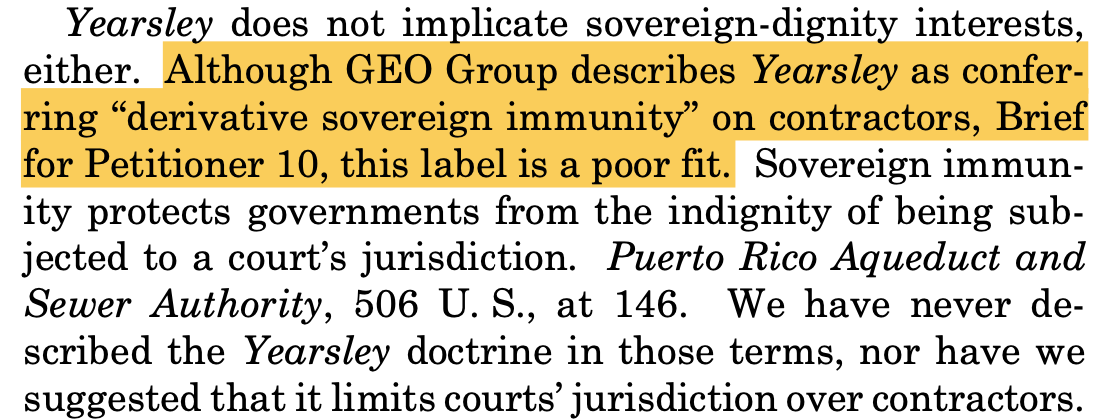
Even Alito, who reached the conclusion on slightly different grounds, was not buying GEO Group’s argument about “derivative sovereign immunity.” He wrote:
With that, the case was sent back down to the lower courts. Unanimously.
This matters because GEO Group doesn’t want to be held accountable for its actions despite getting billions of dollars from government contracts.
This case — over allegations of forced labor in an immigration detention facility it operated in Colorado — was initially filed on October 22, 2014.
Here’s how the complaint began:
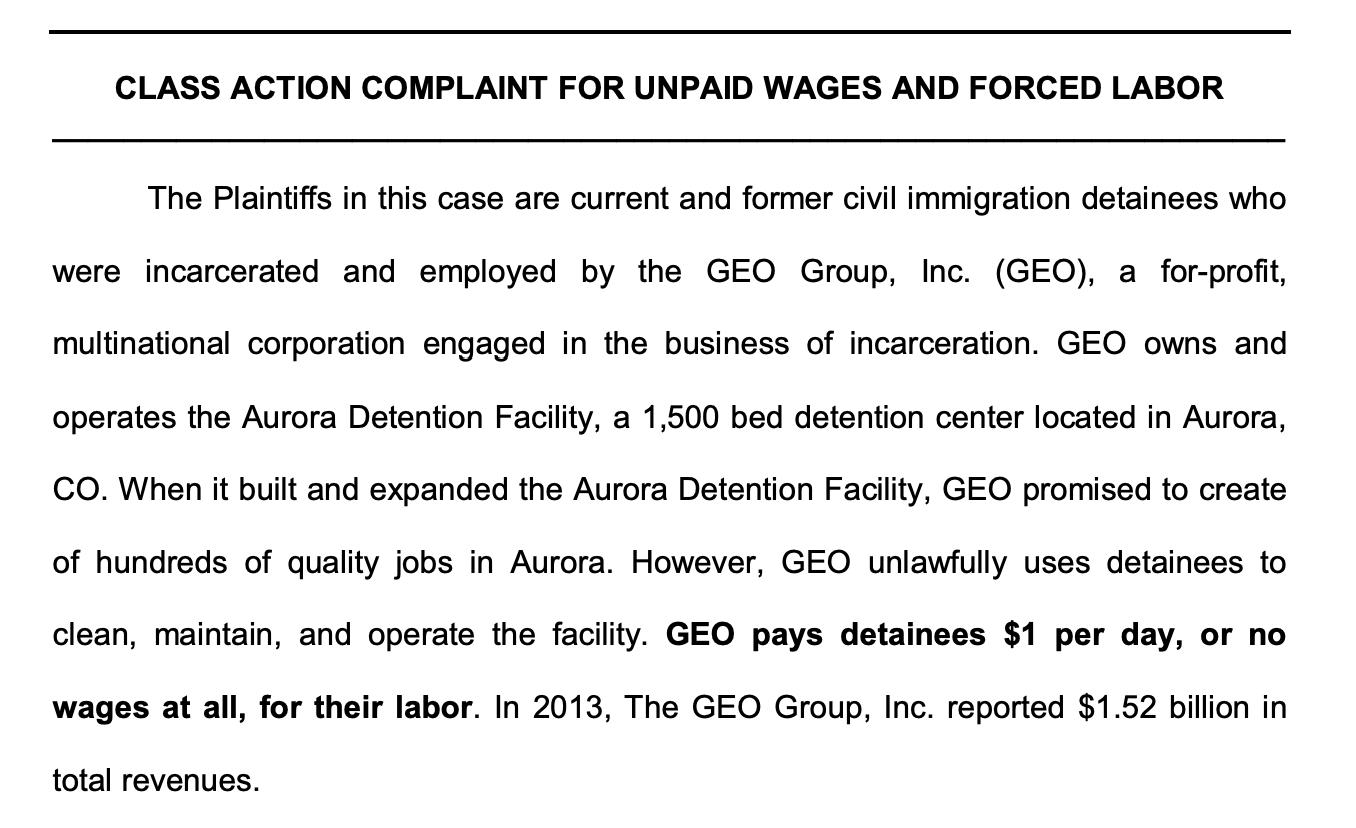
In the nearly eight years since, GEO Group has fought the lawsuit at all three levels of federal courts — returning to the appeals court twice in addition to this trip to the Supreme Court. First, it unsuccessfully fought class certification. Then, it tried to appeal the Yearsley ruling.
In short, the interlocutory appeal that GEO Group was seeking here would have given them a chance to take this extensive delay any time a court found that they actually could face liability in connection with their government contract work.
The effort to protect contractors from accountability was perhaps most clearly seen in the fact that one of their key amicus supporters was the Chamber of Commerce.
You have to wade through it at times, but the lawyers for the Chamber argued that “this case implicates the availability and degree of litigation protection afforded by derivative sovereign immunity, a critical doctrine on which contractors rely when they agree to share their expertise with the government and provide services on the public’s behalf.“
Or, as they put it more simply in one corporate-speak section heading:
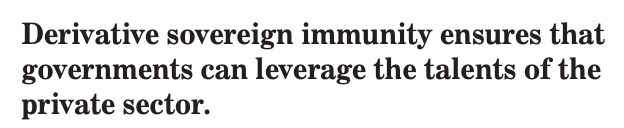
This, again, was an argument that couldn’t even win over the Trump administration.
Since the lawsuit was filed, GEO Group’s profits have increased significantly. They reported total revenues of $2.63 billion for 2025 over their $1.52 billion total revenues in 2013 — with further increases expected in light of the Trump administration’s immigration enforcement activities and the $75 billion in ICE funding provided for in the One Big Beautiful Bill Act.
As President Donald Trump said at Tuesday night’s State of the Union, “Corporations are doing just fine.“
Accountability is fine, too.
I joined Minnesota Public Radio on Wednesday night to talk about President Donald Trump’s State of the Union address, such as it was; this past week’s Supreme Court tariffs decision; and more.

Check it out!