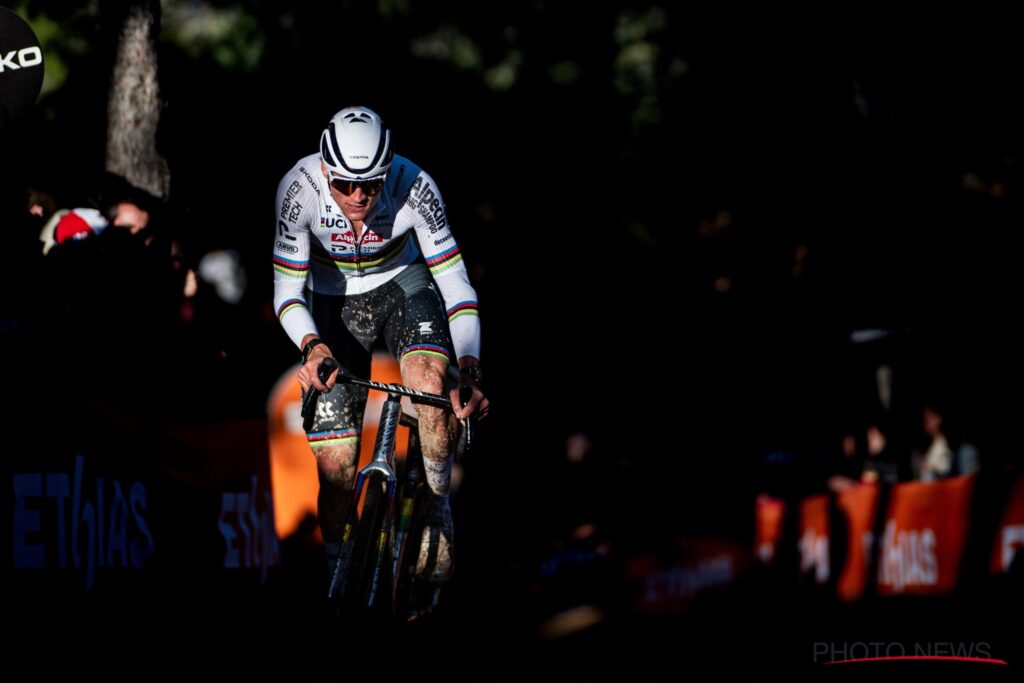
Mathieu van der Poel offers insights into his body. He reveals what helps him in terms of training, nutrition, and recovery, and what motivates and drives him. In an interview with WHOOP founder and CEO Will Ahmed, the Dutch pro cyclist from Team Alpecin-Premier Tech is surprisingly open.
HRV over 200: What Mathieu van der Poel reveals about recovery and fitness
“My heart rate variability is extremely high,” says van der Poel about the metric that reflects recovery capacity. “Over 200 on average.” The pro cyclist immediately provides context: “Maybe it’s partly genetic, but fitness also plays an important role.”
Resting heart rate makes it even more tangible for many: “On average, I’m at 38; the lowest value WHOOP has recorded for me was 34—that’s very low.” However, he adds: “Many endurance athletes have that—the heart is simply very well trained.”
While many pros treat their performance data like classified information, van der Poel remains relaxed: “To be honest, I don’t mind sharing data.” Although he admits that competitors can learn something from it, he adds: “In my opinion, it won’t make a decisive difference.”
Spring Classics: Positioning as the key to success
Because data isn’t everything. Especially in the races he loves, other things matter too. “Positioning is extremely important,” he says, touching on a secret to success in Spring Classics like the Tour of Flanders or Paris-Roubaix. “You need the numbers. But you can also win races by being smarter or doing the right thing at the right moment.”
Van der Poel, who has already won the “Hell of the North” three times and the “Ronde” twice, describes the crucial key points: the roads narrow, a climb begins, and there’s movement in the peloton. “There are key points: you go from a wide road into a smaller climb, and you have to be among the first twenty riders.” And then comes a sentence that could be framed for any Classics preview: “If a group goes at the front and you’re too far back, it’s impossible. Even with the best numbers, it’s impossible to get into the lead group.”
It’s not just about power, but also race intelligence, timing, the team, and the battle for position—at least in the tough one-day races like the Spring Classics. Nonetheless, van der Poel knows: “On a mountain stage in the Tour, the numbers often speak for themselves: usually, the strongest rider wins.”
WHOOP interview with Mathieu van der Poel on YouTube
You are currently viewing placeholder content.
To access the actual content, adjust your Cookie Consent settings and reload the page.
Please note that this will share data with third parties.
Even though van der Poel is “genetically blessed,” he knows he has to work hard on himself—meaning training. “On good days, training comes easy to him. On bad days, it’s tough, especially when the legs don’t cooperate. But that’s part of the sport. Everyone has good and bad days, and you have to push through,” he says. Music and caffeine help him overcome those moments. And the competition, especially Wout van Aert, is an incentive for him: “A strong competitor raises your level because you know you have to do everything 100% right to beat him. That keeps you focused. Not just during the race, but actually 24/7.”
“If you won every race by two minutes, it would be easy to say, ‘I’ll skip the gym today’ or ‘one less interval.’ But when you have someone who is almost as strong, you might do one extra rep just to be sure,” van der Poel explains.
Strength training in cycling: Why van der Poel goes to the gym twice a week
Speaking of the gym. For four years, he has integrated strength training and core stability into his training plan and goes to the gym twice a week. “I’ve started to really like it. When I don’t do it—like now during the off-season—I feel weaker. It hurts at first when I start back up, but I know it’s a process and I need it,” he says.
His program mainly consists of squats, deadlifts, and single-leg squats. Plus, a lot of stability work for the lower back and core. Stability work.
Van der Poel knows exactly why he does things—including when it comes to nutrition. He doesn’t weigh his food, but he knows what’s good and bad for him. “I know my portion sizes,” he says, adding: “You should be allowed to eat what you feel like sometimes—just not every day. I try to cut back on classics like fried food, chocolate, and chips.”
Tracking with his WHOOP wearable helps him categorize good and bad eating habits. “I see a clear effect with red meat. And also with eating late: if I eat early in the evening, I sleep much better.”
Even with sleep, the most important recovery booster, the seven-time cyclocross world champion leaves nothing to chance: he takes magnesium for muscle relaxation before bed. Reading before sleep helps him fall asleep faster and recover better.
Photo: Photonews.be