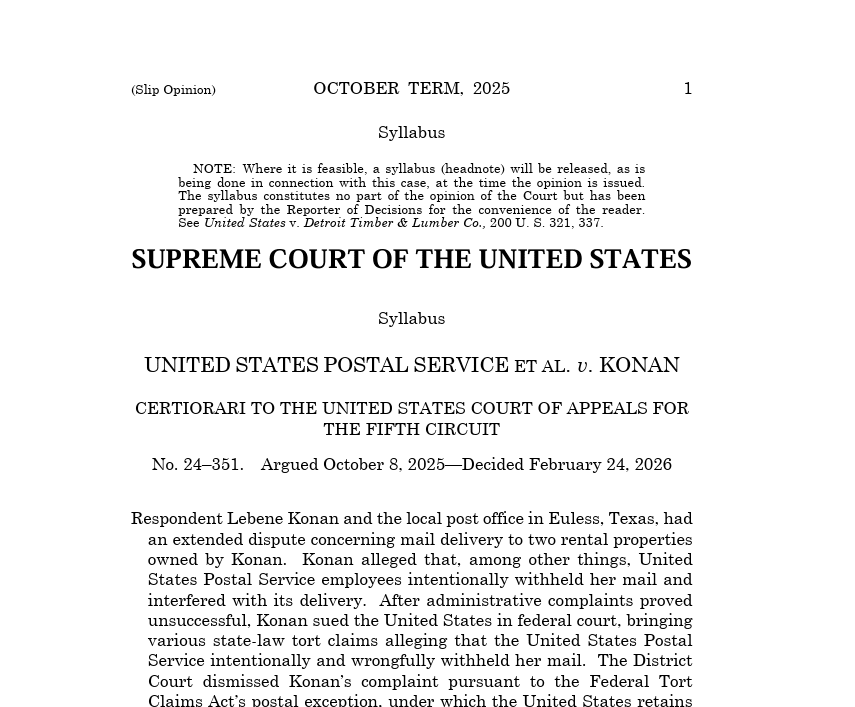
The Supreme Court on Tuesday ruled that the federal government cannot be sued over claims that Postal Service workers intentionally withheld mail.
In a 5–4 decision in United States Postal Service v. Konan, the Court held that the Federal Tort Claims Act’s “postal exception” covers not only lost or misdirected mail and negligent handling, but also the intentional nondelivery of letters and packages. The ruling vacates a decision by the U.S. Court of Appeals for the Fifth Circuit and sends the case back for further proceedings.
Justice Clarence Thomas, writing for the majority, said Congress chose broad, overlapping language in the FTCA to keep mail-delivery disputes out of court, even when plaintiffs allege deliberate misconduct by postal employees.
The case arose from a dispute between Lebene Konan, a Texas landlord, and her local post office in Euless, Texas. Konan alleged that carriers and supervisors intentionally stopped delivering mail to two rental properties she owns, changed ownership records without her consent, returned mail to senders, and refused to give her held mail, causing her to lose tenants and rental income.
Konan sued the United States in 2022, asserting state-law claims including nuisance, tortious interference with prospective business relations, conversion, and intentional infliction of emotional distress, and seeking damages for lost income, withheld mail, and emotional distress. A federal district court in Texas dismissed the case, finding it barred by the FTCA’s postal exception, which preserves sovereign immunity for “any claim arising out of the loss, miscarriage, or negligent transmission” of mail.
The Fifth Circuit reversed, holding that the statutory terms “loss” and “miscarriage” did not extend to a Postal Service employee’s intentional decision not to deliver mail. That ruling deepened a split with the First and Second Circuits, which had read the postal exception to reach harms caused by intentional misconduct related to mail handling.
Thomas’s opinion focused on the ordinary meaning of “loss” and “miscarriage” when Congress enacted the FTCA in 1946. Citing contemporary dictionaries and historical usage, he concluded that a “miscarriage of mail” meant any failure of mail to reach its intended destination and that a “loss of mail” meant a deprivation of mail, regardless of the postal worker’s intent.
The Court rejected arguments that the presence of the phrase “negligent transmission” in the statute implies that “loss” and “miscarriage” are limited to unintentional conduct. Thomas said the adjective “negligent” modifies only “transmission,” not the preceding nouns, and that Congress likely used overlapping terms “to better keep complaints about mail delivery out of court.”
Justice Sonia Sotomayor, joined by Justices Elena Kagan, Neil Gorsuch and Ketanji Brown Jackson, accused the majority of transforming a targeted carve-out into a blanket immunity for the Postal Service.
“Today, the Court holds that one exception—the postal exception—prevents individuals from recovering for injuries based on a postal employee’s intentional misconduct, including when an employee maliciously withholds their mail. Because this reading of the postal exception transforms, rather than honors, the exception Congress enacted, I respectfully dissent.”
Sotomayor emphasized that the FTCA was designed as a “sweeping” waiver of sovereign immunity and that Congress used more specific language for the postal exception than for other agencies, signaling that it did not intend to insulate all mail-related actions from suit. She argued that the ordinary meanings of “loss” and “miscarriage,” read in context with “negligent transmission,” point to inadvertent or negligent mishandling — not purposeful campaigns to withhold mail.
“As the Fifth Circuit observed below, ‘no one intentionally loses something.’ People lose their keys when they misplace them, not when they give them to their children. People lose their mail when it Cite as: 607 U. S. __ (2026) SOTOMAYOR, J., dissenting 7 gets stuck behind a drawer, not when they intentionally throw it away. If someone said that they “lost” their car, no one would think it was stolen, only that the person forgot where they had parked it. The same is true when the Postal Service loses someone’s mail. The reason is an error, not deliberate wrongdoing.”
While Konan’s separate federal civil rights claims were dismissed and are not before the Court, Sotomayor said the majority’s interpretation means “individuals cannot recover for injuries based on a postal employee’s intentional misconduct, including when an employee maliciously withholds their mail” for discriminatory reasons.
The ruling does not resolve whether every one of Konan’s state-law claims is barred by the postal exception or whether all were properly preserved on appeal. The Court vacated the Fifth Circuit’s judgment and remanded for further proceedings, leaving those issues for the lower court.