
Your support helps us to tell the story
From reproductive rights to climate change to Big Tech, The Independent is on the ground when the story is developing. Whether it’s investigating the financials of Elon Musk’s pro-Trump PAC or producing our latest documentary, ‘The A Word’, which shines a light on the American women fighting for reproductive rights, we know how important it is to parse out the facts from the messaging.
At such a critical moment in US history, we need reporters on the ground. Your donation allows us to keep sending journalists to speak to both sides of the story.
The Independent is trusted by Americans across the entire political spectrum. And unlike many other quality news outlets, we choose not to lock Americans out of our reporting and analysis with paywalls. We believe quality journalism should be available to everyone, paid for by those who can afford it.
Your support makes all the difference.Read more
I’m staring at my phone, scrolling through video after video of people bouncing up and down on the spot. This is the viral “50 jumps every morning” trend.
I then hit a clip of someone reeling off a list of “scientific reasons” why I should try it: “It wakes up your cardiovascular system… It improves lymphatic flow, which helps clear your body of waste… It elevates body temperature, which primes your metabolism…”
The list lasts for roughly two minutes. There are a lot of attractive claims in there, along with plenty of health and fitness buzzwords, and many social media users have reported impressive benefits from trying the trend. But I remain sceptical.
I coach and write about fitness for a living – I’m not here to discourage people from moving more, quite the opposite. But I am here to challenge any outlandish claims that might warp people’s perception of exercise.
To do this, I enlisted the help of Jack McNamara, a senior lecturer with the University of East London’s school of health, sport and bioscience, and Jordan Sahota, a sports therapist and founder of Active Motion Injury Clinic.
What are the benefits of the 50 jumps every morning trend?
“The most honest answer is: probably modest, but not zero,” McNamara tells me. “You’ll likely experience some short-term alertness and perhaps a psychological boost from establishing a consistent morning habit.”
A transient uptick in alertness may come from moving your body in the morning, he continues. But he and Sahota agree that a gentle bounce is unlikely to trigger improvements in bone density and tendon strength, as many videos online suggest.
It could, however, act as a gateway to further exercise, which is a significant net positive. The current World Health Organisation line is that “every move counts towards better health”. If a trend encourages people to move more, I’m all for that.
“Anything that normalises daily movement and lowers the barrier to entry has value,” McNamara says. “This trend’s appeal lies in its simplicity – no equipment, no gym, no special clothing, and it takes less than a minute. For someone who finds the prospect of exercise intimidating, this feels achievable.”
But to see many of the improvements promised in the videos I’ve encountered, continued progression is needed. This is because the body adapts to better handle the things we ask it to do. If we ask it to do the same thing every day – in this case, 50 jumps – then once it can do this comfortably, there is no reason for it to adapt further.
Read more: The overlooked vegetable packed with nutrients for reducing inflammation and improving heart health

open image in gallery
Doing 50 jumps in the morning could increase alertness and build an exercise habit, experts say (Getty/iStock)
What to expect from doing the 50 jumps every morning trend for 30 days
“Most people would notice they feel more awake in the first few minutes after doing it,” says McNamara. “A few might also notice reduced feelings of stiffness or heaviness in the legs, particularly if they’re otherwise quite sedentary.”
Yet, contrary to much of the anecdotal evidence online, he says people shouldn’t expect significant changes to body composition or measurable improvements in cardiovascular fitness.
“The metabolic effect of 50 light jumps, burning perhaps 10-15 calories, is negligible in terms of meaningful metabolic change,” he concludes.
What not to expect…
“If an attractive person starts talking to you at a bar, you don’t ask them why they’re talking to you, you just keep talking,” an experienced strength coach once told me after I asked him why a certain exercise was beneficial.
As such, if there are people who follow this trend and enjoy transformative results, reading this article is no reason to stop. But the physiological knowhow we have at our disposal suggests many health claims around it are exaggerated.
“The trend’s framing as ‘lymphatic drainage’ taps into wellness language that often exaggerates or misrepresents how the body works,” McNamara says. “Your lymphatic system functions continuously; you don’t need to ‘jumpstart’ it each morning, and the term ‘detox’ in this context is largely marketing rather than physiology.
“The lymphatic system lacks its own pump and relies on muscle contractions and body movement to circulate lymph fluid. Any physical activity helps with this, including jumping.”
This is a common theme. The benefits listed, such as improved circulation, “waking up the cardiovascular system” and “elevating body temperature to prime metabolism”, are not exclusive to jumping, but rather universal to any activity that has you moving your whole body. They are also loaded with jargon.
However, Sahota warns that social media platforms will champion eye-catching content that presents a simple one-move solution to all your exercise needs.
“One exercise is not enough to achieve all the benefits of exercise,” he says. “What you actually need are several things done in a way that is tailored to you. But that’s not as sexy for the social media platform to push out, and that’s why that advice is less likely to be put out there.”
When this single exercise falls short of the plethora of health perks promised, it could have negative impacts above the neck, too.
“If someone commits to 50 jumps for a month, doesn’t experience the transformative benefits promised, then concludes that exercise ‘doesn’t work for them’, it’s done more harm than good,” says McNamara. “Overpromising sets people up for disappointment, and disappointment erodes motivation.”
Read more: I tried Harry Styles’ workout – I’m not surprised by his impressive Berlin Marathon time
open image in gallery
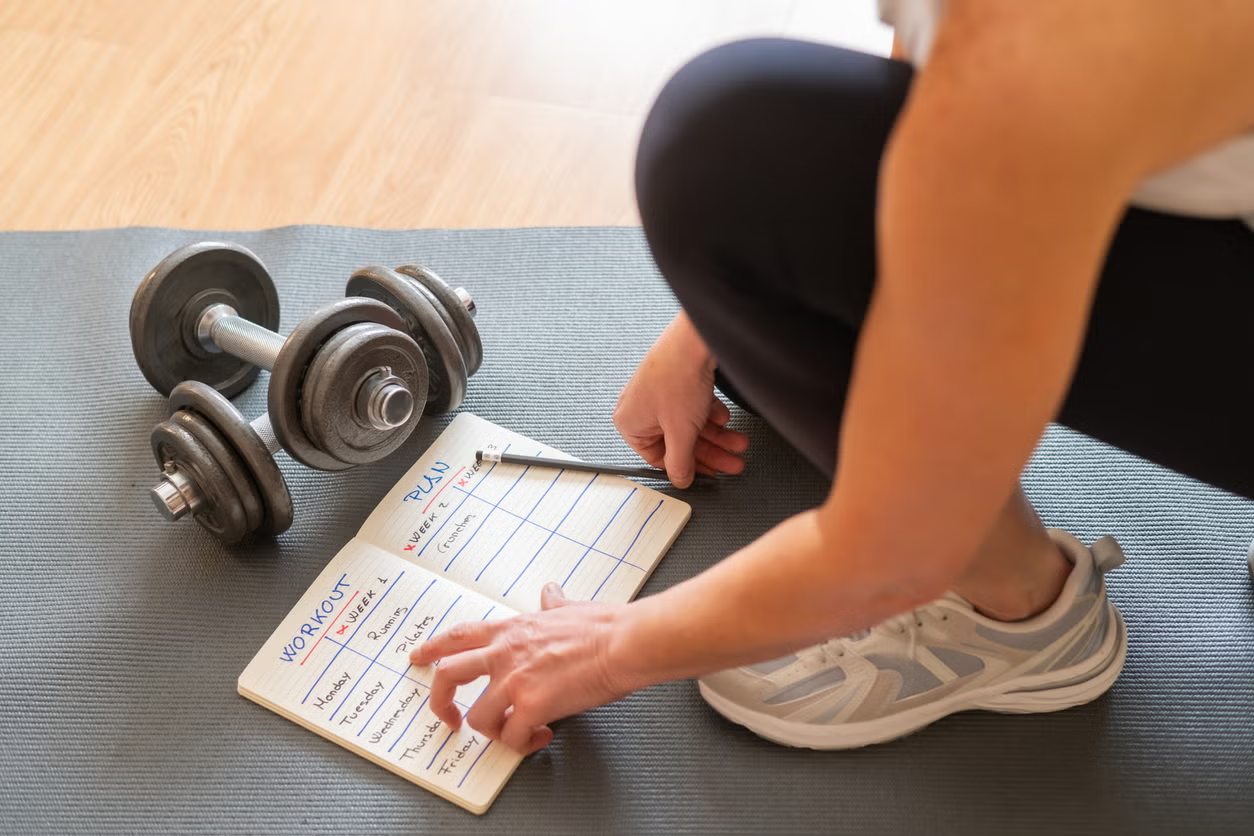
If an exercise trend overpromises and underdelivers, it can cause motivation to wane (Getty/iStock)
And there are some drawbacks too…
Another claim around the “50 jumps every morning” trend is that it can “it stimulates blood flow to your hands, feet, every area in your body – blood flow is what makes things heal”.
“If you’re trying to heal a tissue, why are you doing plyometric [aka, explosive] exercise?” Sahota counters. “You’re putting a short, sharp load through the lower body, which has the potential to irritate tissues.”
This is unlikely to be a problem if you are an experienced exerciser. But if you do not currently do much physical activity, diving straight into 50 jumps in a row could trigger an injury because the body has not yet developed the strength needed to tackle this task.
“If you’re going to do 50 jumps every day for a month, having never done these pogo-style jumps before, you’re probably going to get an injury first – things like tendinopathy, plantar fasciitis or a calf tear,” Sahota continues.
“Instead, I would do three sets of 10 gentle jumps for a few days, then three sets of 15, then two sets of 20 and a set of 10. If you build that up, you might be able to do 50 straight jumps by the end of the month, although this will depend on the individual.”
These are problems consistent with most daily fitness challenges that have proved so popular on social media: 100 kettlebell swings a day, 100 press-ups a day, running 5K a day. There is no structured progression, and they do not consider the context of the individual.
“When you start a new type of exercise, you want to take off like an aeroplane, not a helicopter – start slow and progress gradually over time,” Sahota says. “When you do a challenge, your body adapts until it’s not challenging any more. If you do the same thing every day, after a while, your progress will plateau.”
Read more: Swap the gym for this trainer’s six-move kettlebell workout to build full-body strength at home

open image in gallery
Doing the 50 jumps every morning trend can be a good gateway to further structured exercise (Getty/iStock)
Should you try the 50 jumps every morning trend?
If you are new to exercise, no. You should build up your exercise efforts gradually until the tissues in your lower body – the muscles, bones, tendons and ligaments – are robust enough to handle 30 seconds or so of straight jumping.
If you have the required tissue tolerance, McNamara describes it as a “fine way to wake yourself up and establish a morning movement habit, and it contributes – in a small way – to your overall activity”.
“But it’s not a substitute for meeting physical activity guidelines, and anyone hoping for meaningful fitness or health improvements will need to build from here,” he concludes.
“I’d encourage people to see this as a starting point rather than a destination. The concept of exercise snacks has genuine research support, and morning movement absolutely can be part of that. But the evidence suggests those snacks are most effective when they’re vigorous enough to elevate heart rate meaningfully and when they’re part of a broader pattern of regular physical activity, not a standalone intervention.
“If 50 morning jumps help someone discover that moving their body feels good, that’s worthwhile. The next step is building from there.”
Read more: I tried the Royal Navy’s new fitness test – and it wasn’t what I expected