
If you are wondering whether Planet Fitness at around US$83.77 is a bargain or a trap, you are not alone. The answer really comes down to what you think the business is worth versus the current price. The share price has seen some pressure recently, with a 7 day return of an 8.1% decline, a 30 day return of a 9.6% decline, a year to date return of a 23.7% decline and a 1 year return of an 8.3% decline. The 3 year and 5 year returns sit at 4.3% and 4.0% respectively. Recent coverage has focused on Planet Fitness as a well known name in the US fitness market and on how investors are reacting to changing expectations around gym memberships and broader consumer spending. This context helps explain why the share price has been under pressure recently and why some investors are rethinking the balance between potential growth and risk. Simply Wall St currently gives Planet Fitness a valuation score of 1 out of 6, which suggests only one of six valuation checks points to the stock looking undervalued. Next we will walk through the usual valuation approaches and then finish with a different way of thinking about value that might help you see the company in a new light.
Planet Fitness scores just 1/6 on our valuation checks. See what other red flags we found in the full valuation breakdown.
Approach 1: Planet Fitness Discounted Cash Flow (DCF) Analysis
A Discounted Cash Flow model takes projected future cash flows and then discounts them back to today to estimate what the entire business might be worth right now. It is essentially asking what you would pay today for all the cash Planet Fitness could generate in the future.
Planet Fitness currently has last twelve month free cash flow of about $250.1 million. Analysts and extrapolated estimates project free cash flow reaching $503 million by 2030, with a series of annual projections in between that are discounted back to today using a 2 Stage Free Cash Flow to Equity model. All of these figures are in US dollars.
Putting those discounted cash flows together, Simply Wall St arrives at an estimated intrinsic value of about $97.87 per share. Compared with the recent share price of around $83.77, that implies the stock screens as about 14.4% undervalued under this DCF framework.
Result: UNDERVALUED
Our Discounted Cash Flow (DCF) analysis suggests Planet Fitness is undervalued by 14.4%. Track this in your watchlist or portfolio, or discover 54 more high quality undervalued stocks.
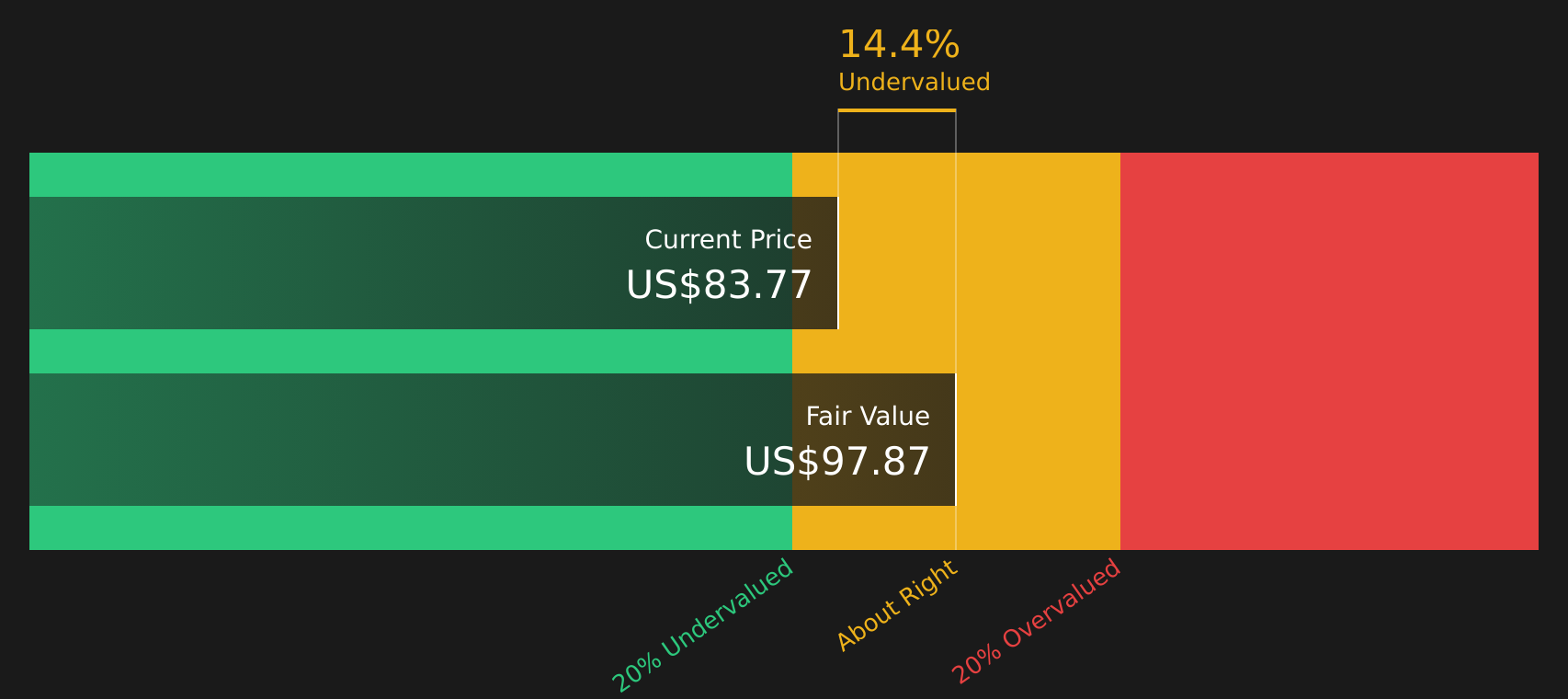 PLNT Discounted Cash Flow as at Feb 2026
Approach 2: Planet Fitness Price vs Earnings
For a profitable company like Planet Fitness, the P/E ratio is a useful way to link what you pay per share to the earnings the business is generating today. It gives you a simple sense of how many dollars investors are currently paying for each dollar of earnings.
In general, higher expected growth and lower perceived risk can justify a higher P/E ratio, while slower expected growth or higher risk usually points to a lower, more cautious multiple. Planet Fitness currently trades on a P/E of 30.76x. That sits above both the Hospitality industry average of 23.54x and the peer group average of 23.13x.
Simply Wall St also calculates a proprietary “Fair Ratio” for Planet Fitness of 22.28x. This metric aims to capture what a more tailored P/E might look like after considering factors such as earnings growth, profit margins, industry, company size and specific risks. Because it is built around the company’s own profile rather than broad group averages, it can be a more focused yardstick than simple peer or industry comparisons.
Comparing the Fair Ratio of 22.28x to the current P/E of 30.76x suggests the shares screen as overvalued on this metric.
Result: OVERVALUED
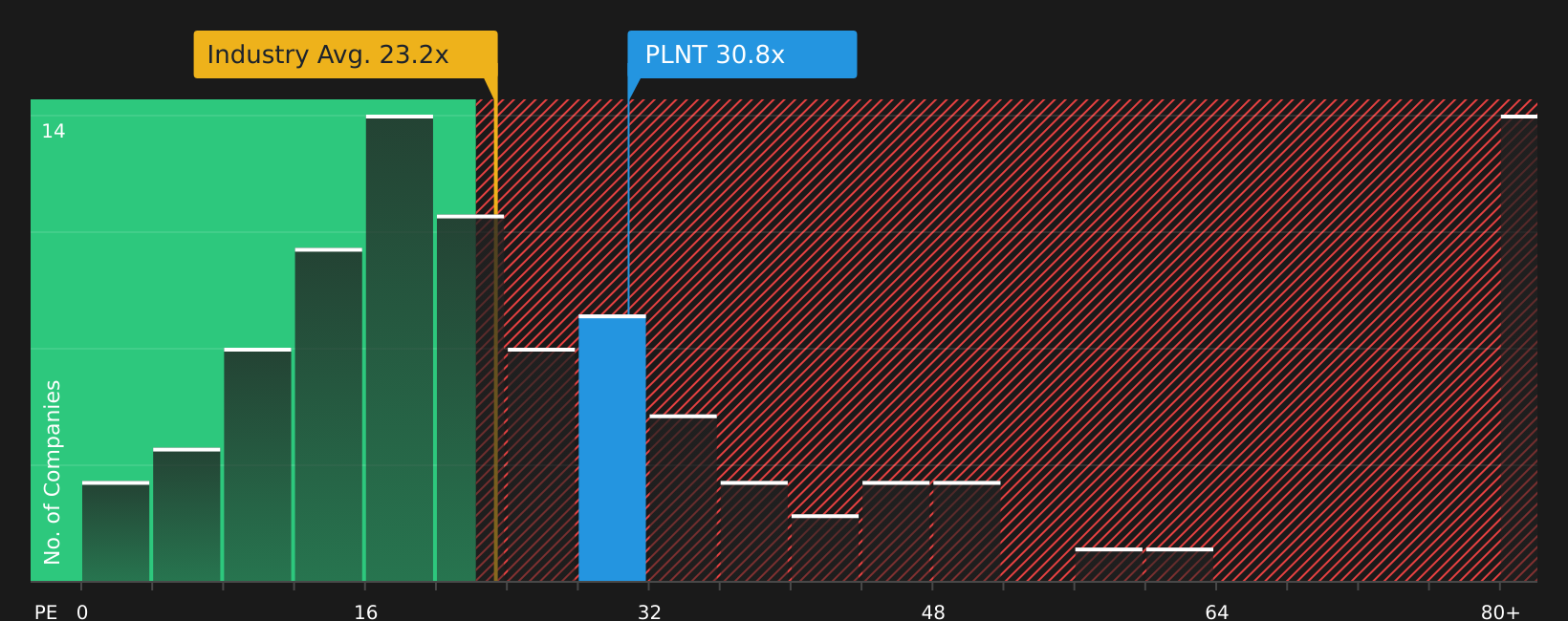 NYSE:PLNT P/E Ratio as at Feb 2026
P/E ratios tell one story, but what if the real opportunity lies elsewhere? Start investing in legacies, not executives. Discover our 19 top founder-led companies.
Upgrade Your Decision Making: Choose your Planet Fitness Narrative
Earlier we mentioned that there is an even better way to understand valuation. Let us introduce you to Narratives, a simple tool on Simply Wall St’s Community page that lets you connect your view of Planet Fitness’s story to concrete forecasts and a fair value. You can then compare that fair value with the current share price to frame your own buy or sell decisions, and see how different viewpoints line up. For example, one investor might build a bullish Narrative around a Fair Value near US$164.23, while another takes a more cautious stance closer to US$112, with each Narrative automatically updating as new company news or earnings are reflected in the numbers.
Do you think there’s more to the story for Planet Fitness? Head over to our Community to see what others are saying!
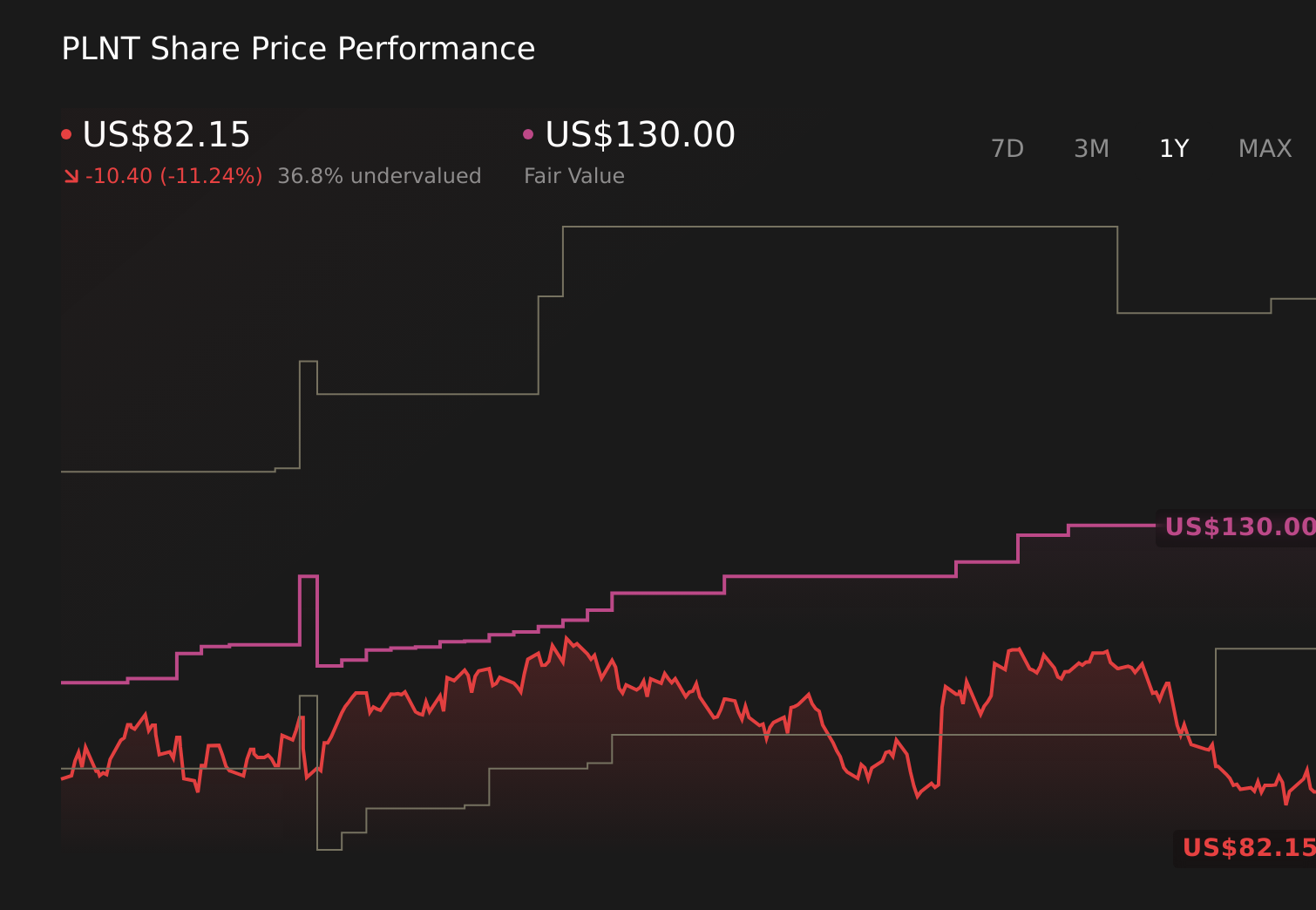 NYSE:PLNT 1-Year Stock Price Chart
This article by Simply Wall St is general in nature. We provide commentary based on historical data
and analyst forecasts only using an unbiased methodology and our articles are not intended to be financial advice. It does not constitute a recommendation to buy or sell any stock, and does not take account of your objectives, or your
financial situation. We aim to bring you long-term focused analysis driven by fundamental data.
Note that our analysis may not factor in the latest price-sensitive company announcements or qualitative material.
Simply Wall St has no position in any stocks mentioned.
New: Manage All Your Stock Portfolios in One Place
We’ve created the ultimate portfolio companion for stock investors, and it’s free.
• Connect an unlimited number of Portfolios and see your total in one currency
• Be alerted to new Warning Signs or Risks via email or mobile
• Track the Fair Value of your stocks
Have feedback on this article? Concerned about the content? Get in touch with us directly. Alternatively, email editorial-team@simplywallst.com