
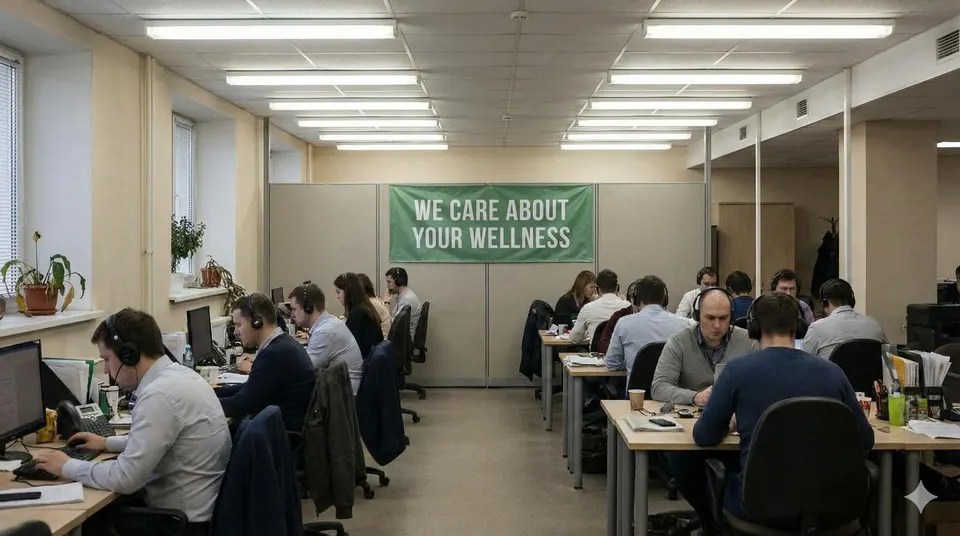
An open-plan corporate office with a green “We Care About Your Wellness” banner or poster visible in the background, while employees work at cramped desks under fluorescent lighting. The contrast between the cheerful wellness branding and the sterile, pressured work environment should be visually evident.
AI Generated
Global corporate spending on employee wellness has crossed $60 billion. The global cost of worker disengagement and burnout sits at $8.8 trillion. One number is growing faster than the other, and it’s not the one you’d hope.
That ratio — roughly $147 of damage for every $1 of remedy — tells us something the green banners in the lobby do not. We are not witnessing a wellness effort that hasn’t yet scaled. We are witnessing a system that generates distress at the structural level and manages it at the individual one. The gap between those two levels is where $8.8 trillion disappears.
The Enemy You Weren’t Looking For
The assumption, almost always, is that work is the problem. Too much of it, too fast, too relentless.
But this is a misdiagnosis.
Some work carries genuine inherent risk — trauma exposure for emergency physicians, moral injury for frontline social workers, vicarious distress for journalists covering conflict. For those roles, wellbeing support addresses something real. But for the vast majority of the workforce, the pathology originates not in the task but in the apparatus wrapped around it.
Work — the act of writing code, treating a patient, solving a logistics problem — is rarely what breaks people. Decades of self-determination research converge on a single, stubborn finding: human beings who have autonomy over a meaningful task don’t burn out. They engage. The nurse who controls her ward rounds thrives. The engineer given ownership of a system finds quiet satisfaction in its elegance.
The enemy is not the work. The enemy is the layer between you and the work.
Between every employee and their task now stands a dense apparatus of organizational mediation: the KPI cascade, the utilization review, the six-minute timesheet increment, the algorithmic scheduler, the dashboard you cannot see but that sees you. The task is to write a report. The job is to write the report by 4:00 PM while monitoring Slack, logging hours in billable fragments, and managing your visibility to a performance metric calibrated by someone who has never done your work.
The task is self-actualizing. The job is depleting. The World Health Organization does not list “hard work” among its primary psychosocial risks. It lists low job control, excessive workload, and job insecurity — features not of the activity, but of the management structure wrapped around it.
The Surveillance Premium
Before we dismiss this as theory, a technical reality check.
The American Psychological Association’s 2023 Work in America survey found that 51% of U.S. workers know their employer monitors them digitally. Among those monitored workers, 45% report their workplace negatively impacts their mental health, compared with 29% of unmonitored workers. A 2024 Canadian national study went further: surveillance’s harm is fully mediated by three factors — reduced autonomy, increased pressure, and perceived privacy violations. The monitoring doesn’t damage people directly. It damages them by restructuring the job into one of high pressure, low discretion, and zero trust.
Put differently: surveillance doesn’t watch the work. It replaces it. The employee’s primary relationship shifts from the task to the metric — from producing value to performing legibility.
Here is where the wellness industry enters the picture, and here is where it fails in a way that is not accidental but architectural.
The $60 Billion Bandage
Three features define the structural function of corporate wellness — and none of them involve making workers well.
First, the utilization paradox. While 98% of large companies offer Employee Assistance Programs, utilization rates stagnate between 2% and 6%. Employees don’t avoid these programs because they’re healthy. They avoid them because they don’t trust the source. In a UK poll by MHR, 79% of employees said they did not believe their employer’s wellbeing claims. The program exists. Almost nobody uses it. But it documents that the firm tried — and that documentation has legal value.
Second, the diagnostic inversion. Wellness programs reframe a structural problem — chronic understaffing, impossible targets, algorithmic management — as an individual failure of self-regulation. If you are stressed, the implicit message runs, it is not because the workload is toxic. It is because you have not breathed deeply enough. Research confirms that organizational interventions consistently outperform individual ones, yet the corporate default remains the meditation app, the resilience seminar, the mindfulness webinar. Scholars of what Ronald Purser calls “McMindfulness” have documented how mindfulness in corporate settings becomes a disciplinary technology — adjusting workers to the conditions causing their distress rather than contesting those conditions.
Third, the scarcity illusion. Asalet Tulaz, an NHS staff counselor and wellbeing expert who has worked across the charity and corporate sectors, identifies the dynamic that separates corporate burnout from every other kind. In the NHS or charities, burnout stems from genuine scarcity — there simply aren’t enough resources. The exhaustion is tragic, but it is shared.
In the corporate world, the scarcity is often artificial.
“Staff can feel the company is purposefully not investing in their wellbeing, despite having the means to do so,” Tulaz observes. “This adds a layer of hurt that differs from the frustration in under-resourced sectors.”
The meditation app, in this context, becomes an insult. It signals that the company sees your distress not as a resource problem but as a resilience problem. “Corporate efforts feel hollow,” Tulaz argues. “They’re asking staff to be resilient to conditions the organization is actively choosing to maintain.”
The Middle Management Crush
The human cost concentrates in a specific structural position.
Middle managers absorb the contradiction. They are tasked with enforcing the targets that generate distress while simultaneously promoting the wellness programs designed to manage it. They hold what Tulaz calls “impossible tensions” — organizational goals pulling one way, staff wellbeing pulling the other, and no authority to resolve the conflict.
“We ask middle managers to hold impossible tensions,” she notes, “then wonder why they burn out or disengage.”
Without the power to redesign workloads or push back on targets, the middle manager becomes a transmission belt for stress — converting executive strategy into frontline pressure and absorbing the resentment flowing in the opposite direction. The wellness program offers them nothing, because their problem is not psychological. It is positional.
The Design Problem
The structural critique is no longer fringe. The WHO’s 2022 Guidelines on Mental Health at Work explicitly prioritize organizational interventions — flexible working, fair work design, participatory decision-making — over individual therapy and apps. The OECD concurs: programs that modify the environment and organization of work produce the strongest, most cost-effective results.
“They’re asking staff to be resilient to conditions the organization is actively choosing to maintain.”
Asalet Tulaz, NHS staff counselor and wellbeing expert
Both employers and employees, when surveyed, agree. “Good work” — autonomy, fair workload, work-life balance, fair pay — ranks as the most effective mental health intervention. But only half of UK employers actually provide those basics. Instead, 37% invest in yoga, resilience training, and lifestyle seminars. Only 26% of employees find those effective.
The numbers expose the logic. Organizational redesign — shorter hours, higher staffing ratios, genuine worker voice — would redistribute power. A meditation app redistributes nothing. It costs less. It documents compliance. And it leaves the management model that generates distress entirely intact.
Tulaz frames the alternative simply: “Be honest about the trade-offs. Staff aren’t naive. They know resources are limited. What damages trust is pretending everything can be done simultaneously.”
Until organizations make that structural shift — redesigning jobs rather than medicating workers — the green banner in the lobby will remain what it has always been. Not a promise. A receipt. Proof that the firm purchased $60 billion worth of documented good intentions while the $8.8 trillion cost of the system those intentions decorate continued to compound.
The app cannot save you. Only the work can — if they let you do it.