When you buy through links on our articles, Future and its syndication partners may earn a commission.

Credit: Getty Images
I train my dad twice a week, and without fail, he will at some point utter words along the lines of: “I’m too old for that” when I give him an exercise he isn’t familiar with. I hear it a lot from “older” clients, and I will never, ever agree.
At Tom’s Guide, we’ve had the privilege of interviewing trainers in their 60s and 70s who are still keeping fit and coaching others to do the same. Continuing to exercise as you get older can combat muscle mass decline, bone density loss and chronic health conditions; it can also help you build strength, muscle, stability, mobility and balance well into your later years.
At 72 years old, my dad strength trains once a week using a full-body workout (programmed by me). We also work on combined strength and mobility twice a week using one-hour sessions. The change I have seen is enormous, and you can do it too. Here are three moves we swear by, and they’re essential to his routine.
What are the 3 anti-aging exercises?
One component of fitness that can decline pretty easily with age and sedentary living is mobility. A strong, mobile body is the best anti-aging tool we have for increasing longevity. Here are three moves that combine strength and mobility, and they’re my essentials.
1. Eccentric step-ups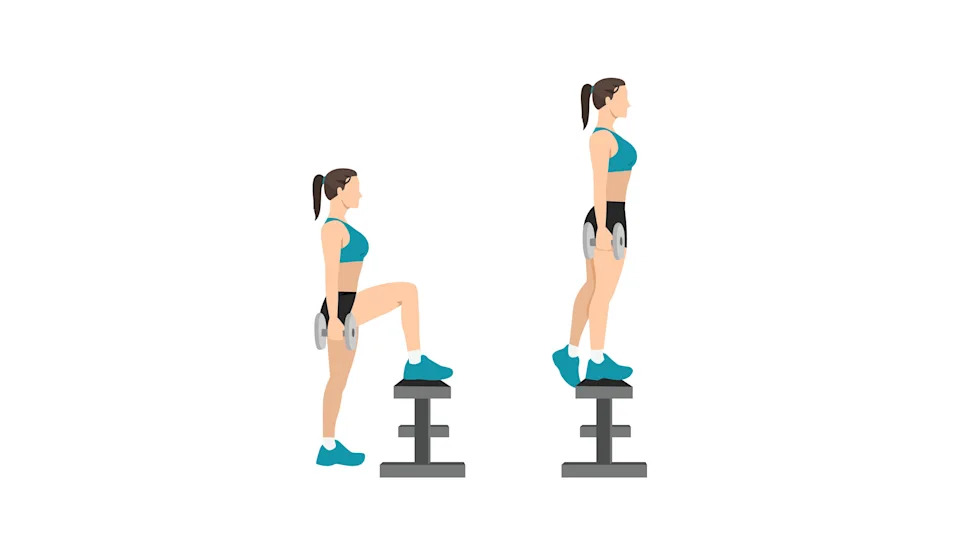
Credit: Shutterstock
You can do these with or without weights racked at your shoulders or held by your sides. But for this variation, you might want to start with your bodyweight first until you feel comfortable.
To do eccentric step-ups, we slow and control the stepping down portion of the exercise to increase muscle tension. Eccentrics are a great muscle and stability-building tool, and step-ups are a great way to bring eccentric loading in.
Position a box or bench in front of you. Ideally, we want to go higher than usual so that you have to drive a lot of power through your core and legs to push upward and stand.
Once you’ve stood on the bench, trace your foot down slowly to the floor using your standing leg for balance, and for a count of four to five seconds. From here, you can step your other leg down.
Stand with a box or bench in front of you
Step your right foot onto the box with the foot completely flat
Engage your core and lean slightly forward, then push through your right leg to stand on the box
Allow your left leg to follow, standing fully on your box
Place your weight into your right leg, then slowly begin to step down with your left leg, lowering for 4-5 seconds while bending your right knee and leaning slightly forward
Once your left foot reaches the ground below, step down fully with your right leg
Aim for 3-4 sets of 6-8 reps per side.
Step-ups require you to balance and stabilize using one side of your body at a time. What else requires this? Walking, running and climbing the stairs.
The higher the step, the more you can drive force through your legs and core muscles, and a slight forward lean will also help activate your glutes, which act as stabilizer muscles for the hips, pelvis and lower spine.
Weights will increase the difficulty of this exercise, but lowering down more slowly than usual will also feel challenging, so start slowly and build over time.
2. Feet-elevated push-ups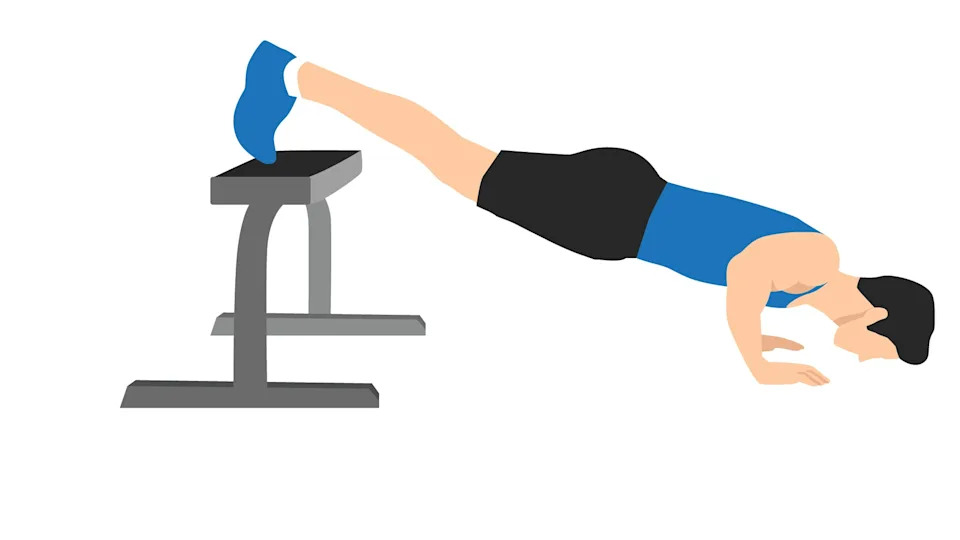
Credit: Shutterstock
Decline push-ups should only be attempted once you’re comfortable with regular push-ups on the toes without knees. Start by elevating your feet on a weight plate or similar, and over time, you can increase the elevation.
Lifting your feet shifts the emphasis toward the front of your body, working the triceps, shoulders, core and pectorals harder. You could even lift one leg into the air while you perform your push-up for a more challenging variation.
Pushing your own body weight is extremely functional and will translate to other areas of your life, such as opening a heavy door or controlling a grocery trolley.
Start in a push-up position with your shoulders aligned with your wrists and hips aligned with your shoulders
Engage your glutes, core and quads
Step your feet up onto a bench, box, or similar
Bend your elbows and lower your chest toward the floor. Keep your elbows tracking back and close to your ribcage
Pause at the bottom, then push the ground away to extend your elbows
Aim for 3-4 sets of 6-8 reps.
Avoid letting your hips collapse to the floor or lifting your butt too high. It’s common to flare your elbows to the sides, too, so try to keep them locked close to the body. If you don’t feel confident with this move, focus on regular push-ups first, and start with a very small deficit when you do give it another go.
3. Chair squat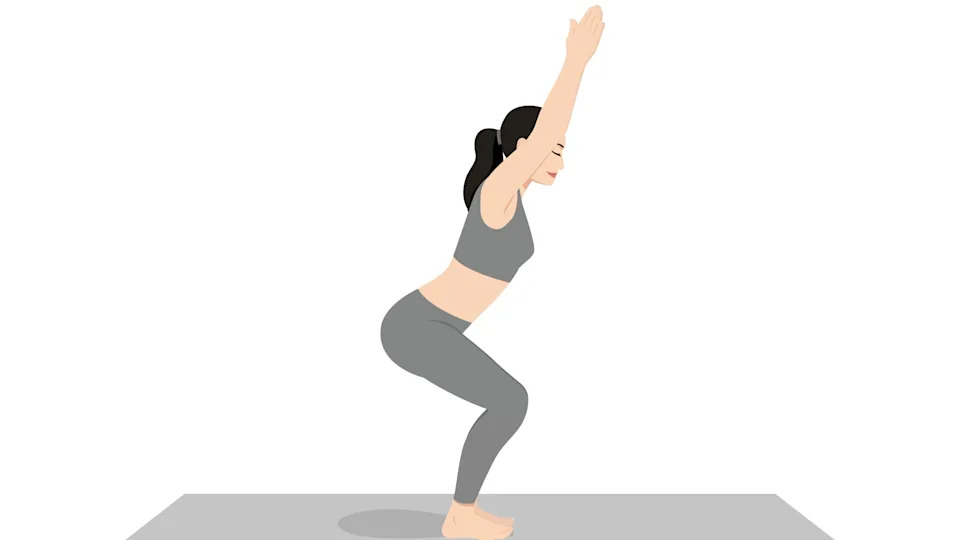
Credit: Shutterstock
The thoracic spine (think of your torso) aids movements like rotation, flexion and extension through all planes of motion in your upper body, meaning multi-directional movement.
Thoracic mobility will determine how well you can move and do things like stabilize weight overhead, place your hands behind your head and squat. While people are quick to point out limited mobility in their lower body, like in the knees, hips, or ankles, the thoracic spine can quietly become the culprit of much of people’s limited range of motion.
Your ability to perform the chair pose is a great indicator of overall mobility. Focus on keeping both feet planted, then rock your weight into your heels; lift your chest and try to avoid falling forward; keep your arms glued next to your ears and reach your fingertips toward the ceiling; draw your shoulders down and lower your butt.
Start with your big toes and heels touching, legs gently pressing together. If you need to, opt for a hip-width apart foot position instead
Inhale as you reach your arms overhead, then exhale as you bend your knees and sit your hips back into a squat
Lower as far as you can without falling forward. Take a quick look at your toes to make sure you can see them
Lift your chest and draw your hands upward
Aim for 20-30 seconds while breathing calmly. Repeat for 2-3 rounds. Alternatively, perform 8-10 reps and 2-3 sets.

Google News
Follow Tom’s Guide on Google News and add us as a preferred source to get our up-to-date news, analysis, and reviews in your feeds.
More from Tom’s Guide