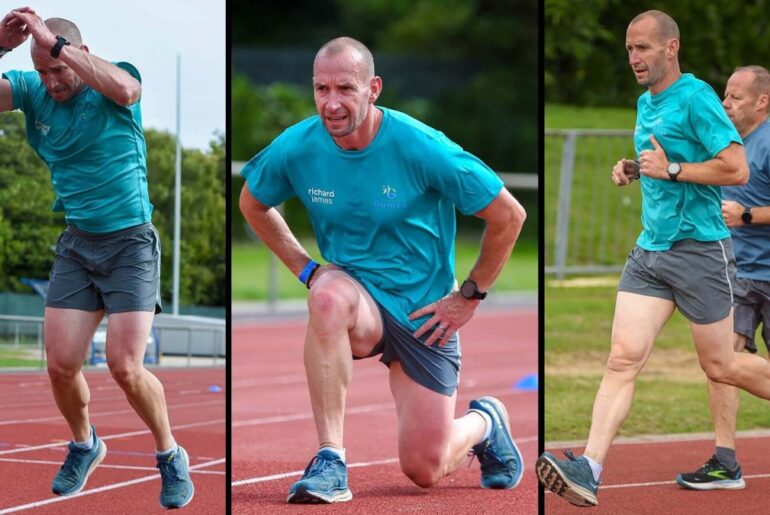
Tim Howe is on a mission to extend your life. You may not have heard of him (yet), but the 52-year-old is slowly gaining a reputation as the Joe Wicks of longevity. Howe, a father of two from Swindon who works as a forklift truck salesman when he is not spreading the word, admits he is an unlikely wellness guru. But his brainchild is an approach to exercise that has the potential to help thousands of us add years to our lives.
A lifelong fitness enthusiast, Howe had become disillusioned with spiralling costs and commercialism of many classes and events. “I was a Hyrox fan but access to events and the cost of entering was becoming prohibitive,” he says. Two years ago on an adventure holiday with family and friends to celebrate his 50th birthday, conversation turned to hacks for boosting longevity. “A friend of mine was adamant that he wanted to give himself the best chance to live a long and healthy life,” he says. “I started researching how simple functional exercise done regularly could have a powerful effect on lifespan.”
On his return to the UK, he gathered friends for a 6am workout in a field that included six exercises known for their life-extending properties and the concept of the Longevity Games community training was born. “It quickly became a community and we did a set of exercises with no equipment that could be adapted to be performed by anyone, whatever their level.” From the start, Howe established three performance levels — novice for complete beginners, intermediate for the averagely fit and proficient for the super fit — meaning anyone could take part. “We are part of a generation in a comfort crisis,” he says. “We are not moving around in the way our grandparents did and our sedentary lifestyles are cutting lives short, sometimes by decades.”
• Read more expert advice on healthy living, fitness and wellbeing
As word spread about the hour-long, early-morning classes, these attracted the attention of local councillors and GPs as well as Sport England, and in 2025 more than 700 people took part in the first Longevity Games, a festival-style fitness finale, at a sports centre in Swindon. “The idea is that it is one of the most inclusive fitness events in the country,” Howe, who now runs several classes a week, says. “There is no timing chip so that pressure is taken away, there is nobody there counting reps or saying you are not going deep enough on your squat because everyone is on a different journey.” If you don’t yet have the strength for a full burpee, he says, nobody cares.

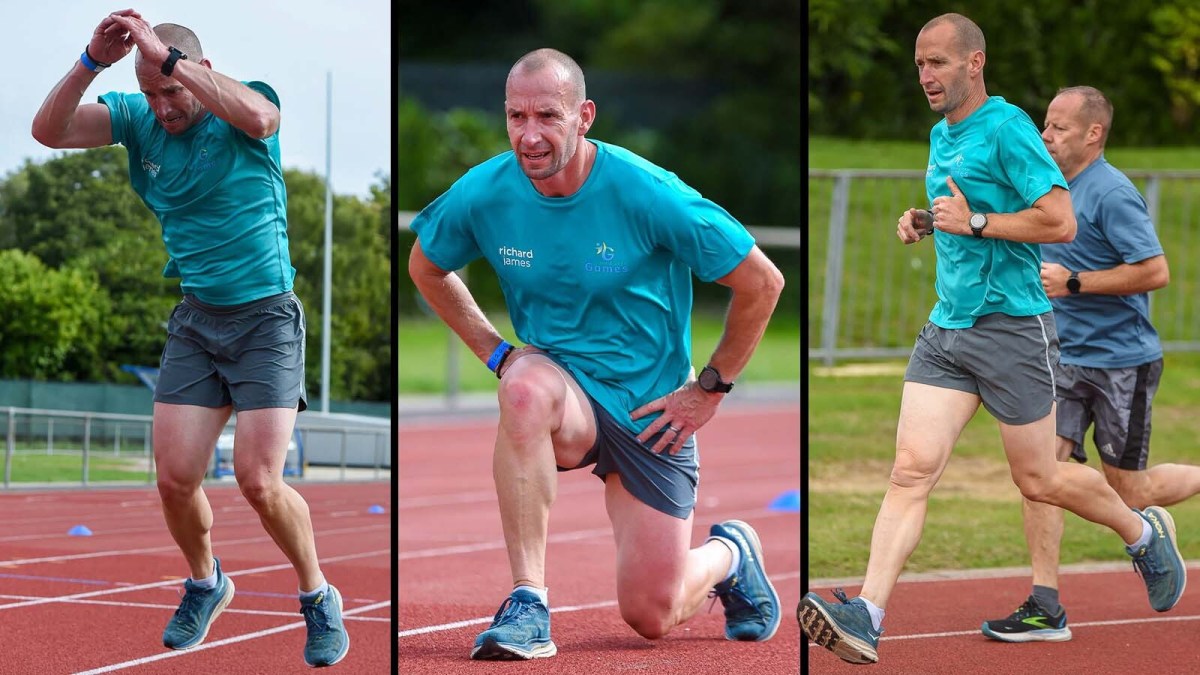
Competitors at the Longevity Games in Swindon
JAMES BOOTH
Spend five minutes scrolling through Instagram and you will realise that longevity experts are nothing new. What’s different about Howe is his drive to make his workouts available to everyone. “We want people who haven’t exercised for years, people with dodgy hips or people who are fit, to be exercising together without judgment,” he says. He is not interested in the aesthetics of attaining a buff and chiselled body and, refreshingly, he’s not in it for the money. His weekly classes remain free and although it costs £39.71 to enter one of the four annual Longevity Games events, including the women-only Her Longevity Games championships in May, it is purely to cover the costs of staging the events. To put it into perspective, the entry fee is half the cost of entering the London Marathon and a third of the sign-up fee to many Hyrox events.
• Men and women ‘should follow different diets to live longer’
In much the same way as the Parkrun phenomenon began in 2004 when 13 local runners got together in Bushy Park, Teddington, the community is growing organically and, with no funds for advertising, the message is spreading by word of mouth. Parkrun now attracts more than 380,000 participants worldwide (more than 200,000 of them in the UK) to its Saturday morning 5km events with the same basic principles — that fitness should be weekly, free and for everyone — remaining at the heart of its success. Could Howe be spearheading the longevity alternative? “What started as a simple idea two years ago is already having a mind-blowing impact,” he says. “It is already changing lives and one man who has been doing it regularly recently came off his blood pressure medication.”
His goal is to expand the format nationwide, although he concedes that it will take time. “I want to give people the opportunity to train in a way that will help them to live longer by avoiding disease but without barriers to participation,” Howe says. “When they exercise in this way as a community they will improve their aerobic capacity, their bone mass, balance and muscular strength so that they will give themselves the best chance of longevity.” That, he says, is priceless.
thelongevitygames.co.uk
The 20-minute longevity workout
By Tim Howe
These are the six key exercises included in the Longevity Games training plans and competitions. You can do these as a set format once, twice or more a week or do some of the exercises every day. The ultimate goal should be to enter one of the four Longevity Games events held each year.
Run or walk
Longevity effect Dozens of studies, including one in the journal Geroscience, confirm that regular walking improves longevity and running for as little as 12 minutes a week was shown in a 2023 study at Brigham Young University to add up to 12 years to your lifespan.
How to do it You will need to run/walk before every one of the exercises in the longevity workout. This can be done anywhere — walk or jog round the block if you like. On days you are not doing the workout too, build up your daily steps by increments of 500-1,000 steps every few weeks.
Novice One lap of a 400m running track or 3 minutes run/walk
Intermediate Two laps of a 400m running track or 6 minutes run/walk
Proficient Three laps of a 400m running track or 9 minutes run/walk
• It’s peak injury season in the gym: here are six ways to train smarter
Squats
Longevity effect Squats are a powerful functional movement that engage the body’s joints and largest muscles and have a powerful anti-ageing effect if performed regularly. In 2023 researchers from Japan showed that breaking up bouts of sitting with 60 seconds of squats may help to preserve the brain’s cognitive function. A study in the Scandinavian Journal of Medicine and Science in Sports showed that doing 100 squats a day — broken down as ten every 45 minutes — helped to control blood sugar, reducing the risk of type 2 diabetes.
How to do it Keep your back straight, chest up and knees tracking over your toes. Aim to go only as low as your mobility and form allow at first. Ultimately you can aim for deeper squats but take your time.
Novice 25 squats
Intermediate 50 squats
Proficient 100 squats
Lie down/stand-up
Longevity effect This exercise improves overall strength, flexibility and coordination. It also tells you a lot about your physical health and how long and well you might live. A study published in the European Journal of Preventive Cardiology last year found that adults aged 46-75 who were most proficient at this type of exercise were six times less likely to die from heart disease and other cardiovascular conditions such as a stroke. They were also four times less likely to die early from any cause than those who struggled with the movement.
How to do it The goal is to transition smoothly between lying and standing positions and to move fluidly without using hands or assistance from other body parts. Starting on your back, move slowly and keep your core muscles engaged to maintain stability and control. It takes practice and you may need to use your hands initially if you are new to this exercise, but eventually you will be able to progress to no hands which is when the greatest benefits will come.
Novice 10 lie down/stand-ups
Intermediate 25 lie down/stand-ups
Proficient 50 lie down/stand-ups
• Billionaires trying to prolong their life end up wasting it
The walk-out
Longevity effect Also known as the inch worm, the walk-out is a functional exercise that improves muscle mass and strength, flexibility and mobility, and core stability, contributing to improved longevity.
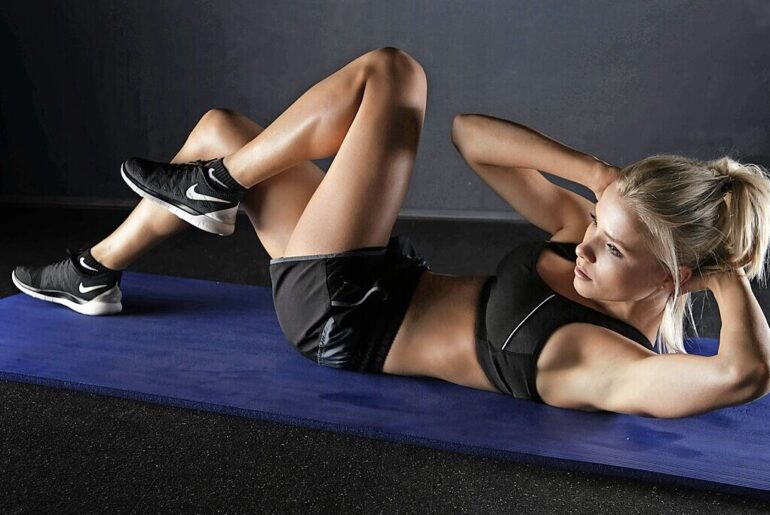
How to do it Stand with your feet hip-width apart and bend at your hips to touch the floor with your hands. If you can’t reach the floor, bend your knees. Place your hands on the floor and walk them forward until you are in a plank position (your body should form a straight line from your head to your heels). Hold here for a moment, engaging your core muscles. Walk your hands back towards your feet and stand up to return to the starting position. That’s one inch worm completed.
Novice 10 walk-outs
Intermediate 25 walk-outs
Proficient 50 walk-outs
Walking lunges
Longevity effect Like squats, lunges are a highly effective compound movement that engage multiple joints and the largest muscles in the body for a potent metabolic boost. Lunges strengthen muscles around the hips, knees and core, which means daily functional activities such as stair climbing and getting up from the floor unaided are improved. During a walking lunge you are challenging stability and balance, more so than in a symmetrical stance such as the squat.
How to do it Standing upright, take a large stride forward with your left leg, keeping your torso upright, core engaged, and ensuring your left knee does not extend beyond your left toes to avoid strain on the knee joint. Bend both knees to 90 degrees or as low as you feel comfortable to start with. Push forward through the left heel and bring the right leg forward to step into the next lunge. Continue in this way for the set distance or number of repetitions.
Novice 30-40 (15-20 on each leg) or 50m of walking lunges
Intermediate 60-80 (30-40 on each leg) or 100m of walking lunges
Proficient 150-200 (75-100 on each leg) or 200m of walking lunges
• Mixing up gym routine ‘can lead to a longer life’
Burpees
Longevity effect Burpees are challenging and combine a squat, plank and press-up in one movement. But they are also highly effective at engaging muscles in your legs, chest, buttocks, shoulders and core as well as working your lungs — they elevate your heart rate quickly, improving cardiovascular endurance — in every single exercise. The high intensity of burpees helps to burn a significant number of calories (about 15 a minute) in a short amount of time and they mimic real-life movements, enhancing your functional strength and agility.
How to do it The basic burpee involves squatting down, placing both hands on the floor, jumping the feet back into a plank position and then jumping the feet to the squat position before standing. Beginners can eliminate the jumps by stepping back to a plank and stepping forward to a squat before standing. Adding a full push-up at the bottom makes it more challenging.
Novice 12-15 (or 25 metres if jumping) burpees
Intermediate 24-30 (or 50 metres if jumping) burpees
Proficient 45-60 (or 100 metres if jumping) burpees