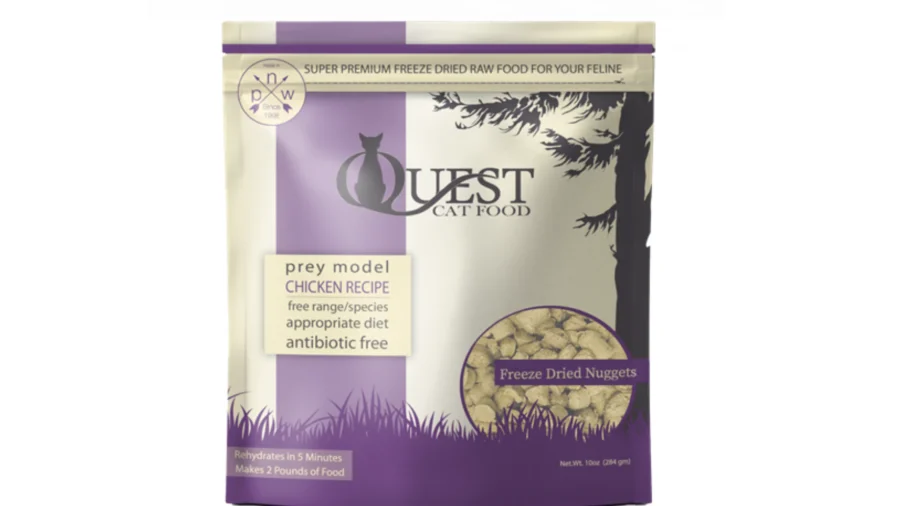
Go Raw LLC has expanded its recall of certain cat food products after finding additional lots with potentially low levels of thiamine—an essential B vitamin that cats need, the U.S. Food and Drug Administration announced on Thursday.
The company said in it’s own announcement, published by the FDA, that the expanded voluntary recall now includes two lots of Quest Cat Food Chicken Recipe Frozen Diet: lot codes MCD25350 (Best By 6/16/2027) and MCC25321 (Best By 5/17/2027). The products were sold nationwide in beige, two-pound, zip-lock bags featuring a purple stripe and UPC code 6-91730-17104-9.
Earlier this month, Go Raw voluntarily recalled a separate product—Quest Cat Food Chicken Recipe Freeze Dried Nuggets, lot code C25288 (Best By 10/15/2027)—after a cat reportedly became ill and tested positive for thiamine levels below the amount required for a feline diet. The cat was treated by a veterinarian and has since recovered.
Thiamine, also known as vitamin B1, is crucial to a cat’s health. A deficiency can cause loss of appetite, vomiting, salivation, and weight loss, with more serious neurological symptoms such as an unsteady gait, neck weakness, confusion, circling, and even seizures emerging in advanced cases, according to the company and veterinary guidance shared by VCA animal hospitals. The company warns that cats fed a diet low in thiamine over time may be at risk for deficiency, but that the condition is typically reversible with prompt veterinary treatment.
Go Raw said it discovered the low vitamin levels during an internal review earlier in February, prompting an investigation into its formulation processes, ingredient suppliers, and manufacturing methods. Following the findings, the company said it decided to remove all Quest brand products from retail shelves until the thiamine issue is fully resolved.
“We take the safety and well-being of pets extremely seriously,” said Shantel Goodrich, vice president of operations for Go Raw LLC, in a statement. “Rather than risk any potential concern, we made the decision to remove the affected product from the market and replace it with products we are confident meet our nutritional standards.”
According to the company, the newly identified frozen products were distributed through retail stores across Colorado, Utah, Washington, Oregon, Pennsylvania, Rhode Island, Michigan, California, Texas, Illinois, Georgia, North Carolina, South Carolina, Florida, Minnesota, New York, Ohio, Wisconsin, Pennsylvania, Idaho, and Montana.
Retailers have been instructed to pull the affected items immediately, and new, reformulated products are expected to reach distribution channels by mid-March.
Customers who purchased the recalled products should stop feeding them to their cats and return them to the place of purchase for a full refund or replacement. Go Raw added that consumers with questions can reach the company at [email protected] or by calling 801-432-7478 between 9 a.m. and 4 p.m. Mountain Standard Time, Monday through Friday.
Thiamine deficiency, while serious, is treatable. According to information from VCA animal hospitals, vitamin B1 supplements and injections are commonly prescribed to cats for prevention or treatment. The supplement is given either orally or via injection—intravenously, intramuscularly, or under the skin—depending on veterinary recommendations. While side effects can occur, they are typically rare if administered correctly.
Veterinarians caution that thiamine should only be used under medical supervision. Certain medications, such as amprolium and fluorouracil, may interact with the vitamin, and overdosing can lead to adverse reactions like swelling, hives, rapid heartbeat, or, in rare cases, collapse.
The FDA’s notice emphasized that non-drug animal supplements—including vitamins such as thiamine—are not reviewed for safety or effectiveness before sale and must carry a disclaimer stating that they are not intended to diagnose, treat, cure, or prevent disease.
Go Raw said it has implemented corrective measures to ensure thiamine levels in future batches meet the required nutritional standards for cats. “All existing inventory is being replaced with the newly formulated product,” the company’s statement said.
As of late February, no new illnesses linked to the expanded recall have been reported.