Among various aspects of food security, ensuring satisfactory nutrition levels for older people has generally not received adequate attention, despite its well-established importance for healthy ageing and hence for overall well-being of entire households.
Providing a medical perspective on this, Vincenza Glanfredi et al write in their paper ‘Aging, longevity, and healthy aging: the public health approach’ (Aging Clinical and Experimental Research (2025) 37:125, “Proper nutrition in older adults must consider the need to preserve muscle and bone mass. Adequate protein intake is essential to counteract sarcopenia, a common condition involving the loss of muscle mass and strength with aging. The intake of calcium and vitamin D is equally important for bone health, helping to prevent osteoporosis and fractures. Promoting healthy eating habits that include foods rich in high-quality proteins and essential nutrients is therefore a cornerstone for maintaining health and functional independence in older adults.”
However, despite the existence of pension and ration (subsidized as well as free food grains) in India the essential nutrition needs of a significant number of older persons are not being met, as is evident from official data. According to Longitudinal Ageing Study in India (LASI), Wave 1, Ministry of Health and Family Welfare, in India, 27% of elderly age 60 and above are underweight. What is more, the prevalence of underweight among the elderly age 60 and above is almost threefold (32%) higher in rural areas than in urban areas (12%). Among scheduled tribes this is 41%.
Keeping in view these realities, there is need also for campaigns to improve nutrition among the relatively neglected older people, particularly in the more remote rural areas and among tribal communities.
Prabal Yatra (PY) is precisely such an ongoing campaign in several rural, mostly tribal clusters of South Rajasthan, initiated by a leading voluntary organization, Action Research and Training for Health (ARTH).
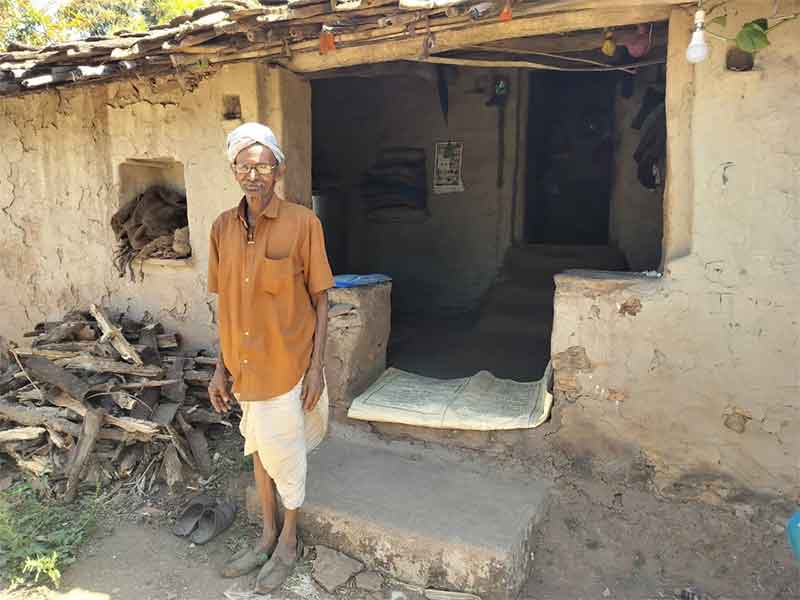
Visiting some of these villages with ARTH team members recently, I met Kanaram in village Sandukon Ka Guda (Kumbhalgarh block). Kanaram is a dalit small farmer. He lives with a son who has a low paying and uncertain job in a nearby small hotel. His working ability is limited, eroded further by a jeep accident.
Kanaram has less than five bighas of land whose food productivity has been declining in increasingly adverse weather conditions (climate change) and due to increasing inroads of wild animals in farms. Besides, neither 70 year old Kanaram nor his son Laluram can work much on the farm and must get it cultivated by paying others for which enough funds are not available.
Kanaram says that earlier, about a decade or two back, more food was grown on the farm. As it was grown organically (desi khaad), this food gave more strength, he says, and adds and the grain was processed into flour on a hand operated chakki which again gave more strength.
Now maize and wheat grown on the farms contribute only a part of the food needs of Kanaram. The production of pulses has declined even more. He has a buffalo and a little milk obtained is processed mainly to obtain chaach for daily use which is the cheapest available source of calcium and protein. Chaach and maize are used to prepare raabri which is commonly used. This is the cheapest local food that gives some nutrition, but is not adequate in itself.
So an increasing part of food security is the free food the government provides (5 kg of wheat per member for one month, so 10 kg for the two member household). The other source is an old age pension of about rupees one thousand a month only.
This is quite a typical situation for many households, combining several sources to somehow get some limited food security and avoiding hunger. Cooking food is also not easy for elder people, although Kanram is managing so far (his son finds it difficult to make rotis after an accident).
In this situation, PY seeks to be helpful in several ways. As pension and ration are important, PY community workers try to sort out any problems in accessing these. Although the availability of these two benefits is widespread, problems can arise in updating documents or in other ways. As elderly people cannot cope with digital and related problems on their own, help received from PY community workers is valued by them.
PY has been trying to improve the nutrition situation for several older people also by helping and encouraging them to use small plots of land close to their home for growing raised bed vegetable gardens in which several seasonal vegetables are grown on a very small plot of land. This helps to bring in vegetables more regularly in their daily food. Kanaram, for example, has been growing tomatoes, carrots and green leafy vegetables like methi in his raised bed garden in recent times.
In monthly meetings of older persons, both men and women, in villages PY has initiated several discussions on nutrition situation so that various suggestions and ideas on improving nutrition based on locally available foods can be shared. Also ideas regarding the foods which can be more easily eaten by the older people are also discussed.
Sometimes special nutrition meetings are also held in which a dish suitable for older people is cooked and eaten together in community spirit. Recently I attended one such community meeting in Majavari village (Udaipur district, Gogunda block) where a joyous mood prevailed in the course of cooking khichri (rice and pulse cooked together) with some green vegetables. While the individual stories were sadder, the elderly people mixed up well and discussed many things at the meeting.
Elderly persons who are living alone can face the most difficulties in ensuring daily food supplies and their proper cooking. Even fetching drinking water regularly can be a problem for some of them. Hence they need to get more attention. At a wider level, younger family members even when living separately need to be motivated to accept more responsibility for nutrition of older family members. Potentially improvements can be made in several aspects of food security of older people with sustained efforts.
Subscribe to Our Newsletter
Get the latest CounterCurrents updates delivered straight to your inbox.
Bharat Dogra is Honorary Convener, Campaign to Save Earth Now. His recent books include A Day in 2071, Man over Machine, When the Two Streams Met and Earth without Borders.