Editor’s note: This story is part of Meet a UChicagoan, a regular series focusing on the people who make UChicago a distinct intellectual community.
Carolyn Yackel, SB’92, flipped through photos of herself sporting brightly dyed, handsewn garments—a red pleated skirt, a blue sarong, a pink tunic.
Last summer, she showed off the distinct look on the runway at Bridges, the annual conference for mathematics and the arts.
“I’ve never been in the fashion show before,” said Yackel, a professor at Mercer University, ahead of the gathering in the Netherlands.
For her, math is a thing of beauty—literally. She dyed the fabrics for the garments using a Japanese technique known as itajime shibori to reproduce “wallpaper groups,” a mathematical concept of repeating, symmetrical patterns. An expert in mathematical art, she works in different fiber arts—shibori, temari and knitting among them—each with its own constraints and possibilities.
Raised by two mathematicians, Yackel incorporated math into creative play from an early age. When her grandmother taught her to crochet, she found joy in deciphering complicated instructions and puzzling out how to correct mistakes. She brings this same curiosity to her research today, starting from questions of how and to what extent she can reproduce a mathematical concept in a handicraft.
Her research often revolves around symmetry, which Yackel has been drawn to since childhood.
“My mom used to tease me when I was a little kid,” she said, “like with blocks, I would always make these really symmetrical arrangements and be like, ‘Please come take a picture of this!’”
Dyeing for symmetry
Yackel’s shibori work began with a challenge—reproducing as many of the 17 total wallpaper groups as she could on handkerchiefs and other pieces of fabric.
“I dreamt of all the symmetry types I would produce using shibori, even before I had tried the technique,” wrote Yackel in the introduction to a 2021 paper about her efforts.
Itajime shibori involves folding fabric and applying “resists” to prevent the dye from penetrating certain areas of the textile.
You can think of wallpaper groups as all possible patterns you would get from orienting a patterned tile in different ways across the floor. One, for example, involves simple translation, keeping the tiles oriented the same way as you place them in horizontal and vertical rows. Some wallpaper groups exhibit reflection, which mirrors the tile across a vertical or horizontal axis, or both. Others involve rotational symmetry, or turning your tile by, say, 90 degrees.
Some of the wallpaper groups were immediately out because they can’t be reproduced in three-dimensional space—they would require passing a handkerchief through itself. Others were also impossible without cutting the fabric.
Given these constraints, Yackel was able to reproduce seven of the wallpaper groups.
Stitching solids onto spheres
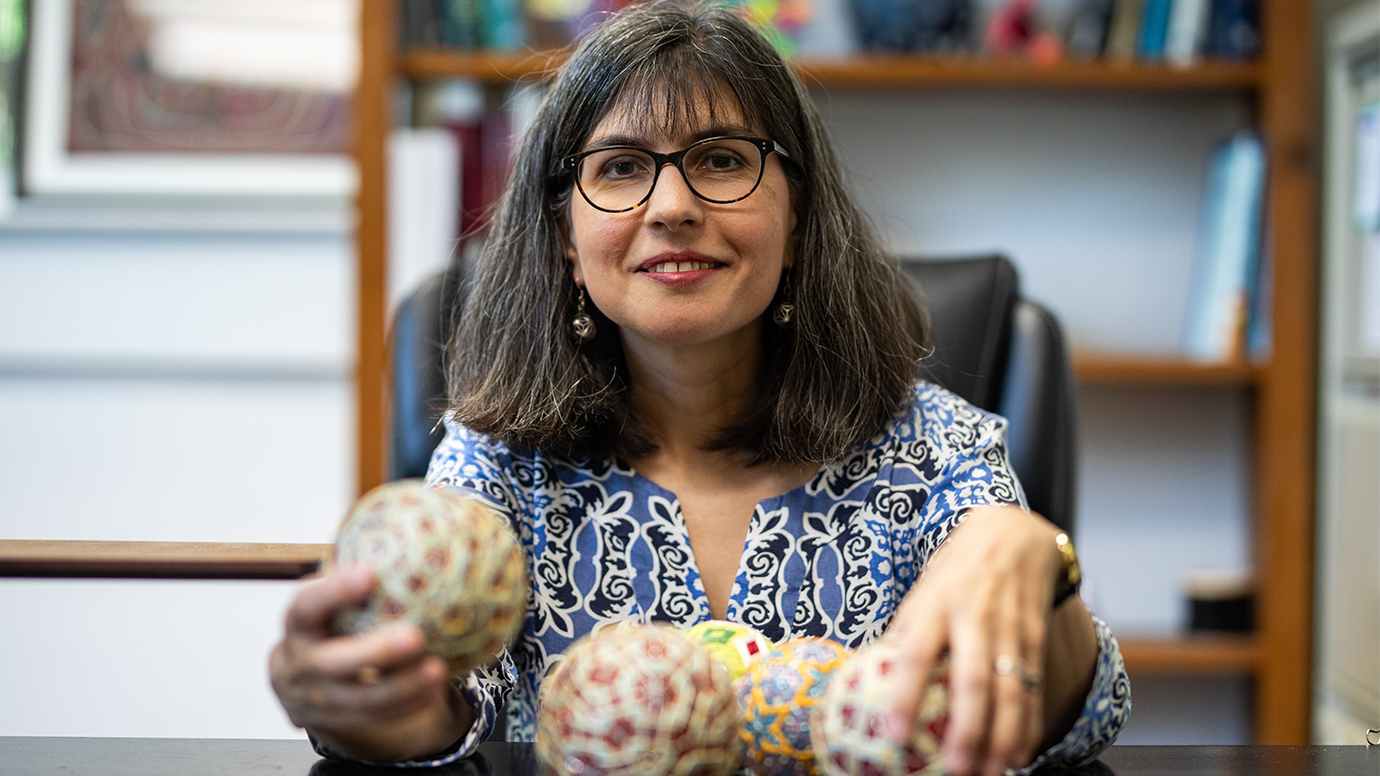
Temari, a Japanese folk art of intricately embroidered balls, evolved from handmade balls used centuries ago for a game akin to hacky sack. Today the core of the balls is made of scrap fabric or Styrofoam, which is wrapped in fabric batting and then in layers of thread.
“One of the things that’s considered really beautiful about temari balls is when you make these symmetric motifs all around the ball,” said Yackel, “and you just don’t have a shot at doing that unless you make some lines on your canvas.”
For those with a mathematical eye, the guidelines used in temari naturally generate Platonic solids. These are five three-dimensional shapes made of the same regular polygons, which meet at identical angles at the vertices.
As you embroider symmetric designs around a temari ball, it’s common for both a Platonic solid and its dual—a kind of counterpoint shape—to emerge.
Just as there are 17 wallpaper groups, there are 14 discrete spherical symmetry groups. Yackel and her frequent collaborator sarah-marie belcastro proved that you can represent all of them using temari balls.
They found that while all spherical symmetry groups were possible in temari, this mathematical classification system couldn’t fully describe the art form: Two balls could exhibit the same symmetry even while representing different solids.
As a result of the project, they proposed a more precise classification system for spherical symmetry in temari.
Yackel’s latest project involves using temari balls to illustrate the 13 Catalan solids, another mathematical concept.
This work started as part of Mathemalchemy, a traveling exhibition of whimsical math-related art—including a cryptographic quilt, a knit tortoise with heptagonal tiling on its ceramic shell and a cat serving pi-shaped cookies—created by a team of 24 mathematicians and artists.
For the exhibition, Yackel designed two giant arches made of more than 120 temari balls, some of them embroidered with Catalan solids.
Knitting to the limit
Yackel has also set out to bring mathematical symmetry to a technique known as mosaic knitting.
She and her collaborator Susan Goldstine attempted to use it to reproduce all 17 two-color frieze symmetries. But they found that the rows of alternating working color and slipped stitches that characterize mosaic knitting introduced some complications.
Three of the frieze symmetries proved impossible to produce with mosaic knitting, either because the technique constrains how colors stack, or because they would require some stitches to be two colors at once.
The wall hanging “Float Free, Bumblebee,” which Goldstine knitted, exhibits the 14 attainable two-color frieze symmetries.
Weaving a community
Yackel is part of a small but highly passionate mathematical art community.
In 2001 she cofounded a knitting circle at the Joint Math Meetings, the American Mathematical Society’s major annual conference, where she and her compatriots have now gathered for 25 years. The circle’s meetups have led to several special sessions at the Joint Math Meetings as well as a special issue of the Journal of Mathematics and the Arts and three books, all of which Yackel coedited.
In the books, readers can explore all manner of concept and craft—socks with algebraic structure, group actions in cross-stitch, Gosper-like fractals and intermeshed crochet, tessellations and quilting.
Next year a new open-access journal dedicated to mathematics and fiber arts, Interlace, coedited by Yackel, will publish its first issue, providing another forum for this research.
Yackel hopes it will make questions at the intersection of math and art accessible to those outside the academic math community, allowing as many people as possible to engage with these new ways of understanding—and creating—the world around us.
It’s a mathematical outlook that many share, even if they don’t realize it.
As Yackel wrote in the dedication to her 2008 edited volume, Making Mathematics with Needlework: Ten Papers and Ten Projects: “To my grandmothers, who were excellent needleworkers but didn’t know they were mathematicians.”