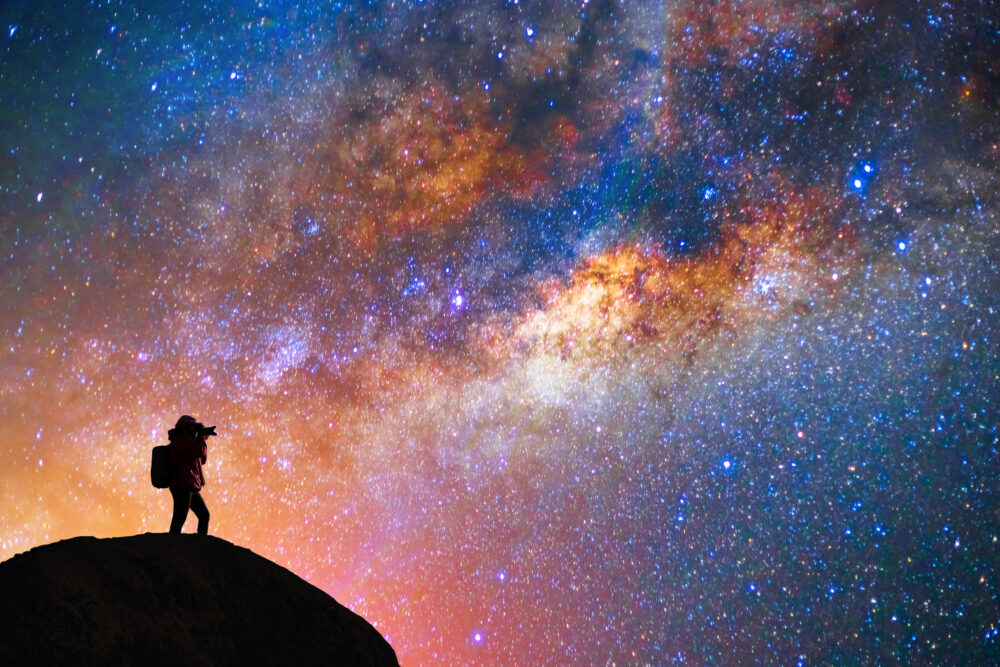
The darkest corners of Southern California are getting harder to find, but for serious astrophotographers, the chase is part of the magic. On clear, moonless nights, when the Milky Way finally lifts out of the glow of Los Angeles and Santa Clarita, local experts say the universe opens up in a way that a city sky simply can’t.
‘Painting with Photons’
Astrophotography is, at its heart, photography of the night sky — but it reveals a universe our eyes can’t see on their own. “When looking at objects like galaxies and nebulae through a telescope using only your eyeball, most objects will appear in black and white,” explained Dave Flynn, president of the Local Group Astronomy Club of Santa Clarita Valley. “Our eyes capture images every 1/20th of a second and amateur telescopes simply aren’t large enough to capture enough photons in that amount of time to see color.”
Cameras change that equation. By taking long exposures — sometimes minutes at a time — and stacking multiple images, Flynn said, “photos that rival even images from space-based telescopes are possible.”
Spencer SooHoo, secretary of the Los Angeles Astronomical Society, sees many newcomers start by simply holding a smartphone up to a telescope eyepiece to record what they’ve just seen. “While that may suffice for some, others want more,” he said, and that curiosity is often the first step down the path to more advanced gear and deeper sky targets.
Chasing the Dark: Timing the Sky
When it comes to timing, most newcomers get one big thing wrong: the moon. “Many folks think of a clear night with a full moon shining down and all the stars twinkling magnificently,” Flynn said. “Nope.” For deep-sky astrophotography — galaxies, nebulae, faint star clusters — he advises a “clear, cool night with no moon (called a ‘new moon’) and far from city lights.”
What you can capture also changes with the seasons. “The objects that are visible depend on what you want to image,” SooHoo said. Spring is generally best for distant galaxies, he noted, because “the night sky is pointed away from the center of our Milky Way galaxy,” while showpiece nebulae like Orion are fall-and-winter objects and others, like the Ring and Dumbbell nebulae, are mostly summer targets.
Planets drift in and out of the evening or predawn sky depending on the time of year, and brighter targets like the moon, Jupiter, Saturn and even the sun (with proper filters) can be photographed almost anywhere.
Where the Stars Still Shine
In Southern California, distance from city lights is now as important as distance from clouds. “Anyone remember when you could see the Milky Way from Santa Clarita?” Flynn asked. “Now you need to travel a ways from town to be able to see the fainter objects.” His club regularly heads to “dark sky” observing sites near the new moon, giving members and guests a chance to photograph planets, galaxies, nebulae, star clusters, comets, meteors and, increasingly, satellites.
SooHoo said the very best deep-sky imaging requires getting well away from the Los Angeles basin. Dim, distant galaxies and faint nebulae are best captured from “remote areas like Death Valley or parts of the Mojave Desert where there is little light pollution,” he said.
Even some longtime favorites have degraded: “Joshua Tree is not what it used to be in terms of darkness thanks to light pollution from Palm Springs,” he noted. His own club’s dark sky site near Frazier Park “has gotten quite brighter at night thanks to light pollution from the Santa Clarita Valley.”
That creeping glow is not an illusion. SooHoo points to studies suggesting that light pollution is “increasing at 20–30% per year and at that rate, seeing the Milky Way in the summer will be wistful thinking.” For residents of rapidly growing communities, he added, “projected housing/commercial developments are making the skies where you live brighter.”
Star Party Etiquette Under the Stars
The best way to learn, Flynn and SooHoo agree, is to stand next to someone who already does this. Both clubs host regular public star parties — from Griffith Observatory and Silver Lake to Garvey Ranch Observatory in Monterey Park and College of the Canyons — where experienced amateurs set up personal telescopes and share the view. “Our star parties are the best possible showroom for gear,” Flynn said. “Get there early and talk to the astronomers while they are setting up to learn about what might be right for you.”
But there are rules in the dark. “Please, whenever you attend any star party or other observing session, arrive before sundown and park with your headlights pointed away from the telescopes,” Flynn stressed.
Long exposures are easily ruined; one sweep of headlights, a camera flash or even a bright flashlight “will destroy that image and you will need to throw it away.” It takes 20 minutes to an hour for eyes to fully adapt to the dark, he said, and “less than a second to have that destroyed by an errant flashlight, camera flash or even those light up bracelets or shoes the kids wear.”
For light, astronomers favor dim red flashlights used sparingly, which “will cause the least disturbance of everyone’s night vision.” Above all, Flynn added, “Don’t be afraid of the dark! But of course, use your good judgement and most importantly of all: Have fun! Astronomy is a fantastic and educational activity for the whole family.” The Local Group, he said, “looks forward to seeing you at our next event.”
[Sidebar]
What You Need for Astrophotography
What You Need for Astrophotography
Astrophotography can start as simply as a smartphone on a tripod and grow into a sophisticated, mount-and-telescope setup — so experts urge newcomers to slow down and learn before they spend.
Patience and a learning mindset
“The first ingredient is patience and a willingness to learn,” Flynn said, noting that “modern amateur telescopes can be very sophisticated and the learning curve can be steep.”
Start with what you have Many beginners begin by holding a smartphone to a telescope eyepiece to grab a quick image of the moon or a bright planet. SooHoo said many people who are lucky enough to see the Milky Way “are able to photograph it with their smart phones…they just need a tripod to hold the phone steady for about 20 seconds and can capture stunning Milky Way photos.”
A stable mount or tripod Even for DSLR users, a solid tripod is essential, and for stars to stay sharp beyond 10–20 seconds, a tracking mount is needed to cancel out Earth’s rotation. “Without a mount, stars start to form streaks as the earth rotates,” SooHoo said.
Thoughtful gear choices — not impulse buys Flynn cautioned against rushing out to “purchase a bunch of stuff at your local camera and telescope shop and certainly not at one of the ‘big box’ stores.” Instead, he encourages people to “spend some time up front educating yourself on the equipment you need,” and to use club events as a hands-on showroom before buying. Good-quality telescope gear, he said, can be found from manufacturers such as Celestron, Explore Scientific, ZWO, TeleVue and Astro-Tech.
Dedicated cameras and adapters (when you’re ready) For those who want to go beyond casual snapshots, SooHoo often sees a progression: “They generally start off by holding their smartphone to the eyepiece…so they get a adapter and replace the eyepiece with a DSLR camera…the progression from that is to a dedicated astrophotography camera..”
“Astrophotography appliances” for simplicity For some beginners, fully automated systems can be a low-friction way in. Flynn points to a new class of “astrophotography appliances” — fully automatic telescopes with no eyepiece, operated by smartphone or tablet. “Once they wake up and align themselves, you just tell them what to start taking pictures of and they just do it,” he said, citing examples such as the ZWO Seestar and Vaonis Vespera. While he feels they “kind of take all the fun out of the hobby,” he acknowledges they “can be inexpensive and easy to use.”
Safety first with the sun Both experts note that imaging the sun demands special gear. Flynn emphasized that photographing our nearest star “takes very specialized telescopes to do so safely,” warning: “Never look at or point anything with a lens directly at the Sun or risk instant and permanent blindness!” At events such as the Placerita Canyon Nature Center open house, the Local Group uses proper solar telescopes so visitors can safely view and photograph the sun.
For those willing to travel for dark skies and take the time to learn, Southern California still offers glimpses of a universe far beyond the city glow — one long exposure at a time.