 4 min read
ANYONE WHO HAS traveled outside their own bubble knows one of the strangest and most exhilarating moments is finding really good food.
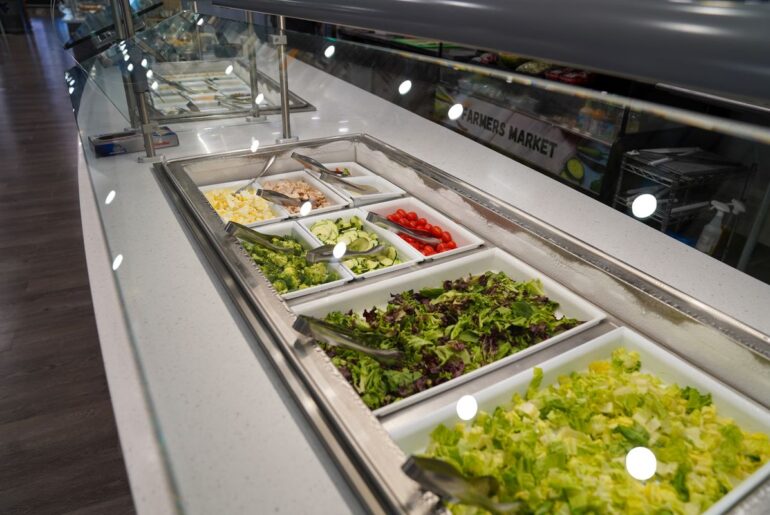
For many Winter Olympians who crossed into a different country in Milan and Cortina d’Ampezzo, Italy, the Olympic Village cafeteria was one of those places to find really good food. The massive eatery was their main access point for performance, and also the holy grail of all-you-can-eat. It’s free food that caters to roughly 2,800 to 2,900 athletes from 92 to 93 nations, competing across 16 disciplines and 116 medal events.
And whether you were a team protein-maxxing or fiber-maxxing, one thing I learned from some of the top athletes was that cheese, pasta, and pizza were core food groups. As a registered dietitian, I don’t recommend that approach to eating for my clients, but there are plenty of things you can learn about eating smarter from Olympians.
Carbs are the base layer
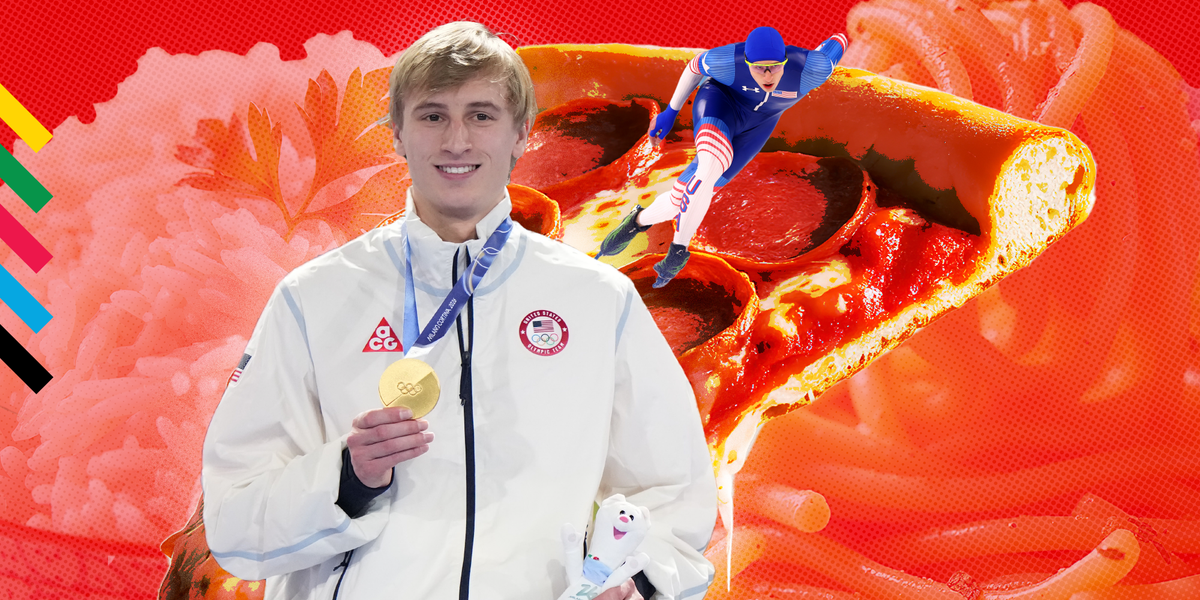
Olympic speed skater Jordan Stolz just won gold in the 1,000 meters and set an Olympic record with a 1:06.28. When you hear what he credits, it sounds almost too simple.
“The lunch before a race, it’s only rice … I’m trying to get as many carbs in as possible,” Stolz says.
That sentence is music to a sports dietitian’s ears. Carbs are the preferred fuel for high-output work, and they refill glycogen so your legs can show up again tomorrow. You see the same pattern across the Village.
Chris Fogt, a coach with the U.S. bobsled team, summed up the cafeteria reality in Italy with one line: “cheese, pizza and pasta,” plus “pizza 24 hours a day.” While I wouldn’t recommend smashing a slice right before training or comp, it’s a signal that athletes keep carbs in rotation because the work demands it.
Keep carbs at most meals when training volume is high. Then tighten the timing by putting the quick-digesting carbs (fruit, rice, etc.) closer to hard sessions, and let the heavier, richer carbs (legumes and whole grains) live farther from the start line. Once carbs are handled, the next challenge in the Olympic Village is the one most people don’t expect: protein.
Protein gets creative
Protein-maxxing is really having its day. Everywhere you look, they’re putting protein in water, in chips, and now we’ve got protein sour gummies. The Village doesn’t work like that. According to Fogt, protein was simply harder to find in the cafeteria, which forced athletes to get creative. He even mentioned seeing people eat more lentils than they normally would, because sometimes you take what’s available and make it work.
And while we’re on the topic, before we bash, here’s a fun one: hard parmesan is surprisingly protein-dense (35g of protein/100g). That’s the part most of us miss. High performers build protein in layers and get creative. Parmesan on pasta and lentils in the bowl. Yogurt on the side and eggs, when they can. A little here, a little there, and the math starts to work, so your meal hits what you need to recover.
Build protein with add-ons. Add legumes, seeds, dairy, or even a protein-forward beverage on the side.
Caffeine is a tool; keep it that way
Most people try to fix energy fatigue with caffeine. That’s how you end up stacking a “medium” coffee that can land anywhere from 150 to 300 milligrams, then adding a second one because the first didn’t hit the way you wanted. The problem is not caffeine; it’s treating caffeine like a personality trait instead of a strategy.
In elite sport, caffeine is allowed, but it’s still watched. The World Anti-Doping Agency (WADA) removed caffeine from the prohibited list in 2004 and added it to the monitoring program, which means it’s permitted, and they keep an eye on trends and misuse. Athletes are still advised not to chase extreme dosing. One common reference point in sports nutrition is the old urine threshold of 12 micrograms per milliliter, which roughly adds up to 10mg/kg of bodyweight.
Fogt put the real-world version of this into plain language: there’s a legal limit, and their goal is to keep it “under a gram,” even though that sounds absurd. He also pointed out that caffeine use isn’t one-size-fits-all. Pilots tend to take less because their job requires accuracy. The brakeman, as Fogt put it, is like a “caged animal,” and then has to go all out in a resisted sprint, pushing a sled that’s roughly 400 to 500 pounds for about eight seconds.
Build a caffeine strategy. Pick the smallest dose that helps; even low to moderate doses can improve focus and performance. Test it in training first and take it early enough that your sleep stays intact. But remember, caffeine’s half-life averages around four-five hours, with wide person-to-person variability, so late-day dosing can easily bleed into bedtime.
Fuel first, taste second, and try new foods
I’m going to hold your hand when I say this. Elite athletes appreciate taste like the rest of us, but it’s not the priority. As Fogt put it, “it’s not about taste, it’s about the fuel.”
That mindset is what makes the Village work, even when it’s imperfect. Getting creative and trying things you may not have eaten before builds flexibility, and flexibility is how you stay consistent. It gives you more options for your default meals, especially when your usual foods are not available.
That’s also why I’m big on working with registered dietitians, like myself. Creativity can meet function, and a hectic situation can still produce “good enough” plates. You don’t need perfect meals. You need repeatable ones. And while we’re at it, who is going to say no to a party pizza?
Your takeaway: Carbs for the work, protein for the rebuild, caffeine with a plan, and flexibility as the secret weapon.
Related Stories
Dezi Abeyta, RDN, is a Men’s Health Nutrition Adviser, author of Lose Your Gut Guide, and founder of Foodtalk Nutrition LLC.