San Antonio in the ‘90s was an extended moment in which a “burgeoning” scene over-flowed its banks. By the time Artpace came into existence in 1995, a full ten years after the birth of the Blue Star (now the Contemporary at Blue Star), which itself had been born in an atmosphere riffing on ‘60/‘70s alternate-space mentality, the artist-run space reputation of the city was about to take a leap.
CactusBRA, the collaborative studio/exhibition space of artists Jayne Lawrence and Leigh Anne Lester, began becoming in 1993 and by December ‘97 had hosted 15 exhibitions. Their run in the Blue Star Complex continued for a total of 19 years, and with a ten-year gap in which each artist focused more on their own work, by 2023 had morphed into cactusBARN, a small gambrel-shaped shed, permanently parked in Lester’s yard in the Southtown San Antonio neighborhood of King William.
Curator Scott Sherer, Professor of Art and Art History at the University of Texas at San Antonio (UTSA), Director of the University’s galleries, and curator/instigator of the exhibition, Thorns and Living Systems, which celebrates these artists and their contribution to the San Antonio scene, offers this note on Lawrence, Lester, cactusBRA, and cactusBARN:
“I was so interested in organizing an exhibition of Jayne’s and Leigh Anne’s work because I have long been fascinated with complexities of their work both visually and conceptually and because of the great impact cactusBRA had for so many years and that cactusBARN continues. Both Jayne and Leigh Anne take viewers on remarkable journeys where intimate details capture our attention, but then encourage remarkable shifts into considerations of the intellectual structures that influence the production of discourses and knowledge systems and that encourage us to consider how imagination influences storytelling. Further, Jayne and Leigh Anne are so incredibly rigorous in their individual practices and so generous with sharing their art and encouraging artists that having the opportunity to show their work has been an honor and pleasure and so very fulfilling.”
Thorns and Living Systems
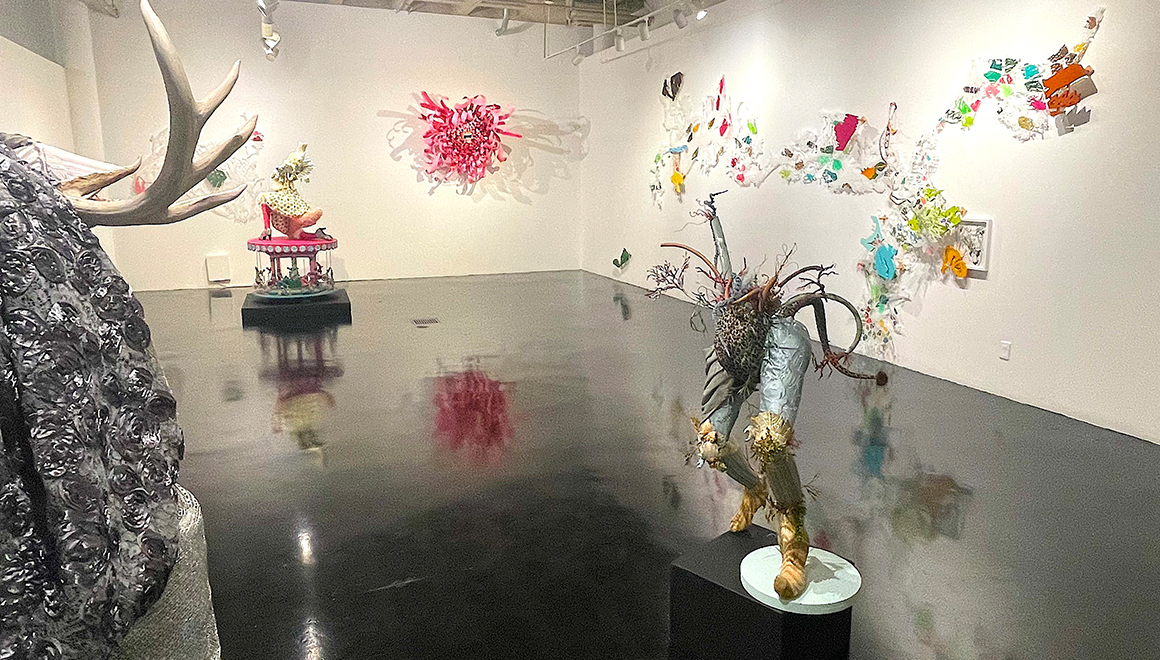
 An installation view of “Thorns and Living Systems: Jayne Lawrence, Leigh Anne Lester, cactusBRA/cactusBARN” at Russell Hill Rogers Galleries at UTSA Southwest
Thorns and Living Systems: Jayne Lawrence, Leigh Anne Lester, cactusBRA/cactusBARN at UTSA Art, Southwest Campus, offers 52 works, spanning 1994 to 2026, giving a cross section of past and present with antecedents, variations, and ongoing concerns populating the two large galleries at UTSA Arts, Southwest Campus near downtown San Antonio. The exhibition includes drawings, sculpture, monoprints, and photography, employing a diverse array of materials: steel, vinyl, ceramic, lead, handmade paper, lentils, Plexiglas, silk, rubber, and more. Works range in scale from tiny, self-contained vignettes and small empathetic embroideries of hereditary diseases to human-sized two-legged archetypes and intricate, sprawling wall installations.
Sherer has shown a sure hand and eye in the organization of the exhibition, which emphasizes the way both artists’ works stand alone and in intertwining relationship, as the collaborative gallery projects of cactusBRA and cactusBARN seem sprung from the same fanciful earth science as their art, even down to the word play in the gallery names.
 cactusBRA archive on view in “Thorns and Living Systems: Jayne Lawrence, Leigh Anne Lester, cactusBRA/cactusBARN” at UTSA
A horizontal vitrine centered on the entrance to the galleries contains samples from the archive of cactusBRA/cactusBARN that will be housed in the UTSA Library. It contains collected gallery remnants, mementos, press releases, posters, reviews, stickers, and assorted detritus, including a prickly pear bra, spines intact, signaling a feminism based on assertion and self-reliance. An artist-run space is a lot of things, but above all else, it is a lot of doing much, signifying plenty.
Within the context of this exhibition, the fantastic and rational aspects inherent in each artist’s work is revealed to feel drawn out of the other, as if to balance and emphasize — the rational in one revealing the capricious in the other, scheme of story placed next to molecular schematic, in some kind of monoclonal conversation in which the extra cells are pals.
 Jayne Lawrence, “In Just Moments,” 2010, graphite and watercolor on clayboard, 24 x 30 inches
Jayne Lawrence’s work sits comfortably with fairy tales, laden with the weight of portent, but draped with the extravagance of the runway, clearly showing a path to the fantasy realm by way of fashion, an unexpected overlay, a cloture on couture, divining that aspect of clothing that is a form of art that cross-examines societal expectations. To say something like Leonora Carrington meets Liberace is momentarily entertaining, but ultimately reductive, so it won’t be said. Nevertheless, the unintentional cinematic-pun title of Screening Suit (1999-2000) cues up a woman wearing an ensemble made of screen — protective, but with dangerous edges, and see-through, all at the same time.
The artist’s habit of collecting scraps and swaths of fabric began as a child, when her paternal grandmother and aunt taught her to sew. For the past two decades, beginning with a trip to Guatemala, this habit has been well supplied by travels: Amsterdam, Berlin, Mexico City, to name a few destinations. Silks, wools, tweeds, brocades, cottons, chiffons, lace, leather, upholstery, organza, taffeta, tolles, and sequined polyesters, have all provided surfaces and textures for her human-scale archetypal characters, which stem from a very specific bit of world-building that Lawrence refers to as Omigosh. They wear it well — along with Shakespearean chopines festooned with clusters of plastic orbs-a-coming, antlers, devilish stockings, stems, shoots, tendrils, buds, branches, nodes, pods, petioles, leaves bursting atop legs, zoot-suit regalia, ganglia yearning into sci-fi by way of Pandora Sellars.
 Jayne Lawrence, “Carousel of The Arcane,” 2015, hand-colored print, 41 x 32 inches, 1 of 10
In Lawrence’s drawings, associations pile up like folktales strung up on trellises, arranged there in parts, as if left for take-over by rampant vegetation. The growth is unruly, sprouting sentences in which noun and adjective dangle equally in random usage, each becoming or replacing the other, fruition achieved by friction, a rubbing off of genre-skins, a cross-pollinated marking that seems to grow when unseen, momentarily ceasing motion when observed.
 Jayne Lawrence, “Radish Queen” from Carousel of The Arcane Series, 2017, hand-colored print and graphite on Bristol, 45 1/2 x 35 1/2 inches
Lawrence’s Radish Queen (2017), from her series Carousel of The Arcane, masterfully drawn and seemingly a beshroomed steampunk self-portrait, in which the artist looks out beneath a prolific pouffe made humble by its diverse composition of drooping spiky pods, wild radish blossoms, gears, strings of beads, strands of hair, and the like; and she, enthralled by a radish held aloft by her own right hand, itself suspended from a curvaceous gesture made of the same constituents; sinuous plant become human tendon, the mechanism within, attended nonchalantly by caterpillar and something winged, all held suspended in space by a larger radish, the mother radish, with mythic gravity-defying qualities. And there is an adjustment rod for that final minute tweak to the machine, as fine and pointedly purposeful as a conductor’s baton, affixed to the apparatus that sustains the momentum that makes it all go: cam and pulley, spring and rivet, the calash behind the curtain; with micro-adjustment supplied by the artist’s left hand, and meanwhile, the inquisitive six-legged grasp of a beetle, tarsomeres gripping a crown nut of the scapula guide plate that keeps the drive-wheel aligned. And when this generator really gets moving, driven by a third hand, perhaps that of an ancestor — she holds a cluster of wild radishes with the delicacy of a lover’s hand holding a rose — this tri-partite self-sustaining machine of metamorphosis commences, each of the hands extending from serpentine swoops of replication, return, and replenishment…, well, it whirs.
 Leigh Anne Lester, “Blind Adjacent Continuum,” 2026, hand-cut drafting film, graphite, vinyl, acrylic and enamel, wood, Plexiglas, colored pencil, and shadow, dimensions variable
The gamesome attitude inherent in Leigh Anne Lester’s study of plant genomics is naturally followed by a conceptual playfulness in the way she builds images. Blind Trajectory #2 (2024), Blind Adjacent Continuum (2026), and Adjacent Impression 1.1 (2019), are works in which Lester’s use of blind contour drawing gives reference to the “blindness” of natural selection, just as the way the titles of these works tend to be partially handed-off to each other is parallel to reproduction and mutation. The language of that study can be a mirror of itself, as in “polymerase error,” another way of saying “mutation,” but even though “ase” is a modifier added on to “polymer,” the phrase still contains the word “erase,” as if the mutation knows it is some kind of bad boy.
Within the genome, jumping genes, or transposons (posers?) cut, self-duplicate, translocate, distort, disrupt, create new forms, paralleling the artist’s own working methods (or vice versa). “Sampled, shifted, obliterated, chopped,” are the words she uses to describe her treatment of the material, but there is no analogous attempt at total control of where the work’s mutational destination may be, even though her handling of the material is precise. Lester lets the work lead and uses various strategies of mitigation to loosen her grip. Images are altered with photoshop, a separation is built in, the removal of “hand” analogous to the distance built into viewing microscopic action through a magnifying lens.
 Leigh Anne Lester, “Adjacent Impession 1.1” (2019), “Flexible Foundation” (2016), and “Proclamation of Nature” (2024)
In Lester’s work, science becomes mixed with visual audacity. The risk that is inherent to anything that is evolving is mimicked in her use of vulnerable materials like drafting film and vinyl, to achieve ends that contradict that quality of the material. The flow of her cut-out waves of mutational movement is liquid, though the Mylar is stiff. The lightness and light altering opacity of the material adds to the effect and signals something molecular, internal, possibly unreliable, definitely mysterious, and at this scale, intriguing, the way looking into a microscope is intriguing.
Lester’s Proclamation of Nature (2024), addresses the way systems can overlap and resemble other systems, even mutate and modify to the point of “forgetting” former forms. Approximating grammar book diagrams of sentence structures, the shapes held in frames branching off other frames, which are holding shapes referring to earlier manifestations of the same shapes, now modified, call this to mind. The diagrammatic branching of the drawings in a sentence structure exercise book is an expression of a system, as are molecular conduits, blind contour drawings, genetic ladders, and Darwin’s original evolutionary tree drawing, which attracted the artist doubly, with its relevance to mutation and its graphic reminder of her childhood grammar book. They branch and fork the way stories do, with background characteristics coming to the foreground and the reverse, emphasizing the similarities shared by genetics and language. Methylation becomes mythylation and Nature is caught proclaiming, which then speaks to body joy, being alive, swimming in the DNA of existence.
Misremembered information can be like mutation, and in a way Proclamation of Nature is not unlike the sleepover game “telephone,” in which a brief story is told or a statement is made and passed along, with the inevitable result that veracity will be lost in the telling. Child’s play serves as an introduction to the literary device, “unreliable narrator.” Mitochondrial whispers, just out of earshot, spread rumors of replication as amnesiac cells branch-off in a Y to elsewhere (where kenning meets portmanteau), but the plot may be regained in the mutation — this is the proclamation in Lester’s science-dream images, a love of challenges and changes in which imagination and problem solving are the actions in which her creative honesty finds full purchase. Her work with the material is the mutation.
Beauty and The Beast
The most recent exhibition at cactusBARN was Ken Little and Cathy Cunningham-Little, Beauty and The Beast (September 5 to November 7, 2025). The story that lends its title to the show, is an 18th-century example of the “what can I bring you on my return” trope familiar in traditional ballads. For the artists this title is tongue-in-cheek, but what they did with the space was truly worthy of the request that Beauty made of her father to accompany his arrival from a journey, “the promise of a rose.”
The 9-by-13-by-12-foot space lends itself to intimate experience. A door swings open and you’re in, though in the case of this show, more within than merely in. There is a desire to shut the door, to return the space to its self-contained sense of enclosure, to be in the secret space at the back of the proverbial closet.
So yes, enchantment was on offer.
 An installation view of “Ken Little and Cathy Cunningham-Little: Beauty and The Beast” at cactusBARN, 2025
In this project, both artists work in ways familiar to followers of their work — Little’s taxidermy manikins covered with assorted thrift store finds: belts, cords, shoes; Cunningham-Little’s experiments with motion and reflected light; but this collaboration offered a kind of magic that comes from proximity: they know each other well and this show is nothing if not loving.
Cunningham-Little’s Dichroic glass mobiles illuminated by LED spotlight enliven the space with movement, allowing units of reflected light to dance on the walls and gambrel with an energy that can best be described as floatiness, a term associated with the movement of fairies. The luminescent motion seems effortless, noiseless, more glide than drift, animated in the way of a firefly. A pale yellow superellipse tracks the east abutment of the space before meeting the corner, where it turns to traverse the north wall, then, suddenly perpendicular to the light source, recasts as the thinnest of edges before seeming to find a narrow slot in the wall through which it disappears. The capering circles of light intermingle with stickers of colored vinyl applied to walls, ceiling, and floor, miming the reflections and providing a polka-dot stability in the otherwise swirling space.
 An installation view of “Ken Little and Cathy Cunningham-Little: Beauty and The Beast” at cactusBARN, 2025
Little’s animal heads poke out from the walls like self-aware hunter’s trophies. A sandal and a tap shoe grant one of the rabbit manikins the ears their species is known for. A deer plastered with dollar bills steps through the roof of a house made of screen shingled and sided with pages from the New Testament. Another deer, wrapped in aluminum foil, is surmounted by a similar Bible-page covered house, and has her chest cavity cracked open to reveal blue light within, which also shines through the windows of the house. Nearby, a deer head is slathered with pink paint, obviously applied by the same hand that long ago painted Little’s boots turquoise. The multitextured faces convey human emotion with well-placed gestures of belt or buckle. The artist’s prodigious collection of materials has expanded to include, in this project, faucet handles, beads, bangles, even a be-jeweled owl, absurdly positioned on the haunches of a rabbit.
The compact nature of the space may be seen as the third that walks with both artists. This is the portal through which the enchantment flows. It is easy to imagine them captured within their own three-dimensional composition, feeling the walls for an opening, but ultimately happy to stay put and be marked by the magic.
It was Cathy Cunningham-Little that long ago fabricated the neon sign for cactusBRA; neon that is included in the show at UTSA as part of the archival reference. This highlights the concepts of cooperation and collaboration, which were foundational to the creation of the gallery in the early ‘90s when its first impetus was simply a shared studio between two artists, Lester and Lawrence.
The Little’s bear this out once again with Beauty and The Beast.
Thorns & Living Systems: Jayne Lawrence, Leigh Anne Lester, cactusBRA/cactusBARN is on view at the Russell Hill Rogers Galleries in the Santikos Building on the UT San Antonio Southwest Campus through March 28, 2026.