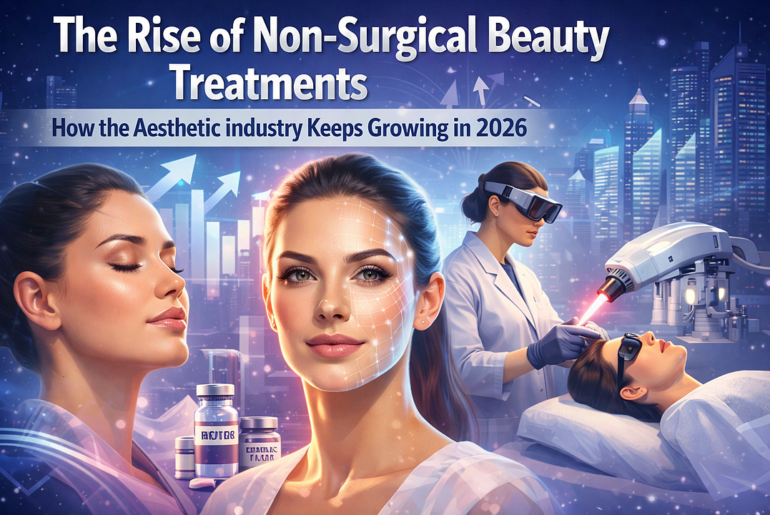
Clean beauty has moved beyond ingredient labels and into the treatment room. Here’s what it actually means, which minimally invasive procedures have solid science behind them, and how to figure out what makes sense for your skin.
How many hours have you spent reading beauty labels?
Be honest. You’re standing in the aisle, phone out, squinting at a 14-syllable ingredient you can’t pronounce, trying to figure out if it’s something you should actually be putting on your face. If this sounds familiar, you’re in excellent company. Nearly one in four beauty and personal care consumers find it difficult to trust new ingredients, driven by concerns surrounding ingredient safety, sourcing, production transparency, and product claims’ validity, according to Mintel. And that habit of healthy skepticism isn’t stopping at the drugstore shelf, either — it’s walking straight into the aesthetician’s office.
What clean beauty actually means (beyond the buzzword)
The clean beauty movement has been building momentum for years, but it’s easy to mistake it for a marketing label rather than a genuine philosophy. At its core, clean beauty is about ingredient transparency, clearer product labeling, and a more intentional approach to understanding what you’re putting on your skin — and why.
The market numbers reflect how seriously consumers have adopted that mindset. The global beauty industry has been growing at 7 percent annually from 2022 to 2024 — and a growing slice of that growth is being driven by people who want to understand what they’re buying. “Proven effectiveness and quality attributes are what drive purchase and replenishment within the total category,” Carson Kitzmiller, Principal Analyst, Beauty and Personal Care at Mintel, explained to Cosmetics Design. “Nearly eight in ten personal care users agree there should be stricter regulations around personal care product safety,” Kitzmiller added — a striking demand for accountability that signals something far bigger than a trend.
The impulse-booking era is cooling. Today’s beauty consumers plan their spending strategically: they may cut unnecessary purchases, but they will splurge on a product or treatment that claims long-term benefits, offers a personalized solution, and aligns with their values.
That deliberateness is showing up at the consultation level, too. Rather than walking into a spa and asking for whatever’s trending, more people are starting with a thoughtful one-on-one aesthetic evaluation — mapping their skin type, history, sensitivities, and goals before committing to anything. The clean beauty mindset, applied to aesthetic medicine, is really just an argument for doing your homework. Roughly 45 percent of luxury beauty shoppers surveyed in 2025 said they are influenced by medical professionals when choosing beauty products, up from 40 percent in 2024 — a sign that expert-backed efficacy is becoming its own form of prestige.
The treatments worth knowing about
The minimally invasive procedures gaining ground under the clean beauty umbrella tend to share a single thread: they work with the skin’s existing biology rather than overriding it. Here’s what the evidence says about the four most popular options.
Microneedling uses fine, sterilized needles to create controlled micro-injuries in the skin, triggering the body’s natural wound-healing response and, in turn, stimulating collagen and elastin production. It can improve texture, reduce the appearance of fine lines, and refine pores over a series of sessions — typically three to six. Its appeal within the clean beauty framework is intuitive: it borrows from the body’s own repair mechanisms rather than introducing foreign volume or aggressive resurfacing. Because the improvement is gradual and cumulative, it rewards patience over instant results.
IPL, or intense pulsed light therapy, takes a different approach, addressing sun damage, redness, and uneven skin tone using broad-spectrum light. Unlike lasers, IPL devices produce noncoherent, polychromatic light with a broad range of wavelengths, meaning they can treat a wide variety of lesions and skin types — and they’re associated with a shorter recovery time than laser alternatives. Most patients can return to normal activities, including work, on the same day — a practical advantage for anyone who doesn’t have days to hide from the world post-procedure.
Gentle chemical peels are the steady-progress option. Lighter formulations remove the outermost layer of dull or damaged cells to brighten the complexion and smooth texture, without the recovery demands of deeper resurfacing treatments. They suit people who prefer refinement over time rather than one dramatic intervention.
Red light therapy rounds out the group as the lowest-intensity entry point. Using specific wavelengths — typically around 630 to 660 nanometers — red light therapy has been shown to reverse collagen downregulation, with more than 90 percent of individuals in one split-face clinical study showing a reduction in rhytid depth and surface roughness after 12 LED treatments, with no adverse events or downtime reported. One of its biggest practical advantages is that it can safely be layered with other procedures — microneedling in particular — though timing matters. Applying red light immediately after microneedling, during the skin’s active inflammatory phase, can overstimulate; waiting several days allows the skin to reach the proliferative phase where light therapy can best support collagen remodeling.
How to choose what’s right for your skin
None of this is a one-size-fits-all situation. Minimally invasive does not mean risk-free, and even gentle treatments can affect people differently based on skin type, prior procedures, sensitivity, and overall skin health. A few principles help narrow the field.
Match the treatment to the actual concern — pigmentation, texture, laxity, and redness each require different approaches, and understanding your specific goal is the most useful first step. When in doubt, start at the lower end of intensity. Building results gradually over time tends to protect the skin barrier and reduce the likelihood of irritation. Factor in your realistic recovery window, too: even the lowest-downtime procedures involve some degree of redness, peeling, or sensitivity, and it’s worth planning around that rather than being caught off guard. Most importantly, consider your full skin history before booking anything — what you’ve done before, how your skin reacted, and what conditions or sensitivities may be at play.
“While there are differing mentalities around the subjective phrase of ‘proven efficacy,’ there is a baseline demand across all demographics that products purchased should be effective in addressing skin needs,” Kitzmiller noted. That baseline demand — for honesty, for evidence, for treatments that actually make sense for the individual — is the most useful definition of clean beauty there is.
Related on Ethos: