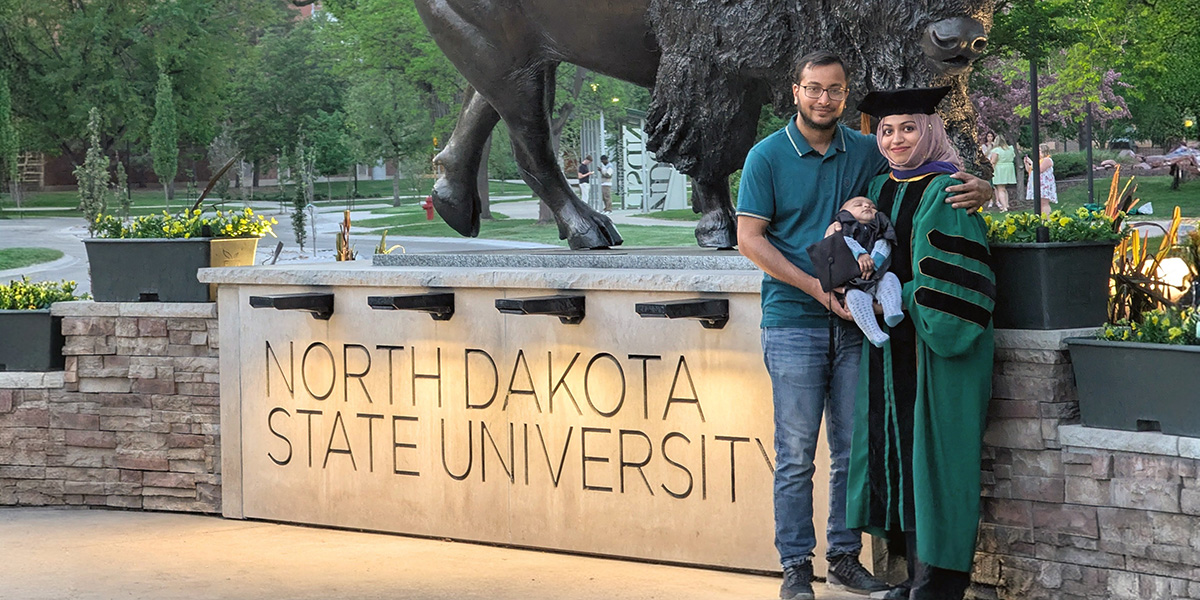
Kazi Sarjana Safain’s late mother never had the chance to study science, but she passed her dreams on to her daughter.
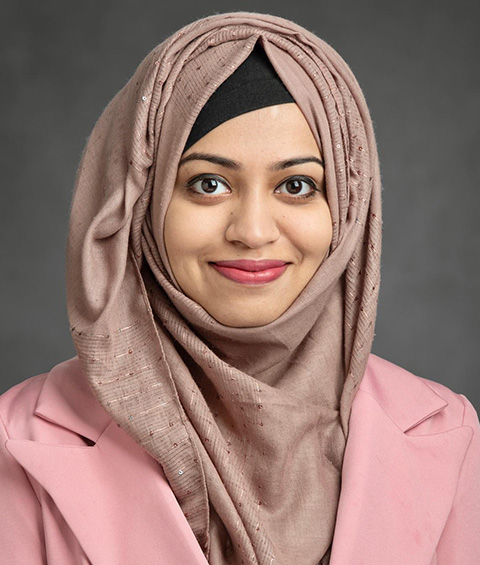
Kazi Sarjana Safain
“My mother’s encouragement shaped my path to science, and she passed her dream onto me,” Safain said. “Her life has motivated me to utilize all the chances I have gotten until now.”
That encouragement carried Safain from Bangladesh to a career at the forefront of nutritional research. She recently completed her Ph.D. in cell and molecular biology at North Dakota State University, where she studied how maternal nutrition shapes livestock development and health outcomes.
Now, as she begins a postdoctoral fellowship at the University of Minnesota’s Hormel Institute, she is shifting her research toward nutrition’s role in human metabolic disorders.
“What motivates me the most is that the work I do does not just answer the scientific questions,” she said. “It has the potential to improve health, food security, and quality of life.”
Leaping across continents
Safain’s path to this research began in Bangladesh, where she developed an early fascination with science and its potential to save lives. She earned a bachelor’s degree in microbiology and a master’s degree in biotechnology from BRAC University in Dhaka. That sustained curiosity motivated her to pursue a Ph.D., where she looked beyond her home country for next steps.
“I decided to come to a well-developed country like the U.S. to further develop my career path,” Safain said. She chose NDSU because of its research-focused, or R1, status and strong life sciences programs.
When Safain moved to the U.S., the transition was not easy. She arrived in the fall of 2021, leaving behind everything familiar during a global pandemic.
“This was a lot of change. Bangladesh is a tropical country, so the winters there were like summers here (North Dakota),” Safain said.
Building a support village
Courtesy of Kazi Sarjana Safain
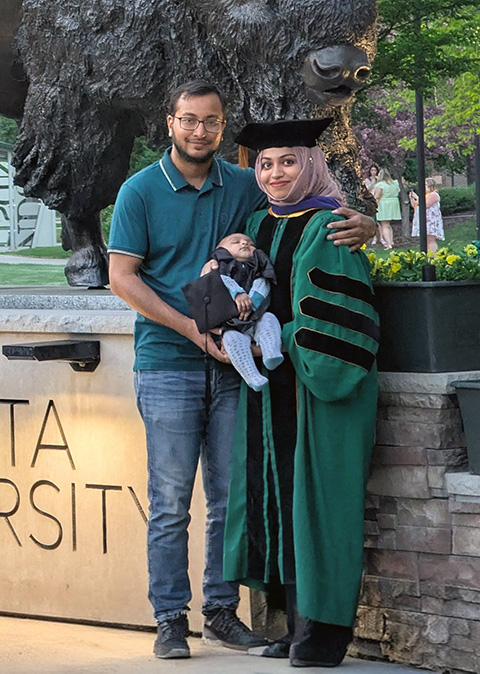
Kazi Sarjana Safain poses for a photo with her husband, Mohammad Al Mahmud Un Nabi, and son, Musahib Un Nabi, at the North Dakota State University Spring Commencement in 2025.
Despite the challenges, she was not alone. Her husband left his job to support her journey, eventually finding his own Ph.D. position at NDSU.
“It takes a village,” Safain said. “And my village was very supportive.”
Her village also included two Ph.D. advisors who provided crucial guidance, colleagues at the USDA, and her program coordinator and department head, who supported her through difficult times.
“They kept telling me to be a good person at first, then I can be a good scientist,” she said. “Small habits have shaped who I am — small habits meaning the discipline to be honest all the time and having good ethics.”
Her path was not without obstacles, both personally and scientifically.
“When I was trying to come (to the U.S.) from my country, I had to face hundreds of rejections,” she said. “Science is full of challenges, failed experiments, and long working hours, but every setback is a scope to learn and grow.”
Discovering nutrition
During her Ph.D., Safain investigated how maternal nutrition and supplementation influence fetal development and offspring health in cattle. She focused on one-carbon metabolites, such as folate and vitamin B-12, which supply methyl groups to DNA and help safeguard fetal growth and organ development when maternal diets are limited.
Along the way, Safain collaborated with scientists at the U.S. Department of Agriculture, or USDA, who introduced her to new data collection methods and strengthened her manuscript-writing skills while reinforcing how nutrition research translates to real-world applications.
She said that witnessing nutrition’s central role in health outcomes during the COVID-19 pandemic further underscored the real-world relevance of her work.
“COVID showed us how central nutrition affected disease outcomes,” she said. “It confirmed for me how meaningful this field is.”
The pandemic highlighted the importance of understanding how nutritional factors influence immune function and overall health, connections that her research continues to explore.
Turning to human health
Safain sees the transition from livestock research to human health as a natural progression.
She said that in the near term, she aims to build expertise in human nutrition and metabolism while strengthening the skills she has developed throughout her academic journey. Her long-term vision is to establish herself as a leader in industry or academia and build programs connecting nutrition, metabolism and developmental biology.
“I plan to create programs that could connect larger challenges in health and food security,” she said.
Gaining inspiration from historic women
Beyond the immediate health implications of her research, Safain commits herself to addressing broader global challenges.
“There are a lot of women who never get to fulfill their dreams, particularly in (developing) countries like Bangladesh,” she said. “When I think about those women, I get motivated to work and contribute to society as far as I can.”
Her scientific inspiration also comes from historical figures who broke barriers.
“I’m deeply motivated by the scientific career of Marie Curie, who was the first female Nobel Prize winner,” she said. “Her story reminds me that curiosity, resilience and dedication can break barriers and change the world.”
Safain’s commitment to breaking barriers in science extends to her involvement in scientific organizations. She’s active in the Association for Women in Science, participating in networking events and outreach activities aimed at advancing science careers for women. She also serves on the American Society for Biochemistry and Molecular Biology’s membership committee and was a student representative for the American Society for Nutrition.
Throughout her career, she hopes to encourage women in STEM and those from underrepresented groups, continuing the cycle of mentorship that has been crucial to her own success.
Paying it forward
Safain’s journey illustrates how scientific curiosity and determination can transcend geographical, disciplinary and cultural boundaries. She will continue exploring how nutrition shapes human health and development and carry forward both her scientific knowledge and commitment to supporting women in science throughout her lifetime.
When advising the upcoming generation of scientists, Safain emphasizes that collaboration is a big part of science and recommends persistence and kindness.
“Always stay curious and resilient — don’t let (challenging) moments discourage you,” she said. “Instead, use them as steppingstones.”