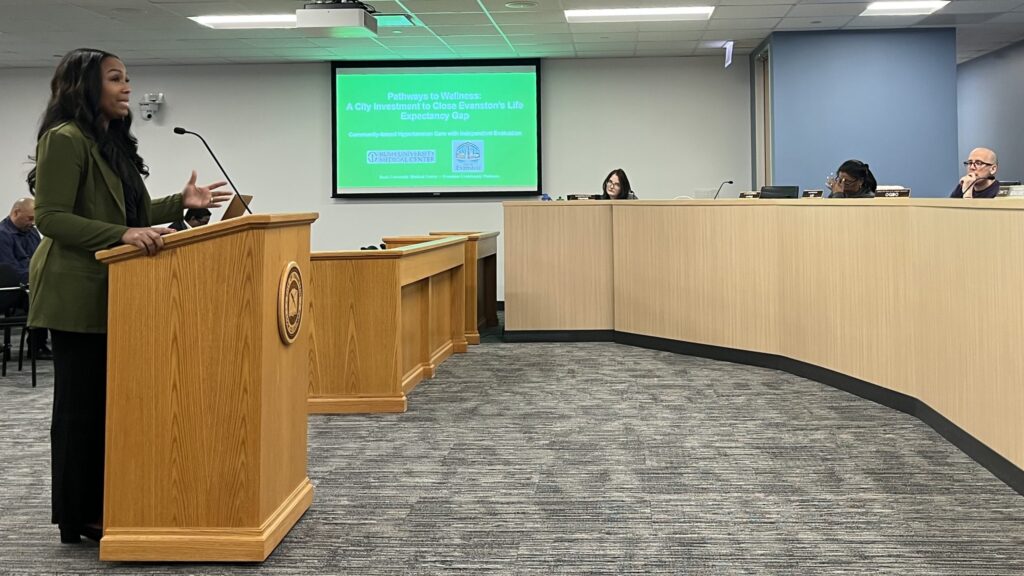
Despite budget concerns, Evanston’s Human Services Committee recommended approval of a $872,000 request to extend the city’s planned Pathways to Wellness program from a one-year pilot to a three-year initiative.
The program, first proposed in 2023, is aimed at “improving health outcomes for Evanston’s most vulnerable populations, specifically focusing on hypertension.”
The program stems from the city’s 2022 EPLAN, which shows a 13-year variation in life expectancy among Evanston neighborhoods. The lowest life expectancy was recorded in Census Tract 8092, in the western portion of the 5th Ward.
The program is described as a “three-year, two-phase hybrid effectiveness-implementation trial” to be conducted in two of Evanston’s highest need census tracts (8092 and 8102).
Dr. Elizabeth Lynch of Rush University Medical Center would lead the team of health professionals, alongside Neticia Blunt-Waldron of Evanston’s Whole Woman Fitness.
Lynch said the program, if approved by the City Council, would include three phases, first a community blood pressure screening to identify residents with undiagnosed hypertension, followed by a 12-week lifestyle program for residents with “uncontrolled blood pressure.”
Finally, participants who need additional care will be referred to community-based medicine management programs or referred to a primary care physician.
Lynch said the goal of the program will be to build a lasting model to create “long-term health equity.”
The program is designed to serve a total of 100 residents for its $1.22 million price tag, and roughly two thirds of the money would be spent on a research component designed to measure the program’s effectiveness.
The HSC, while hesitant about the program’s price tag, ultimately decided to forward it to the city’s Finance and Budget Committee for further consideration. The City Council would ultimately need to approve the program.
“It is a really expensive ask in a year when we’re going to have to make some really tough budgetary decisions,” Ald. Shawn Iles (3rd) said. “Before I vote at council, I want a better estimate of what it will look like to sustain it.”
Ald. Bobby Burns (5th) said he felt the program met two needs in the city that aren’t being offered by the current health department, and noted the time that had been put to craft the program.
Ald. Krissie Harris (2nd) was especially skeptical of the cost, saying she felt there were “aspects of this that can be done in-house, with our own health department.”
In September 2024, the City Council allocated $400,000 to the program through American Rescue Plan Act funds. A significant portion ($344,000) of the original funding remains available, the city said. The new request is for $871,674 from the city’s Water Fund.
“I think it’s extremely admirable that the request was made to do a rigorous evaluation,” Lynch said of the city’s original request for the program. “I think it’s extremely important … if you’re allocating funds, to make sure that the funding you’re allocating is actually going to have an impact.”
Related