Credit: Horticulture Research
Fire blight remains one of the most destructive bacterial diseases threatening global apple production, with limited long-term control options. A new study identifies a family of inducible lectin genes, MdAGGs, as critical components of apple immune defense and demonstrates that their precise activation timing is key to effective resistance. Using genome editing and inducible gene expression strategies, researchers show that disabling MdAGGs compromises chemically induced resistance, while pathogen-triggered expression of MdAGG10 significantly reduces disease severity. Rather than relying on constant gene overexpression, this work highlights the power of conditionally activated defense genes to enhance resistance while avoiding growth penalties, opening a new avenue for durable and sustainable crop protection.
Fire blight, caused by the bacterium Erwinia amylovora, devastates apple orchards worldwide and can rapidly destroy entire trees. Conventional control strategies rely on chemical treatments or resistance breeding, both of which face serious limitations. Resistance based on major genes or QTLs can be overcome as pathogens evolve, while constitutive activation of defense genes often impairs plant growth. Chemical resistance inducers such as acibenzolar-S-methyl (ASM) can enhance immunity, but the downstream genetic mechanisms remain poorly understood. Against this backdrop, there is a growing need to identify durable defense targets and regulatory strategies that strengthen plant immunity without compromising development, motivating deeper investigation into inducible defense genes and their functional roles.
In a study published (DOI: 10.1093/hr/uhaf262) in Horticulture Research on February 1, 2026, researchers from INRAE and Université d’Angers investigated how inducible lectin genes contribute to apple resistance against fire blight. By combining CRISPR/Cas9 genome editing with an intragenic, pathogen-responsive expression strategy, the team examined the functional role of MdAGG genes during infection. Their findings reveal that MdAGGs are essential for full immune activation and that targeted, infection-induced expression of MdAGG10 can substantially enhance resistance, particularly when combined with chemical elicitation.
To dissect the role of MdAGGs in apple immunity, the researchers first used CRISPR/Cas9 to knock down the entire MdAGG gene family. Apple lines lacking functional MdAGGs failed to develop effective resistance after ASM treatment, both in vitro and under greenhouse conditions, demonstrating that these genes are indispensable for induced defense responses. Molecular analyses confirmed that edited plants showed neither transcriptional activation nor protein accumulation of MdAGGs, correlating with increased disease severity.
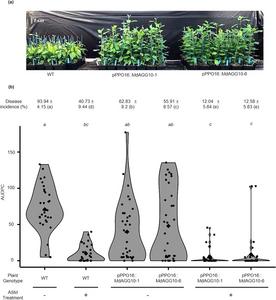
The team then tested whether restoring MdAGG activity in a controlled manner could improve resistance. Instead of constitutive expression—which previously caused growth defects—they linked MdAGG10 to the native, fire blight–inducible PPO16 promoter. This design ensured that MdAGG10 was activated rapidly and transiently upon bacterial infection. Apple lines carrying this inducible construct showed markedly reduced fire blight symptoms, with disease incidence and severity significantly lower than susceptible controls. When combined with ASM treatment, resistance was further enhanced, reducing disease symptoms by up to 90%. Importantly, inducible expression avoided the developmental penalties observed with constant overexpression, underscoring the importance of temporal regulation in plant defense engineering.
“This work shows that how and when a defense gene is expressed can be just as important as the gene itself,” said the study’s senior authors. “By activating MdAGG10 only during infection, we achieved strong protection without harming plant growth. This strategy shifts the focus from simply adding resistance genes to designing smarter regulatory systems that work with the plant’s own immune timing.”
The study introduces a promising framework for breeding durable disease resistance in perennial crops. By targeting downstream defense mechanisms that interact with conserved bacterial features, inducible strategies like pPPO16::MdAGG10 may be harder for pathogens to bypass. This approach aligns well with next-generation breeding technologies and could reduce reliance on antibiotics or intensive chemical controls. Beyond apple, the concept of pathogen-responsive expression of lectin-based defenses may be transferable to other crops facing bacterial threats. Together with environmentally friendly resistance inducers, such precision-engineered defenses could help build more resilient and sustainable agricultural systems.
###
References
DOI
Original Source URL
https://doi.org/10.1093/hr/uhaf262
Funding information
These researches were funded by the Agg-FREDI project (INRAE BAP Department 2020-2021) and the French Priority Research Programme “Cultiver et Protéger Autrement” (PPR-CPA) managed by the Agence Nationale de la Recherche (project ANR-20 PCPA-0003 CapZeroPhyto). A PhD grant was also awarded to A.B. by INRAE-BAP Department and the Pays-de-la-Loire Region.
About Horticulture Research
Horticulture Research is an open access journal of Nanjing Agricultural University and ranked number one in the Horticulture category of the Journal Citation Reports ™ from Clarivate, 2023. The journal is committed to publishing original research articles, reviews, perspectives, comments, correspondence articles and letters to the editor related to all major horticultural plants and disciplines, including biotechnology, breeding, cellular and molecular biology, evolution, genetics, inter-species interactions, physiology, and the origination and domestication of crops.
Journal
Horticulture Research
Subject of Research
Not applicable
Article Title
Inducible MdAGG lectins in apple immunity toward fire blight: CRISPR/Cas9 validation and their potential for intragenesis approaches
Article Publication Date
3-Oct-2025
COI Statement
The authors declare that they have no competing interests.
Disclaimer: AAAS and EurekAlert! are not responsible for the accuracy of news releases posted to EurekAlert! by contributing institutions or for the use of any information through the EurekAlert system.