Robert Bergman’s Portraits in the Hill Collection
Hill Art Foundation
January 15–April 11, 2026
New York
“Seeing comes before words,” writes art critic John Berger, and it’s a steadying thought, a mantra to whisper when the temptation to name and dissect and reason encroaches on the need to quiet down and just look. I think of Berger’s words as I encounter, for the first time, the mysterious sincerity of Robert Bergman’s photographs. An abundance of these works are featured in The Lost Beauty of Humankind: Robert Bergman’s Portraits in the Hill Collection, an exhibition impeccably curated by writer and art critic David Levi Strauss at the Hill Art Foundation.
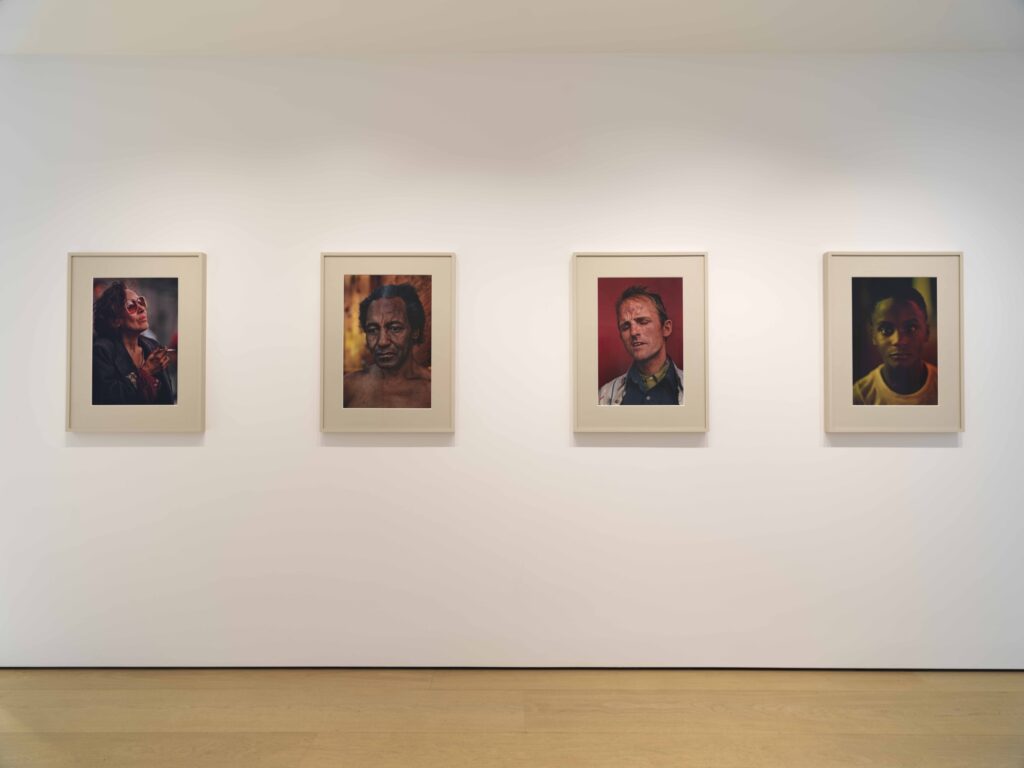
Bergman made portraits of people he met on city streets across America from 1985 to 1993, usually framing only their heads and shoulders and leaving little, if any, recognizable information in the background. The photographs are uniform in size at 30 ½ by 22 ¼ inches and none of them are titled—no names, no places, no words to shortcut a way into deciphering them. There is only the image of a person, equal to all of the others yet singular in what it contains: an elderly woman with sunken cheeks and wide, brown eyes who gazes into Bergman’s lens, golden light spilling onto her silver hair; a bearded man whose shirt falls away from his throat, chin lifted, eyes shut in rapture; an old, blind man in a tidy red cardigan and dark green shirt buttoned to the top; a woman in a brown coat who clutches a bag of groceries to her chest, the plastic wrapper of a loaf of bread picking up the red, white, and blue of the American flag printed on the scarf that encircles her face.
Strauss has selected forty-two of Bergman’s enigmatic images with great care, arranging them throughout the jewel-box galleries of the Hill Foundation in rows that juxtapose the photographs with objects from the Foundation’s collection. Ignoring timelines, schools, or mediums, Strauss places Bergman’s anonymous subjects alongside ecclesiastical objects depicting bible scenes, painted portraits of nobles, and touchstone images of American consciousness. The result is an exhibition that houses the profane with the sacred, the common with the noble—a choice that eradicates social and art historical hierarchies and instead favors the aching beauty of the human condition that is at once present in the subject and awakened in the viewer.
The details of Bergman’s collaborations with his subjects remain unknown, but an untitled photograph taken in 1990 featuring the full figure of a man in tattered clothing, arms extended out and up, belted pants falling below his belly, becomes an uncanny mirror when positioned next to the crucified Christ in Paolo Uccello’s painting The Crucifixion (ca. 1423), in which Jesus, the man, hangs from a cross set against a gold background while angels hover and mourners (likely his mother and John, the disciple whom Jesus loved) stand below. Bergman’s photo also echoes Cristo Morto (cast ca. 1590–1650) by Antonio Susini, a small, gilt bronze sculpture of Christ’s body, which floats alone against the gallery wall—no cross, no attendants. The goateed man in a black leather hat and trench who frowns at me in a 1993 photograph by Bergman commands my attention as powerfully as the figure in the adjacent painting, Portrait of a Gentleman, Half-length, Wearing Black (ca. 1628–29) by Peter Paul Rubens. When X-rayed, the Rubens revealed itself to be painted over a Velazquez portrait of a king or noble, and it is speculated that the man in Ruben’s portrait is Velazquez himself (the two artists may have shared a studio), no less worthy a subject than the patron his likeness eclipses.