Key Takeaways:
Amenities such as gyms, lounges, and hotels have become highly competitive entry points.True success comes from embedding products into real wellness rituals, not just sampling.These spaces are delivering mass exposure, while enabling deeper brand narratives.
Long before beauty brands began popping up in gym locker rooms and airport lounges, the amenities channel was already doing serious business behind the scenes. Hotels, airlines, restaurants, and private clubs have relied on third-party suppliers to stock everything from shampoo and body wash to hand soap and candles for decades. What has changed is not the existence of the channel, but its stakes, visibility, and competitiveness.
Today, amenities are no longer functional afterthoughts. They have become very strategic brand battlegrounds where signals of luxury, cultural relevance, and revenue generation intersect. And as beauty brands increasingly compete for placement in gyms, restaurants, boutiques, and premium travel environments, the channel has evolved from quiet distribution into a sophisticated marketing and licensing ecosystem.
Industry analysts estimate that the global hotel and leisure amenities market alone is valued in the billions, with gyms, spas, and lounges adding incremental growth as wellness spending continues to expand. According to the Global Wellness Institute, the wellness economy will grow at an impressive 8.6% annual pace through 2027, when the market will reach $8.5 trillion, nearly double its 2020 size.
How the Amenities Channel Works
At its core, the amenities business is not about free sampling. It is a B2B supply model, often structured as a licensed or royalty-based arrangement, in which beauty brands sell products, typically at lower margins, to hospitality, fitness, or travel partners at scale. “This is all about brand exposure and what I call ‘tryvertising,” said John Hunter, founder of Hunter Amenities, to BeautyMatter. “Free sampling where you actually make a royalty stream.”
Hunter, whose company supplies personal care products across hospitality and fitness globally, underscored the scale at play. “A hotel chain with 300 properties and 30,000 rooms can provide customer facings of over 7.5 million per year,” he said.
For hotels, amenities are usually sourced through licensed agreements or white-label partnerships, often managed by intermediaries like Hunter Amenities. Brands earn revenue through product supply and licensing fees, while hotels benefit from brand association and consistency across properties. Airlines may operate differently, cycling through brands on fixed-term contracts and tiering product quality depending on cabin class, with first-class and lounge amenities vastly different from onboard bathrooms.
While gyms and lounges may feel like a recent frontier, the amenities strategy has been evolving for years. Brands such as Aesop and Molton Brown were early to expand beyond hotels, placing hand wash and lotions in the bathrooms of high-end restaurants, private clubs, and cultural institutions. That shift reframed amenities from utility to signal. Being the soap in the restroom of a buzzy restaurant or concept store became a quiet endorsement and a way to embed a brand into tastemaker culture without overt advertising.
Indie brands, in particular, have leveraged this strategy effectively. The same has played out, although at a smaller scale, with candles and fragrance, where placement often fuels organic social content and “if you know, you know” discovery. These environments create a win–win: venues elevate their guest experience, while brands gain exposure to a highly curated audience.
Matthew Malin, co-founder of Malin + Goetz described this succinctly. “Two main ideas stand out. First, there is a clear opportunity for brand exposure, storytelling, and authority around culture, lifestyle, and market position,” he said to BeautyMatter. “This carries a lot of weight with a first-time client, and if a client already knows the brand and then sees it in a nice hotel, a favorite gym, or the restroom of a great restaurant, it only strengthens the brand and its position.”
For a smaller brand, the economics can be strategic rather than opportunistic. “As a small brand with limited resources, having this level of exposure was and is key—again, being where our customer is,” Malin said.
From Hotels to Gyms: Expanding the Strategy
What differentiates today’s amenities landscape is its breadth. Brands no longer choose between hotels or nothing; they are now building layered strategies across hospitality, fitness, restaurants, and travel.
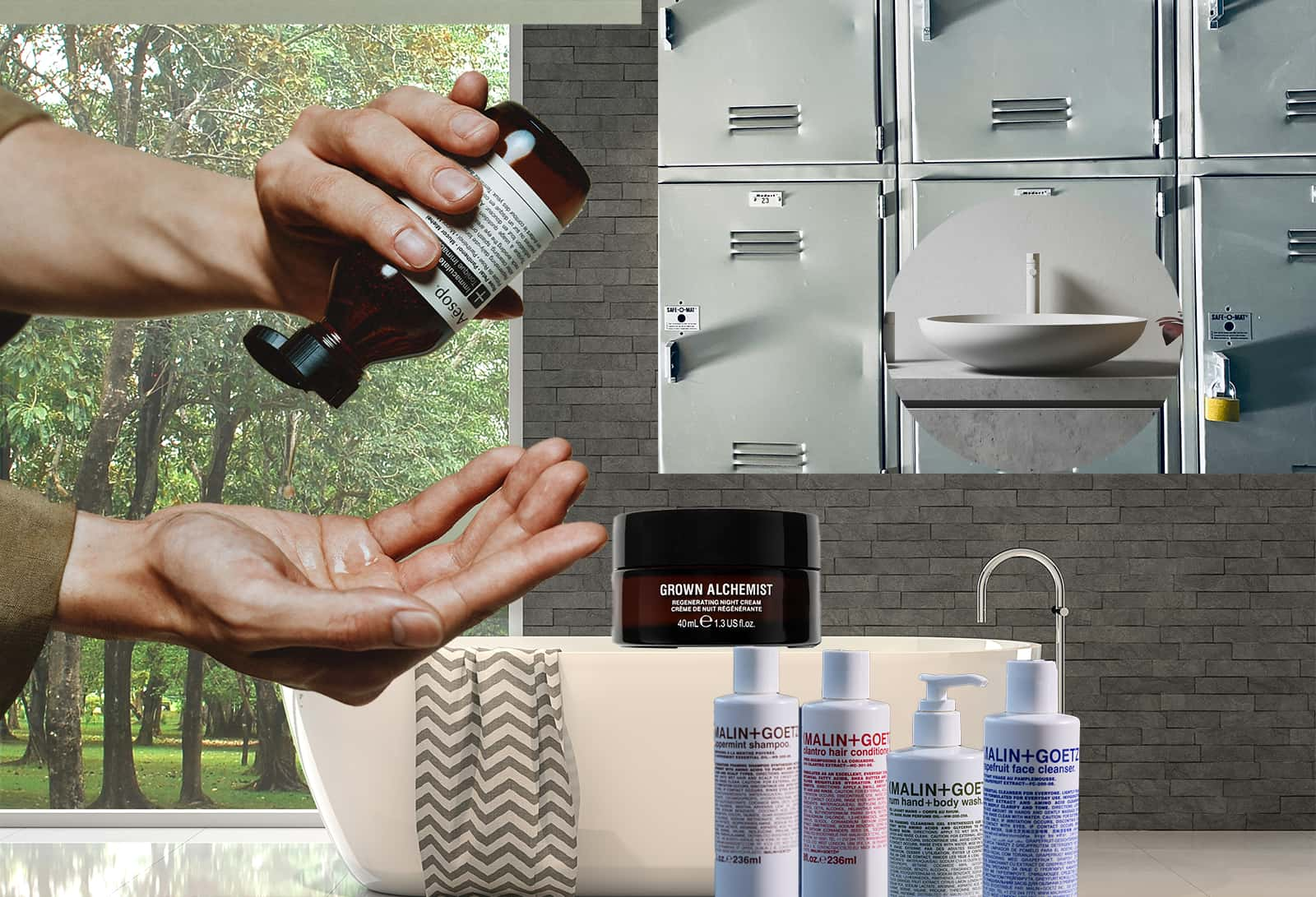
Popular brand Kiehl’s was in this channel for well over a decade with Equinox before the buzzy luxury fitness club replaced Kiehl’s with trendy Grown Alchemist in 2024, which caused major headlines. Kiehl’s latest partnership with Life Time Fitness is a reflection of its expanded thinking. “When we looked at where Kiehl’s shows up most authentically in people’s lives, wellness was a clear space for us to lean back into,” said Guillaume Monsel, Head of Marketing at Kiehl’s US, to BeautyMatter.
“Life Time offered us an opportunity to create a partnership that wasn’t simply about locker room visibility. This partnership allows the brand to be present in a moment where people are already in a self-care mindset,” he continued.
Gyms provide a high-frequency, ritualized environment, one where product performance is tested immediately and repeatedly. “Members encounter Kiehl’s at a moment when self-care is already top of mind,” Monsel said. “The timing matters, and that context makes the interaction both more memorable and more meaningful.”
One of the channel’s most powerful attributes is psychological. Consumers encounter products in these spaces while living, not shopping, according to Malin. “They are not defensive about being solicited or looking to make a transaction; their mindset is relaxed, different,” he said. The absence of sales pressure lowers resistance. Trial becomes personal discovery. “Customers also have an opportunity to experience your products in a very meaningful way,” Malin added. “Showing up at their gym or spa is a natural opportunity for them to ‘try’ the products. It is not forced or solicited and lends itself to the customer’s personal discovery.”
For Grown Alchemist, amenities partnerships are as much about cultural adjacency as they are about scale. The brand’s placements with Equinox and Delta Airlines are designed to reach what CEO Anna Teal called the “urban adventurer”—consumers deeply embedded in fitness, travel, music, and city life.
“Partnerships with brands that are adjacent and [that] work in those spaces offer Grown Alchemist a really authentic opportunity to introduce and seed our brand with that community in a way that isn’t a hard sell,” Teal said to BeautyMatter. “We’re authentically seeding our brand into that consumer’s life.”
Crucially, Grown Alchemist uses data to validate those adjacencies. “We’ve mapped that consumer into passion point areas—fitness, music, travel,” she explained. “That enables us to look at brand adjacencies, where there’s mutual crossover.” This cultural alignment is increasingly what separates winning amenities partnerships from commoditized placement.
The Economics and the Competition
As competition intensifies, brands are investing more deeply in format and functionality. “Great design solves problems, and a user’s experience is just as important as the product,” Malin said. For fitness partnerships, Malin + Goetz developed custom wall-mounted dispensers. “They make sense ergonomically, [as] they can be operated with one hand, applying pressure to the pump using only your palm, but also have a modern, almost utilitarian aesthetic that fits the locker room environment,” he explained.
As more brands chase premium amenities placement, competition has intensified. Space is finite, and not every brand fits every environment. “Being selective as to which brands will be accepted and in what type of hospitality environment is key,” Hunter said. “A younger SKU’d brand would not fit well in an older, more mature hotel brand.”
Costs can also be substantial. While margins are thinner than DTC or prestige retail, brands must account for production scale, customization, logistics, and licensing fees. For many, the value lies in a hybrid return: revenue plus long-term brand equity. Airlines, meanwhile, operate on rotation cycles, often refreshing amenities every few years, and segmenting aggressively by cabin class. First-class lounges and bathrooms offer premium real estate, while economy placements are more transactional.
The amenities channel, once a quiet, operational category, has become a strategic growth lever for many brands. Amenities now sit at the intersection of branding, distribution, and culture, offering reach at scale, credibility through association, and access to consumers in moments of heightened receptivity.
The result is a channel that is no longer experimental but essential, and increasingly competitive. For beauty brands navigating saturation in traditional retail and rising digital acquisition costs, amenities represent something rare: visibility without noise, and growth without shouting.