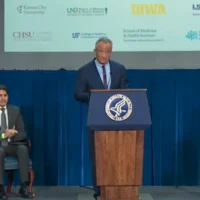
WASHINGTON — Dozens of U.S. medical schools will incorporate nutrition education into their curriculums starting this fall, the departments of Health and Human Services and Education announced Thursday.
As part of a voluntary system to increase nutrition training for future doctors, the schools will provide at least 40 hours of nutrition education or a competency equivalent.
What You Need To Know
Dozens of U.S. medical schools will incorporate nutrition education into their curriculums starting this fall, the Departments of Health and Human Services and Education announced Thursday
53 medical schools have agreed to provide at least 40 hours of nutrition education or a competency equivalent starting this fall
“More than 30,000 physicians will graduate equipped with nutrition education to help prevent, treat and reverse chronic disease,” Health Secretary Robert F. Kennedy Jr. said at an event with Education Secretary Linda McMahon, American Medical Assn. President Dr. Bobby Mukkamala and leaders of the Food and Drug Administration, National Institutes of Health and Centers for Medicare & Medicaid Services
A 2022 survey of med students in the Journal of Wellness reported they received an average of 1.2 hours of formal nutrition education annually
“More than 30,000 physicians will graduate equipped with nutrition education to help prevent, treat and reverse chronic disease,” Health Secretary Robert F. Kennedy Jr. said at an event with Education Secretary Linda McMahon, American Medical Association President Dr. Bobby Mukkamala and leaders of the Food and Drug Administration, National Institutes of Health, and Centers for Medicare & Medicaid Services.
“This is how we implement the MAHA agenda,” Kennedy said of the Make America Healthy Again movement he launched in 2024. “This is how we make America healthy again.”
Nutrition has been a key focus of Kennedy’s agenda since becoming the Trump administration’s health secretary last year. He frequently connects Americans’ diets with the country’s chronic disease epidemic.
“Today we spend $4.5 trillion a year on health care, and 90% of it goes to managing chronic disease. Nutrition is often at its core,” Kennedy said, adding that 6 in 10 American adults live with at least one chronic disease and 4 in 10 teenagers are either prediabetic or diabetic. “When I was growing up, doctors rarely saw any of these conditions.”
Kennedy, 72, said HHS worked with the American Medical Association, the Association of American Medical Colleges and other groups to develop the 40-hour nutrition curriculum standard he described as a “template” to be implemented as individual schools see fit.
“We respect the independence of medical schools and accrediting bodies, and the Department of Education will never mandate curriculum. That’s not our job,” McMahon said. “But we can and will spotlight promising evidence-based models.”
McMahon said Thursday that most U.S. medical schools include about two hours of mandatory nutrition education in their curriculums. A 2022 survey of med students in the Journal of Wellness reported they received an average of 1.2 hours of formal nutrition education annually.
“This isn’t a minor training issue,” McMahon said. “It’s an institutional barrier to better health care outcomes and today we have the power to fix that.”
HHS said about 75% of U.S. medical schools and 86% of residency programs do not require clinical nutrition classes.
“For too long, nutrition has been treated as an elective in medical education,” Mukkamala said. “Considering how important what we eat is for our health, it should be a basic foundational training because it impacts every one of our patients.”
He said improving Americans’ health shouldn’t only rely on breakthrough drugs and new technologies, physicians need tools to help their patients prevent developing disease.
“The science is pretty darn straightforward: Poor diet, highly processed foods that are high in sodium and added sugar is one of the drivers of chronic disease, diabetes, heart disease, obesity and even some cancers, yet many physicians receive very little formal training on nutrition,” Mukkamala said. “That’s not because doctors aren’t interested. It’s because these priorities in medical education need updating. The good news is the change is here.”
As part of Thursday’s announcement, Kennedy said his department will provide $5 million to the National Institutes of Health for a nutrition education challenge designed to help medical schools, nursing residencies and dietician programs integrate nutrition education into their programs. The funding will be used to develop courses and research projects that focus on nutrition science.
Florida State University College of Medicine, New York University Grossman School of Medicine, Purdue University, Tufts University School of Medicine, Tulane University School of Medicine, the University of California Irvine and the University of Nebraska are among the 53 schools in 31 states that are participating.
“Today marks a historic time that the importance of lifestyle decisions that relate to nutrition, exercise, tobacco, alcohol, sleep and so many others will be surfaced and focused on,” University of Nebraska President Dr. Jeffrey Gold said. “Today, we are addressing an important component of that, which is how and what medical students learn.”