 Heat stable probiotics refer to probiotic microorganisms that maintain viability and functional activity during exposure to high temperature processing such as extrusion, baking, pasteurization, spray drying, and pelleting.
The category includes technologies such as spore-forming probiotic strains, microencapsulated lactic acid bacteria, yeast-derived probiotic components, and synbiotic formulations designed to withstand harsh manufacturing environments.
These solutions enable probiotics to be integrated into a wider range of applications including functional foods, dietary supplements, animal feed premixes, bakery products, beverages, and pharmaceutical formulations.
Growing consumer awareness of gut health, immunity, and microbiome science has accelerated the adoption of probiotic ingredients globally, with heat-stable formats becoming critical for industrial processing compatibility.
Global Industry Overview
Global Market Size (2025): USD 3,414 million
Global Market Size (2032): USD 7,937 million
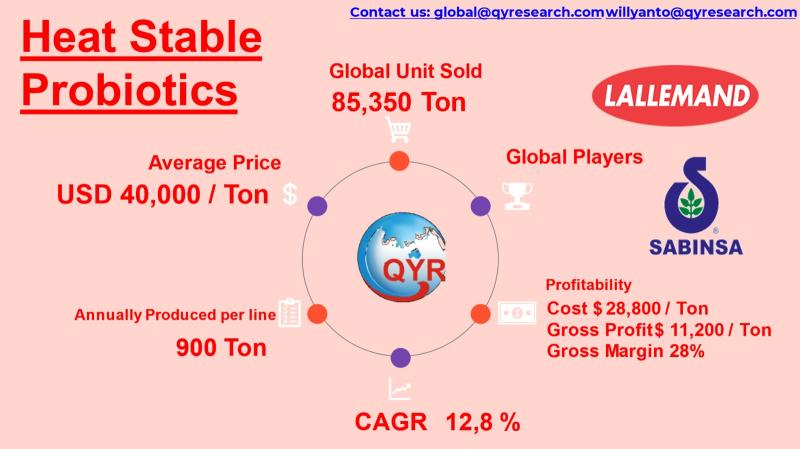
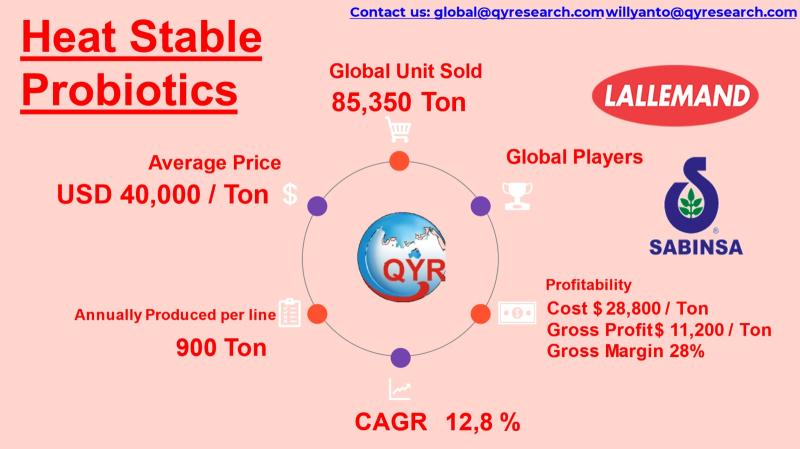
Projected CAGR (2025 to 2032): 12.8%
Average Global Price USD 40,000 per ton
Estimated Global Volume 85,350 tons
Manufacturing Cost Structure
Raw materials (culture media, nutrients, carriers): 34%
Fermentation operations: 16%
Microencapsulation / stabilization technology: 14%
Spray drying / freeze drying: 12%
Packaging & cold chain stabilization: 8%
Quality testing & regulatory compliance: 6%
Utilities and energy: 5%
Labor: 5%
Average Cost of Goods Sold USD 28,800 per ton
Factory Gross Profit USD 11,200 per ton
Factory Gross Margin 28%
Typical Production Capacity Fermentation line capacity:900 tons per year
Downstream Industry Demand
Functional foods and beverages: 34%
Dietary supplements and nutraceutical capsules: 27%
Animal feed additives: 18%
Infant nutrition and dairy: 9%
Pharmaceutical microbiome formulations: 7%
Cosmetics and personal care microbiome products: 5%
Latest Trends and Technological Developments
January 2025: Several probiotic manufacturers introduced spore-forming Bacillus probiotic strains capable of surviving temperatures exceeding 120°C during feed extrusion.
March 2025: Microencapsulation technologies using lipid-polymer matrix systems gained traction to improve probiotic survival in baked goods and powdered beverage mixes.
June 2025: Food ingredient suppliers expanded synbiotic heat-stable formulations combining probiotics with prebiotic fibers to enhance gut microbiome colonization efficiency.
September 2024: Advancements in spray freeze drying improved probiotic survival rates during high-temperature processing, increasing CFU retention by over 30% compared to conventional spray drying.
October 2024: The feed industry adopted thermostable probiotic strains for aquaculture feed, particularly for shrimp and fish feed extrusion lines operating above 90°C.
Key Emerging Technologies
Double-layer microencapsulation
Spore-based probiotics
Controlled release probiotic beads
Microbiome-targeted synbiotic formulations
Precision fermentation for probiotic production
Asia Regional Insights
Asia represents over 42% of global demand for heat stable probiotics.
Key drivers:
Expanding functional food sector
Large livestock and aquaculture industries
Growing consumer awareness of gut health
China
Largest production base for probiotic fermentation globally.
Domestic probiotic ingredient output exceeds 20,000 tons annually.
Japan
Mature probiotic market driven by fermented foods and functional beverages.
Strong R&D in microencapsulation technologies.
South Korea
High penetration of probiotic dietary supplements and microbiome skincare products.
India
Rapid growth in probiotic functional foods and nutraceutical capsules.
Get Full PDF Sample Copy of Report: (Including Full TOC, List of Tables & Figures, Chart)
https://www.qyresearch.com/sample/6003416
Heat Stable Probiotics by Type:
Spore Forming
Microencapsulated Lactic Acid Bacteria
Yeast Derivatives
Synbiotic Blends
Others
Heat Stable Probiotics by Product Category:
Heat Resistance
Acid Resistant
Long Shelf Life
Microencapsulation Technology
Others
Heat Stable Probiotics by Market Segment:
Feed Pelleting
Baking
Capsules and Tablets
Beverage UHT Blending
Others
Heat Stable Probiotics by Features:
Non GMO Certified
Organic Certified
Synbiotic Formulations
Multi Functional Probiotic Blends
Others
Heat Stable Probiotics by Shape:
Powder Probiotics
Capsules Probiotics
Tablet Probiotics
Liquid Suspension
Others
Heat Stable Probiotics by Application:
Food and Beverage
Dietary Supplements
Clinical Nutrition
Animal Feed
Others
Global Top 30 Key Companies in the Heat Stable Probiotics Market
Ganeden Biotech (Ohio, US)
Sabinsa Corporation (New Jersey. US)
Lallemand Health Solutions (Montreal, Canada)
Chr. Hansen Holding A/S (Hørsholm, Denmark)
Morinaga Milk Industry Co. Ltd (Tokyo. Japan)
Kerry Group plc (Kerry. Ireland)
Ingredion Incorporated (Illinois, US)
BASF SE (Ludwigshafen, Germany)
Unique Biotech Limited (Telangana, India)
Probi AB (Lund, Sweden)
ADM(Archer Daniels Midland) (Illinois. US)
Cell Biotech (Gyeonggi-do. South Korea)
Evonik Industries (Essen, Germany)
Novozymes A/S (Bagsværd, Denmark)
BioGaia AB (Stockholm, Sweden)
Angel Yeast Co., Ltd. (Hubei. China)
Mitsubishi Chemical Foods (Tokyo. Japan)
Wecare Probiotics Jiangsu, China
Fengchen Group (Qingdao, China)
Danisco (New York, USA)
DSM-Firmenich (Heerlen, Netherlands)
Bio-Care (Selangor. Malaysia)
DuPont Nutrition & Biosciences (New York. US)
Biofarma Group (Mereto di Tomba. Italy)
Probiotical S.p.A. (Novara. Italy)
Winclove Probiotics (Amsterdam. Netherlands)
Biena (Boucherville. Canada)
Synbalance (Lombardy. Italy)
Blis Technologies (Otago. New Zealand)
Sacco System (Lombardy. Italy)
Regional Insights
ASEAN accounts for approximately 1215% of global probiotic ingredient consumption.
Indonesia
One of the fastest-growing markets in Southeast Asia.
Growth driven by:
Functional beverage industry
Dairy alternatives
Expanding nutraceutical sector
Strong demand in animal feed probiotics for poultry and aquaculture.
Thailand
Large feed probiotic market due to livestock exports.
Vietnam
Growing aquaculture industry utilizing thermostable probiotics for shrimp farming.
Malaysia
Demand mainly from health supplement brands.
Singapore
Hub for biotech R&D and probiotic innovation.
Industry Challenges
High Production Costs
Fermentation, stabilization, and encapsulation technologies require specialized equipment and strict microbial control systems, increasing capital investment.
Solution: adoption of continuous fermentation systems and AI-assisted fermentation monitoring can improve yield and reduce production costs.
Probiotic Viability During Processing
Heat exposure during food processing can reduce bacterial viability significantly.
Solution: advanced multi-layer encapsulation technologies and spore-based probiotic strains can improve survival rates during high temperature processing.
Regulatory Complexity
Different countries maintain varying regulations regarding probiotic claims and strain approval.
Solution: companies should develop region-specific strain dossiers and pursue international clinical validation studies to streamline regulatory approvals.
Market Education
Many food manufacturers are still unfamiliar with incorporating probiotics into high-temperature production processes.
Solution: ingredient suppliers can offer application laboratories and technical support programs to help manufacturers integrate probiotic ingredients effectively.
Strategic Insights
Companies are investing heavily in microbiome research and strain development.
Vertical integration of fermentation, stabilization, and formulation capabilities is becoming a competitive advantage.
Partnerships between food ingredient suppliers and nutraceutical brands are accelerating product innovation.
Expansion into animal feed probiotics offers strong growth potential due to global livestock production.
Product Models
Heat-stable probiotics refer to probiotic microorganisms or derived ingredients engineered or naturally capable of maintaining viability and biological functionality after exposure to heat processing or long-term storage, enabling their use in functional foods, supplements, beverages, and pharmaceutical formulations.
Spore-forming probiotics are beneficial bacteria, primarily Bacillus species, that protect themselves by forming a dormant, hardened, endospore shell. Notable products include:
GanedenBC30® Kerry Group (Ganeden Biotech) High segment USD $90 to 150/kg ingredient equivalent: A patented Bacillus coagulans strain with strong heat resistance used in baked goods, beverages, and sports nutrition products; widely used by functional food brands.
LactoSpore® Sabinsa Corporation High segment USD $80 to 140/kg: Clinically studied Bacillus coagulans MTCC 5856 probiotic designed for supplements, capsules, and fortified functional foods; customers include nutraceutical brands.
ProbioSpore Lallemand Health Solutions High segment USD $90 to 160/kg: Spore-forming probiotic ingredient used in clinical nutrition and immune health supplements.
DE111® Bacillus subtilis ADM (Archer Daniels Midland) High segment USD $85 to 150/kg: Heat-stable probiotic strain commonly used in protein powders, bars, and shelf-stable drinks.
ProDURA® Bacillus coagulans Unique Biotech Limited Middle segment USD $60 to 110/kg: Widely used in digestive health supplements and cost-efficient probiotic blends for private-label brands.
Microencapsulated Lactic Acid Bacteria (LAB) probiotics are live microorganisms, typically from genera like Lactobacillus and Bifidobacterium, entrapped within protective coating materials (hydrocolloids) to form tiny capsules or microspheres. Notable products include:
Probio-Tec® Encapsulation Series Chr. Hansen Holding A/S High segment USD $110 to 190/kg: Advanced encapsulation technology used in dairy alternatives and supplement capsules.
Morinaga Bifidobacteria Encapsulated Powder Morinaga Milk Industry Co. Ltd High segment USD $120 to 210/kg: Microencapsulated Bifidobacterium strains widely used in infant nutrition and functional dairy.
Probi Digestis Encapsulated Probi AB High segment USD $100 to 170/kg: Clinically supported probiotic used in digestive health supplements.
Sabinsa Encapsulated Probiotic Complex Sabinsa Middle segment USD $80 to 140/kg: Encapsulation technology designed for shelf-stable probiotic tablets.
Unique IS-2 Encapsulated Blend Unique Biotech Limited Middle segment USD $70 to 130/kg: Heat-protected probiotic formulation for supplement manufacturers.
Yeast derivative probiotics refer to beneficial, non-pathogenic yeast microorganisms that are administered in adequate amounts to confer health benefits to the host, particularly in improving gastrointestinal health and modulating immune function. Notable products include:
Lynside® Pro Yeast Probiotic Lallemand Health Solutions High segment USD $90 to 160/kg: Saccharomyces boulardii probiotic used in clinical digestive health products.
EpiCor® Fermented Yeast Ingredient ADM High segment USD $100 to 170/kg: Fermented yeast metabolite used in immune health supplements and functional beverages.
Unique Biotech Yeast Probiotic Powder Unique Biotech Middle segment USD $60 to 110/kg: Yeast-based probiotic for dietary supplements.
Diamond V Original XPC – Diamond V (Cargill): (Middle Segment) $70 $110 per 25kg bag. Popular among hobbyist farmers and mid-sized livestock operations, this is a postbiotic yeast fermentate that provides metabolites to support the immune system and overall metabolic health.
Actisaf Sc 47 HR+ – Phileo by Lesaffre: (High Segment) $200 $280 per 25kg bag. A “Heat Resistant” granulated live yeast used by premium feed manufacturers to ensure the probiotic survives steam-conditioning and pelleting temperatures up to 92°C.
Synbiotic blends are functional products that combine probiotics (live beneficial microorganisms) and prebiotics (non-digestible food substrates, such as fiber) into a single formulation. Notable products include
GanedenBC30 Synbiotic Blend Kerry Group / Ganeden High segment USD $120200/kg: Combines spore probiotic with prebiotic fiber for digestive and immune health products.
HOWARU Synbiotic System BASF SE High segment USD $120 to 210/kg: Encapsulated probiotic combined with prebiotic substrates for supplements and functional foods.
Morinaga Synbiotic Bifido Complex Morinaga Milk Industry High segment USD $130 to 220/kg: Designed for infant formula and medical nutrition.
Probi Synbiotic Digestive Formula Probi AB High segment USD $100 to 190/kg: Clinically tested probiotic-prebiotic formulation.
Sabinsa Synbiotic LactoSpore Blend Sabinsa Middle segment USD $90 to 150/kg: Combines Bacillus coagulans with prebiotic fibers for capsules and sachets.
Investor Takeaways
Heat stable probiotics represent one of the fastest growing segments of the probiotic ingredient market.
Demand is expanding beyond supplements into functional foods, bakery, and animal feed applications.
Asia and Southeast Asia represent high-growth markets due to population size and rising health awareness.
Technology leadership in microencapsulation and spore-forming strains is becoming a key competitive differentiator.
Companies with integrated fermentation and stabilization technologies are expected to achieve higher margins.
Investor Analysis
The heat stable probiotics industry presents a strong growth opportunity due to its ability to unlock probiotic applications in high-temperature manufacturing processes. Investors can benefit from companies developing advanced stabilization technologies, proprietary probiotic strains, and microbiome-targeted formulations. Rapid growth in Asia and Southeast Asia further strengthens the market outlook, particularly in functional foods, nutraceuticals, and animal nutrition sectors. Strategic investments in fermentation biotechnology, microbiome research, and encapsulation technologies could generate significant long-term returns.
Request for Pre-Order Enquiry On This Report
https://www.qyresearch.com/customize/5781735
5 Reasons to Buy This Report
Understand the global market size and growth outlook through 2032.
Gain insights into production economics and cost structures.
Identify high-growth regional markets including Asia and ASEAN.
Analyze key technological innovations shaping the industry.
Evaluate leading companies and competitive strategies.
5 Key Questions Answered
What is the current global market size and projected growth for heat stable probiotics?
Which industries drive demand for heat stable probiotic ingredients?
What technologies enable probiotic survival in high temperature processing?
Which regions represent the strongest future growth opportunities?
Who are the major global players dominating the market?
Chapter Outline
Chapter 1: Introduces the report scope of the report, executive summary of different market segments (by region, product type, application, etc), including the market size of each market segment, future development potential, and so on. It offers a high-level view of the current state of the market and its likely evolution in the short to mid-term, and long term.
Chapter 2: key insights, key emerging trends, etc.
Chapter 3: Manufacturers competitive analysis, detailed analysis of the product manufacturers competitive landscape, price, sales and revenue market share, latest development plan, merger, and acquisition information, etc.
Chapter 4: Provides profiles of key players, introducing the basic situation of the main companies in the market in detail, including product sales, revenue, price, gross margin, product introduction, recent development, etc.
Chapter 5 & 6: Sales, revenue of the product in regional level and country level. It provides a quantitative analysis of the market size and development potential of each region and its main countries and introduces the market development, future development prospects, market space, and market size of each country in the world.
Chapter 7: Provides the analysis of various market segments by Type, covering the market size and development potential of each market segment, to help readers find the blue ocean market in different market segments.
Chapter 8: Provides the analysis of various market segments by Application, covering the market size and development potential of each market segment, to help readers find the blue ocean market in different downstream markets.
Chapter 9: Analysis of industrial chain, including the upstream and downstream of the industry.
Chapter 10: The main points and conclusions of the report.
Related Report Recommendation
Global Heat Stable Probiotics Market Research Report 2026
https://www.qyresearch.com/reports/6003416/heat-stable-probiotics
Global Heat Stable Probiotics Market Outlook, InDepth Analysis & Forecast to 2032
https://www.qyresearch.com/reports/6003419/heat-stable-probiotics
Heat Stable Probiotics- Global Market Share and Ranking, Overall Sales and Demand Forecast 2026-2032
https://www.qyresearch.com/reports/6003420/heat-stable-probiotics
Global Heat Stable Probiotics Sales Market Report, Competitive Analysis and Regional Opportunities 2026-2032
https://www.qyresearch.com/reports/6003421/heat-stable-probiotics
Global Shelf Stable Probiotics Market Research Report 2025
https://www.qyresearch.com/reports/4030547/shelf-stable-probiotics
Global Probiotics Market Research Report 2026
https://www.qyresearch.com/reports/5528623/probiotics
Global Vegan Probiotics Market Research Report 2026
https://www.qyresearch.com/reports/5693025/vegan-probiotics
Global Probiotics Market Research Report 2026
https://www.qyresearch.com/reports/5535023/probiotics
Global Probiotics for Feed Market Research Report 2026
https://www.qyresearch.com/reports/5876930/probiotics-for-feed
Global Plant-based Probiotics Market Research Report 2026
https://www.qyresearch.com/reports/5659342/plant-based-probiotics
About QY Research
QY Research has established close partnerships with over 71,000 global leading players. With more than 20,000 industry experts worldwide, we maintain a strong global network to efficiently gather insights and raw data.
Our 36-step verification system ensures the reliability and quality of our data. With over 2 million reports, we have become the world’s largest market report vendor. Our global database spans more than 2,000 sources and covers data from most countries, including import and export details.
We have partners in over 160 countries, providing comprehensive coverage of both sales and research networks. A 90% client return rate and long-term cooperation with key partners demonstrate the high level of service and quality QY Research delivers.
More than 30 IPOs and over 5,000 global media outlets and major corporations have used our data, solidifying QY Research as a global leader in data supply. We are committed to delivering services that exceed both client and societal expectations.
Contact Information:
Tel: +1 626 2952 442 (US) ; +86-1082945717 (China)
+62 896 3769 3166 (Whatsapp)
Email: willyanto@qyresearch.com; global@qyresearch.com
Website: www.qyresearch.com
This release was published on openPR.