WASHINGTON — A group of 53 medical schools pledged to increase the amount of time spent on medical students’ nutrition education starting this fall, HHS announced Thursday.
“I’m pleased to announce a transformative breakthrough in medical education,” HHS Secretary Robert F. Kennedy Jr. said at a press conference at the department’s headquarters. “It will reshape the way that we train doctors in our country and deliver on President Trump’s promise to end the chronic disease epidemic in America.”
Under the initiative, the 53 medical schools across 31 states will require 40 hours of comprehensive nutrition education or competency equivalent before graduation, he said. “More than 30,000 physicians each year will now graduate equipped with nutrition education to help prevent, treat, and reverse chronic disease.”
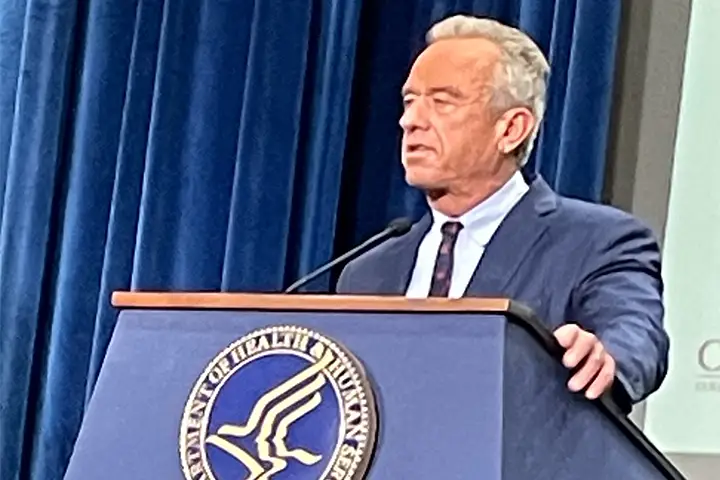
Currently, the average medical student reports receiving less than 2 hours of nutrition education every year, but “that ends now,” said Health and Human Services Secretary Robert F. Kennedy Jr.
Kennedy added that chronic disease “is overwhelming the country and it is accelerating … Today, we spend $4.5 trillion a year on healthcare, and 90% of it goes to managing chronic disease, and poor nutrition is often at its core. Six in 10 American adults live with at least one chronic disease; four in 10 live with two or more. And 38% of our teens are pre-diabetic or diabetic.” He noted that medical students have reported averaging less than 2 hours of nutrition education a year. “That ends now.”
HHS will also dedicate $5 million to support medical schools, nursing residency, nutrition science, and dietitian programs that integrate nutrition education into their curricula, HHS said in a press release. The funding will help institutions develop coursework, clinical training opportunities, and research initiatives focused on evidence-based nutrition science. HHS posted on a department webpage the medical schools involved in the initiative, “so you can see whether your alma mater or the medical school you’re considering is on the list,” Kennedy said.
“To be clear, this announcement is not the Trump administration dictating the medical [school] curriculum,” he added. Instead, “today represents a mutual recognition that HHS and leaders in American medicine can come together to advance shared goals and interests.”
During a question-and-answer session, a reporter quoted previous remarks by Kennedy stating that medical schools that did not include sufficient nutrition education in their curricula might face funding cuts, and asked whether that idea was still being considered. “Today’s announcement is purely about a celebration,” HHS spokesman Sam Waters responded. “So this is purely highlighting the leadership of the schools and putting a megaphone behind their efforts.”
David Skorton, MD, president and CEO of the Association of American Medical Colleges, praised the collaboration between the schools and HHS. “This is a great example of an area where alignment between government and academic medicine can drive real impact for patients,” he said.
Bobby Mukkamala, MD, president of the American Medical Association, also praised the initiative. “For too long, nutrition has been treated as an elective in medical education — a few hours here and there,” he said. But “considering how important what we eat is for our health, it should be a basic foundational training, because it impacts every one of our patients.”
“The science is pretty darn straightforward,” said Mukkamala. “Poor diet — highly processed foods that are high in sodium and added sugar — is one of the drivers of chronic disease, diabetes, heart disease, obesity, and even some cancers. And yet, many physicians receive very little formal training on nutrition. That’s not because doctors aren’t interested. It’s because these priorities in medical education need updating … The good news is that change is here.”
“This isn’t about turning doctors into dieticians,” he added. “It’s about making sure that physicians feel confident having productive conversations with patients about nutrition, conversations that can truly change lives. I see this in my own practice. Patients are starting to ask me about food, weight, and metabolic health, and I’m an [otolaryngologist] … That tells us something. Every specialty needs a basic understanding of how nutrition affects health.”
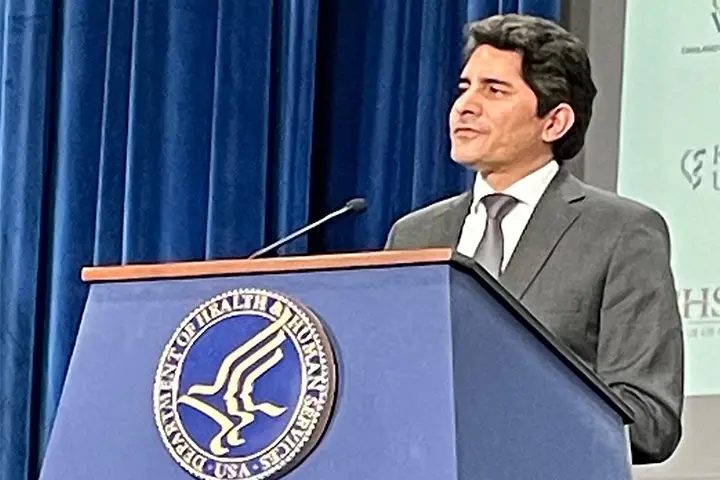
“This isn’t about turning doctors into dieticians,” said American Medical Association president Bobby Mukkamala, MD. “It’s about making sure that physicians feel confident having productive conversations with patients about nutrition.”
As to why medical schools have taken so long to change the curriculum, Mukkamala pointed to his own experience as a brain cancer patient. Instead of a 1- to 2-day turnaround for his pathology report, he said it took 3 weeks, “because there’s so much more to study about this.” The knowledge required in a nutrition curriculum for doctors wouldn’t fit in two volumes anymore, he told MedPage Today. “It’s probably 10 volumes. So the question then is, how do we teach them that stuff and this stuff in a 4-year period?”
Specialty rotations could be one area to buy back time from, he suggested.
For instance, if a medical student is set on becoming a pediatrician, “then why have them do a neurosurgical rotation that takes up weeks when you know this is what they want to do?” he said. “It’s important that they don’t spend critical time in that 4 years doing something that’s irrelevant to their goal. But this [nutrition] is relevant to everybody’s goal, so people should do the basics, like [nutrition], and then the specialty stuff they should be getting because of their passion — instead of rotating through every specialty so there’s no room for diet and nutrition.”