At the Trump administration’s urging, 53 medical schools are expanding their nutrition education curriculum.
Starting next fall, those medical schools—including programs at Tufts University, the University of Florida and George Washington University—will require students to complete at least 40 hours of nutrition education. While all of the nearly 200 medical schools in the United States already require some form of nutrition education, it averages just 1.2 hours per year.
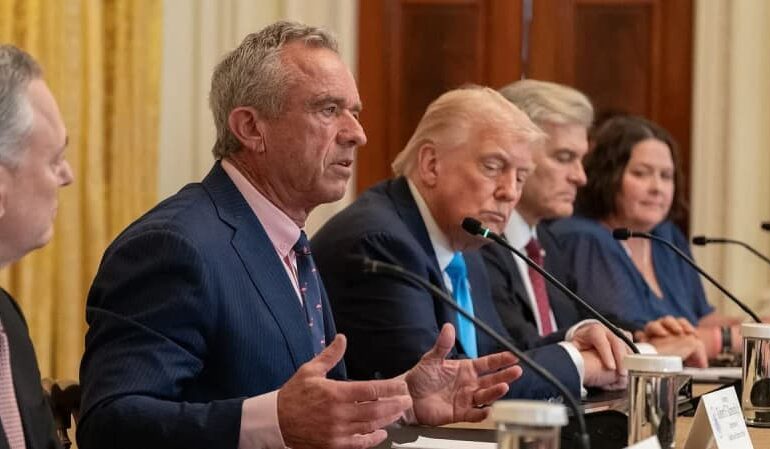
“Chronic disease is bankrupting our health system, and poor nutrition sits at the center of that crisis,” Robert F. Kennedy Jr., secretary of the Department of Health and Human Services, said Thursday at an event in Washington, D.C., announcing the pledges. “Today medical schools are committing to change how America trains its doctors—by putting nutrition back where it belongs: at the heart of patient care.”
Additionally, HHS is launching a $5 million nutrition education challenge led by the National Institutes of Health, according to a department news release. The funding will help medical schools and nursing, residency, nutrition science and dietitian programs develop coursework, clinical training opportunities and research initiatives focused on sound nutrition science. And starting this year, U.S. Public Health Service officers will be required to complete nutrition-focused continuing education hours.
Kennedy and Education Secretary Linda McMahon emphasized at the event that the medical schools’ pledges were voluntary. But the administration has shown a willingness to use federal funding that universities and medical schools rely on as leverage to compel policy changes. In the last year, Kennedy has mentioned that he could cut off federal funding to those who don’t fall in line with his vision for nutrition education, but that threat doesn’t appear to have been formalized.
These expanded nutrition education requirements are part of Kennedy’s plan to advance his larger “Make America Healthy Again” agenda, which aims to address and prevent chronic illness through diet and lifestyle choices. “This is how we implement the MAHA agenda,” Kennedy said Thursday. “This is how we make America healthy again.”
Although the medical community has pushed back against some of Kennedy’s other MAHA initiatives—including limiting vaccine research and publicizing false or misleading claims about fluoride, raw milk and food dyes—the American Medical Association, the Association of American Medical Colleges and the American Association of Colleges of Osteopathic Medicine praised the government’s emphasis on nutrition education.
“For too long, nutrition has been treated as an elective in medical education,” AMA president Bobby Mukkamala said at the event. “Considering how important what we eat is for our health, it should be a basic foundational training, because it impacts every one of our patients.”
And while some physicians have long called for expanded nutrition education, the Trump administration’s intervention over the past year finally got results.
In June, Kennedy mentioned in passing that he was considering withholding federal funding for medical schools that don’t offer nutrition education. But that threat wasn’t included in the official directive he issued with McMahon in August, which gave premed programs, medical schools, residencies, medical licensing exams, board certifications and continuing education organizations two weeks to submit plans for integrating comprehensive nutrition education and training into their curriculum.
But according to The New York Times, Kennedy shifted to a softer approach after medical schools pushed back. In a January letter to university leaders, Kennedy said HHS “welcomes your participation to implement” at least 40 hours of nutrition education for medical students, promising to publicly celebrate any school that exhibited such “leadership.”
Skepticism of Curricular Control
The letter also included a list of 71 topics for medical schools to consider while developing their curricula, according to the Times. While some of those suggestions—such as learning about nutrient deficiencies and food allergies—align with the recommendations of medical experts, others, such as a focus on dietary supplements and wearable devices, don’t.
But both Kennedy and McMahon emphasized that medical schools will have full control over development of their nutrition education curriculum.
“To be clear, today’s announcement is not the Trump administration dictating medical curriculum,” Kennedy said at the announcement. “Today represents a mutual recognition that HHS and leaders in American medicine can come together to advance shared goals and interests.”
But some nutrition experts are skeptical.
“I don’t trust the Trump administration when they say they aren’t going to try to influence what will be taught,” David Seres, retired director of medical nutrition and professor of medicine in the Institute of Human Nutrition at Columbia University Medical Center, told Inside Higher Ed.
“Even if they really mean it that they’re not going to force a certain curriculum, this administration has acted in ways that make it unnecessary for them to overtly force their curriculum,” he added. “People are fearful of the kinds of [retribution]—such as withholding funding—the administration has already demonstrated they’re willing to do.”
Since assuming control of the White House last year, the Trump administration has withheld billions in federal funding from colleges and universities—including medical schools and affiliated hospital systems—accused of violating laws and executive orders, such as those prohibiting diversity, equity and inclusion initiatives and gender-affirming care.
But the pressure campaign hasn’t stopped there for medical schools.
In April, President Donald Trump issued an executive order calling on the Education Department to suspend or terminate an accreditor’s federal recognition if it violates federal civil rights law, including engaging “in unlawful discrimination in accreditation-related activity under the guise” of DEI initiatives. The order also directed the federal government to investigate the Liaison Committee on Medical Education, which accredits medical schools and has since dropped its DEI standards.
The LCME then voted last month to dilute its recently adopted curricular standards on structural competency, which teaches future doctors about how political, economic and social issues—such as food insecurity—influence health outcomes. That change will only hinder the government’s stated aims of its nutrition education push, Seres said.
“That’s going to be devastating. We were finally training physicians to be sensitive to these issues,” he said. “If patients can’t obtain the healthy food we’re telling them to eat, then why are we telling them to eat it?”
What’s more, he worries that MAHA’s influence over the expanded nutrition education curricula may further diminish trust in medical experts.
“Medical schools will strive to do a good job of providing this increased nutrition training,” Seres said. “What I am concerned about is how it will be perceived. Because of where it’s coming from, it may have a deleterious effect on scientific credibility in general and nutrition science specifically.”