Overall, I purchased 12 beauty products from third-party sellers. That includes three products for which I ordered two suspicious versions, simply because more than one listing caught my eye.
I also bought those same products from the brands’ own websites (which, by default, are authorized, first-party sellers). These items served as my control specimens, against which we compared our third-party samples.
I sent all of my purchases to Johnson, the cosmetic chemist in New Jersey, who conducted a series of tests to compare our controls with our more suspicious samples.
To assess chemical similarities and differences between the products, Johnson relied on a Fourier Transform Infrared (FTIR) spectrometer. Frequently used for quality control or material authentication, an FTIR shoots a laser at a substance and provides a breakdown of what’s inside. It can’t spit out a word-for-word ingredient list, but it can determine the number of ingredients in a substance and (depending on the complexity of the mixture) the concentration of each as a percentage of the overall mixture.
It can also compare results from two separate substances and produce a percentage match. The lower that percentage, the more likely that the two substances are different — or, for our purposes, that one is a spurious version of the other. Analyzing with FTIR involves some margin of error, so Johnson told me that she would want to see a 95% match or higher between an authorized product and its unauthorized counterpart to call the latter “real.”
Only three of our 12 samples — two bottles of Drunk Elephant glycolic serums and a Dior concealer — surpassed that 95% benchmark.
Because there are no precise rules for exactly how fake a product should appear to be before it can be deemed definitely fake, I cross-checked our results with Andrew Koenig, a technical and formulation consultant at CosChemist Consulting in California. He said that a sample could receive as low as an 80% to 90% FTIR match against its real counterpart and still wind up being a legitimate product. (Johnson had mentioned that other chemists might accept an 80% match as authentic. Again, there’s no industry standard.)
By that 80% minimum, five of our 12 samples would be definitively counterfeit. This group included a supposed Nars concealer that was only a 2% match to its authentic counterpart and two alleged bottles of Charlotte Tilbury Airbrush Flawless Setting Spray that got FTIR readings of 21% and 25% compared with the real thing. Four other samples’ FTIR results fell into the 80% to 90% range.
Johnson also employed a 14-point sensory analysis that she uses when formulating “dupes,” which is when a legitimate brand intentionally produces a product similar to one that’s already on the market. For the sensory analysis, Johnson graded each product’s opacity, shine, tackiness, absorption, and similar qualities on a scale from 0 to 10 and then compared the two outcomes.
None of our suspect samples, including those with high FTIR percentage matches, matched its authentic counterpart on all 14 points. In combination with the spectrometer testing and packaging-discrepancy observations, this analysis helped solidify Johnson’s conclusion that all of my third-party products were counterfeit.
For example: Our Amazon-purchased sample of Rhode Peptide Lip Treatment was an 80% FTIR match to its real counterpart. But in addition to all of the peculiarities we saw on the packaging, as well as the potential bacteria lurking inside, we could easily tell just by seeing what came out of each tube that something was different. The real Rhode balm looked opaque, while the other substance looked translucent.
 The Rhode Peptide Lip Treatment that I bought from an Amazon third-party seller earned an FTIR percentage match of 80% to its authentic counterpart. That figure could be regarded as a maybe-fake-maybe-not indicator, according to experts I spoke to. But other discrepancies in the product and the packaging, noticeable to the naked eye, led us to believe that we were likely dealing with a counterfeit. Michael Murtaugh/NYT Wirecutter and Hannah Schwob for NYT Wirecutter
Another example: A tub of supposed Drunk Elephant Protini Polypeptide Cream from eBay achieved an 83% match. But that sample was noticeably more yellow in tone, had a glassier shine (almost as if the product was separating a bit), and did not form peaks as stiff as what we got from the Protini Polypeptide Cream I’d purchased on Drunk Elephant’s website.
 The Drunk Elephant Protini Polypeptide Cream that I got on eBay came in a 30 mL package, which I did not find available for purchase on the brand’s website. However, when I bought a larger size of this cream from Drunk Elephant’s site as our authentic sample, I received a 30 mL container as a freebie with purchase (which I then submitted for testing). At first, I naively thought that whoever had sold this size on eBay was simply trying to make a little money from their authentic freebie. After our testing, however, it became evident that both the packaging and the cream itself were off in several subtle ways. Michael Murtaugh/NYT Wirecutter and Hannah Schwob for NYT Wirecutter
Even when a suspected fake earned an outstanding FTIR match percentage, there were reasons for skepticism.
I bought two bottles of another Drunk Elephant product, T.L.C. Framboos Glycolic Night Serum, from a Walmart third-party seller and an eBay third-party seller. Both samples were a 97% FTIR match to the real thing.
Johnson, however, said that glycolic acid’s molecular structure is rather simple, so even something with a 97% FTIR match might be an inauthentic copycat. (Koenig agreed about the molecular structure but still said that a 97% match was likely not counterfeit.) Additionally, Johnson detected differences in the packaging that led her to believe that the ones I’d purchased via third party might be illegitimate: On the boxes that these serums came in, for example, the lot codes had been stamped in slightly different locations with what appeared to be different marking technologies. (I asked Drunk Elephant if it could confirm any changes in how it printed lot codes but did not receive a response before publication.)
Because packaging differences were a consistent tell across many of my purchases, I also asked Elizabeth Carey Smith, a branding and typography designer in New York, to examine photos we’d taken of our real and maybe-not-real packages and weigh in. Although Smith said she was “very surprised at how close some of these things are,” she pointed out several inconsistencies, including some bits of heavier typeface on the T.L.C. Framboos Glycolic Night Serum boxes, which could indicate that they were “probably using an image [of the legitimate packaging] or scanning it.”
Other smoking guns may have been hiding online. The eBay seller who sent me one of those Drunk Elephant serums has seemingly disappeared in the four-ish months since I placed my order, which certainly doesn’t instill confidence. Meanwhile, the Walmart seller who sent me the other has received at least 10 one-star customer reviews for a variety of items since December 1, 2025, peppered with claims like “This is not an authentic product,” “This seller is selling knockoff perfumes,” “The description and the pictures do not match the product,” and “I see you did [a] bait and switch.”
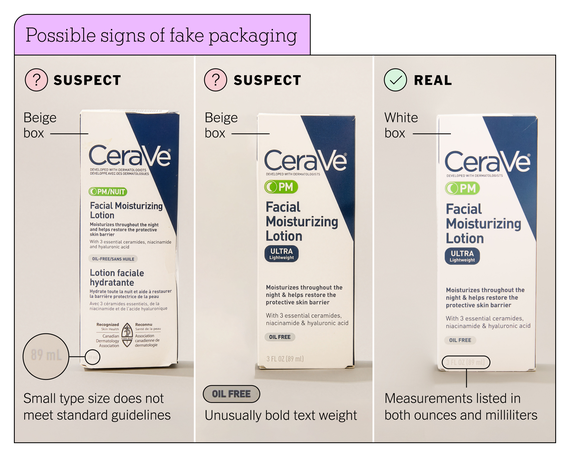 Something I realized while looking into bootleg packaging “tells” is that buyers often concoct narratives in their heads about why a product appears a certain way. For instance, someone might look at the CeraVe box that contains both English and French and just assume it came from Canada. Or they might notice that the white part of the package is more off-white and figure it’s okay, just a bit older. But both of the boxes at left are suspicious and possibly indicators of a counterfeit product. Michael Murtaugh/NYT Wirecutter
My most confounding specimen was a package of SkinCeuticals C E Ferulic serum. The sample I bought from a Walmart third-party seller had an “e-mark,” a quality-assurance emblem from the European Union, which made me wonder if we were dealing with someone who had traveled to Paris, loaded up a suitcase with serums, and come home to turn a quick buck. (Then again, the e-mark could just be fake, perhaps added to the packaging to make me think the item had come from Europe.)
Compared with an identical serum I purchased from the SkinCeuticals site, the one from Walmart registered as a 90% FTIR match — right on the cusp of what may be considered legitimate, according to Koenig (but not Johnson). But the colors of the two serums were significantly different: The one from the SkinCeuticals site was pale yellow, while the e-mark sample looked orange. The latter shade, as experienced vitamin C serum users may know, typically indicates that the product has oxidized, which renders it less potent.
 The SkinCeuticals serum I purchased from a third-party seller on Walmart was especially tricky to analyze. The “e-mark” on the label suggests that it came from the European market. L’Oreal (which owns SkinCeuticals) tested that sample and told me that it was legit and that the European formula differs in color from the US formula. Michael Murtaugh/NYT Wirecutter and Hannah Schwob for NYT Wirecutter
When I contacted L’Oreal, the parent company of SkinCeuticals, for comment, it offered to retest my third-party-purchased sample. I hand-delivered it to the company in New York. L’Oreal claimed it was legit, telling me that the European version is darker in color even when it’s fresh. For what it’s worth, both Johnson and Koenig were skeptical of that claim: As Koenig put it, “No one’s gonna say that their product is oxidizing.”
According to other experts I spoke to, no one’s gonna say that their product is counterfeit, either.
Although brands may work diligently behind the scenes to thwart bad actors who are making or selling fakes based on their intellectual property, admitting publicly that fakes are floating around out there is something that’s rarely done. I learned this firsthand when I contacted the eight beauty brands whose products my testing encompassed. None would grant me an interview (including L’Oreal, which shared those serum-testing results through a spokesperson).
“The bottom line is, [companies] don’t want their brand affiliated with counterfeit goods,” Barchiesi, of the International AntiCounterfeiting Coalition, said. “They don’t want to scare the consumers.” Harley Lewin, an intellectual-property lawyer renowned for his raids on fake-handbag operations, similarly told me, “It’s very easy to get drawn into a debate that you can’t win. That debate being that all of your stuff out there on the market, legitimately or not … is fake.”
In the end, if there really was nothing wrong with that third-party SkinCeuticals serum, all I could think was “How ironic.” Because if you’re a regular user of the North American version of the serum, and you decide to roll the dice on a third-party purchase to save (in my case) about $60, you might look at what you get in the mail and, if it’s like my sample, you may quickly surmise that it’s fake, expired, or otherwise suspicious — when, apparently, you actually won the third-party-seller lottery and found a true bargain, a legit product that you could use with confidence.
But you’d probably just throw it away.