Key Takeaways:
Galeries Lafayette expands its beauty footprint to 40,000-plus square feet.Fashion-beauty integration drives differentiation from specialty retail competitors.Parapharmacy addition strengthens local traffic and skincare authority positioning.
Galeries Lafayette is deepening its investment in beauty with a comprehensive reconfiguration of its Boulevard Haussmann flagship, positioning the category as both a growth driver and strategic bridge between fashion, wellness, and lifestyle.
The transformation builds on the retailer’s post-pandemic reset, which included updates across leather goods, watches, jewelry, and ready-to-wear. Beauty has emerged as a central pillar in evolution, not only for its sales productivity, but for its ability to drive repeat traffic and increase cross-category conversion, all while rebalancing the customer mix toward local and Parisian shoppers.
Globally, beauty accounts for approximately 10% of Galeries Lafayette’s annual sales volume. Even during renovation works, the category posted double-digit year-over-year growth versus 2024, momentum that has carried into early 2026. The retailer is leveraging that strength to differentiate itself from Paris’ dominant specialty beauty chains and parapharmacies by expanding exclusivity, service, and cross-category integration.
The competitive landscape in Paris is formidable. Prestige beauty traffic is heavily concentrated at Sephora Champs-Élysées flagship and increasingly at Printemps and Le Bon Marché, both of which have sharpened their own beauty and wellness propositions in recent years. Against that backdrop, Galeries Lafayette’s strategy leans on fashion adjacent and exclusive brand disruption as its primary differentiators.
Today, the Haussmann flagship houses 40,355 square feet of beauty-selling space. This includes an increase of 5,380 square feet and carries 440 brands, including 190 new additions introduced through its recently launched parapharmacy.
Rewiring the Floor Plan: Fashion Meets Fragrance
A defining feature of the new concept is the physical integration of fashion and beauty, especially on the second floor beneath the store’s iconic dome. The former leather goods space along the inner circumference has been reallocated to exclusive fragrance brands directly linked to luxury fashion houses.
Loewe was the first to introduce the fragrance-and-candle concept, mirroring the architectural codes of its adjacent fashion boutique. Prada Beauty currently occupies a prominent second-floor corner and will relocate to the ground floor in June, presenting fragrance and makeup alongside branded accessories such as scarves and small leather goods.
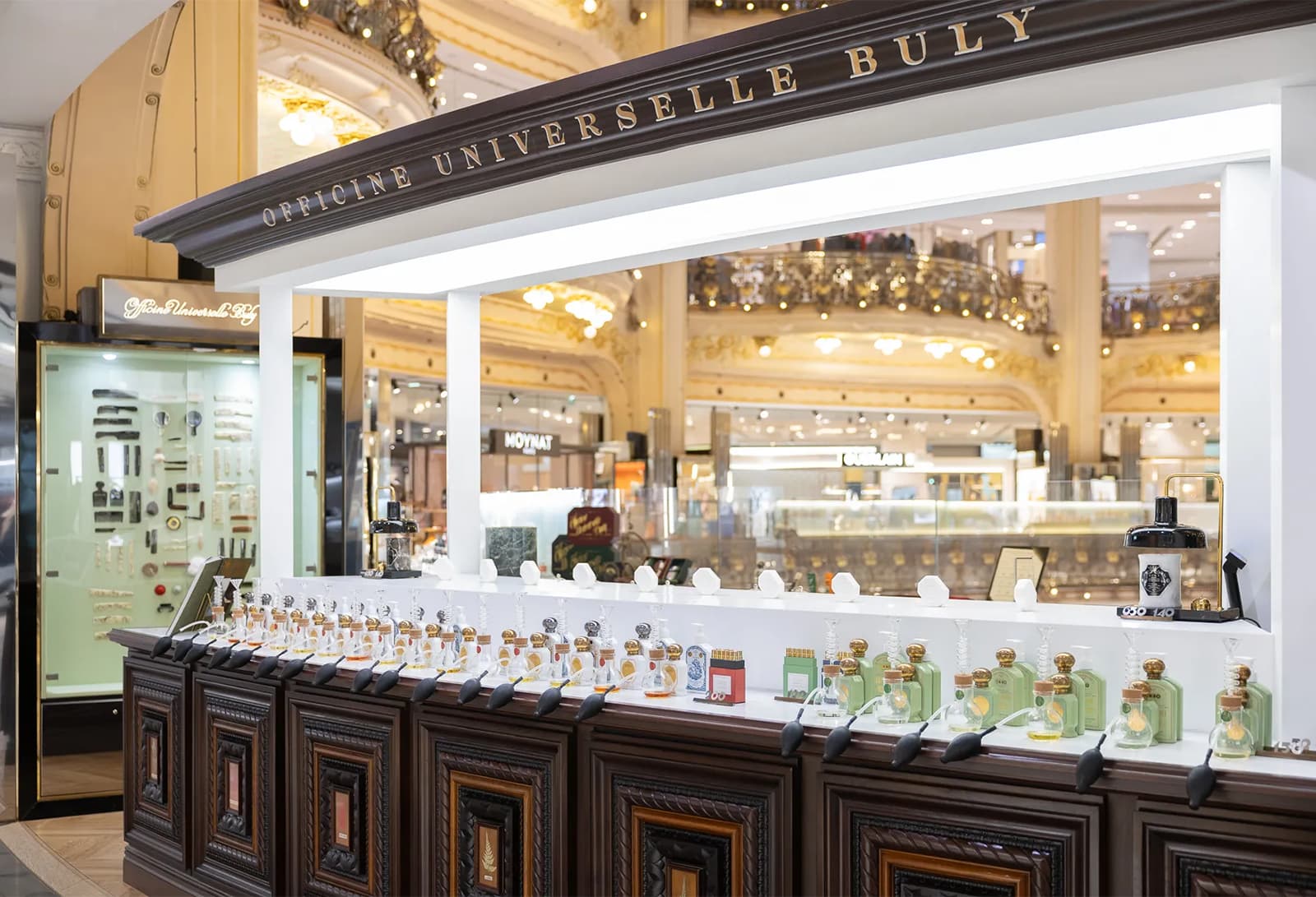
Officine Universelle Buly 1803 opened on the same level in late 2025, bringing its full assortment and signature in-store services. Dior offers a hybrid merchandising strategy that places accessories alongside elevated beauty propositions, such as customizable amphora fragrance bottles, available in fewer than 10 stores globally.
Additional fragrance-led houses on this level include Guerlain, Louis Vuitton, Chanel, and Bottega Veneta. Galeries Lafayette and Bergdorf Goodman are the only department stores globally to carry Bottega Veneta fragrances; in Paris, the brand’s installation is wrapped in Murano glass, referencing its flacons.
Come mid-June, Saint Laurent will debut a new retail concept on the ground floor that blends couture accessories with beauty. The move will mark the first time the houses merge those categories in a unified department store expression.
The overarching strategy: enable customers to move seamlessly between a brand’s fashion and beauty universes, reinforcing lifestyle positioning rather than standalone cosmetic counters.
While Printemps has also leaned into experiential retail and Le Bon Marché continues to elevate niche fragrance and ultra-luxury skincare, neither competitor operates at the same scale beneath a single architectural landmark as Boulevard Haussmann. Galeries Lafayette is effectively wagering that physical proximity between couture and cosmetics, which will drive incremental spend.
Ground Floor: Lifestyle Beauty and Selective Makeup
The ground floor now centers around fragrance and makeup, while skincare has been relocated to the lower ground level. Louis Vuitton’s corner presents the brand’s complete fragrance and makeup line—a distinction unique among Paris department stores—alongside small leather goods and accessories, reinforcing a lifestyle narrative rather than a traditional beauty counter.
Hermès expanded its beauty footprint with architectural elements that mirror its global flagship, including its signature yellow, black, and white flooring.
The selective makeup edit has been streamlined for clarity and productivity. Core brands, including MAC Cosmetics, Bobbi Brown, and NARS Cosmetics, remain, while Charlotte Tilbury and Hourglass Cosmetics have been added. Westman Atelier is set to launch on March 6.
Each brand now operates within its own dedicated service area, elevating makeup through tutorials and full makeovers, reinforcing experiential retail as a competitive differentiator.
A nearby niche fragrance enclave spotlights Parfums de Marly, Maison Crivelli, Kilian Paris, BDK Parfums, and Byredo, underscoring consumer appetite for prestige and artisanal scent.
Lower Ground Floor: Skincare Authority
The lower ground floor consolidates the retailer’s wellness credentials and skincare authority. The 2,690-square-foot parapharmacy introduces 190 new brands, including Avène, Nuxe, La Rosée, and Galderma, a targeted play for local, ingredient-conscious consumers.
Heritage and luxury skincare houses such as Clarins, La Mer, and Estée Lauder have been relocated to this section of the site, joined by exclusives such as EviDenS de Beauté and Helena Rubinstein.
The store now operates with 20 treatment rooms—double the pre-renovation count—embedding services deeper into the commercial model. Brands such as Augustinus Bader and Foreo remain integrated within the wellness-led environment first established through La Wellness Galerie.
The positioning is clear: to offer one of the most comprehensive skincare assortments in Paris, spanning dermocosmetics to ultra-luxury, anchored by service.
The pharmacy expansion also places Galeries Lafayette in more direct competition with France’s powerful pharmacy channel, where dermocosmetic brands such as Avène and Nuxe traditionally dominate. By integrating those brands into a department store environment, the retailer is collapsing what has historically been a divided distribution model in the French market.
Scaling Beauty Across France
The Haussmann overhaul is part of a broader national strategy. This April, Galeries Lafayette will dedicate all French store windows and pop-ups to beauty, amplifying visibility across its network. Recent category investments in Strasbourg, Nice, Bordeaux, Annecy, and Lyon have delivered a strong reception, with Toulouse and Biarritz next slated for refurbishment, each with a beauty focal point.
The retailer is also fully renovating its adjacent Boulevard Haussmann men’s building. Rather than isolating beauty into a standalone men’s department, brands will be embedded throughout the male customer journey, reinforcing beauty’s growing resonance with fashion across gender lines.
In a market long dominated by specialty chains and pharmacies, Galeries Lafayette is making a decisive bet: that department stores can reclaim beauty authority by merging fashion credibility, exclusive distribution, immersive services, and architectural theater—all under one roof.
In a city where Sephora commands scale, Printemps curates fashion-led prestige, and Le Bon Marché refines left-bank luxury, Galeries Lafayette positions itself as the hybrid model. Part fashion cathedral, part wellness destination, part beauty authority.