image:
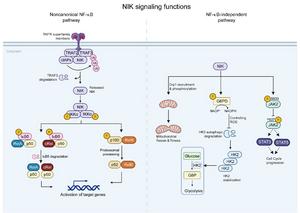
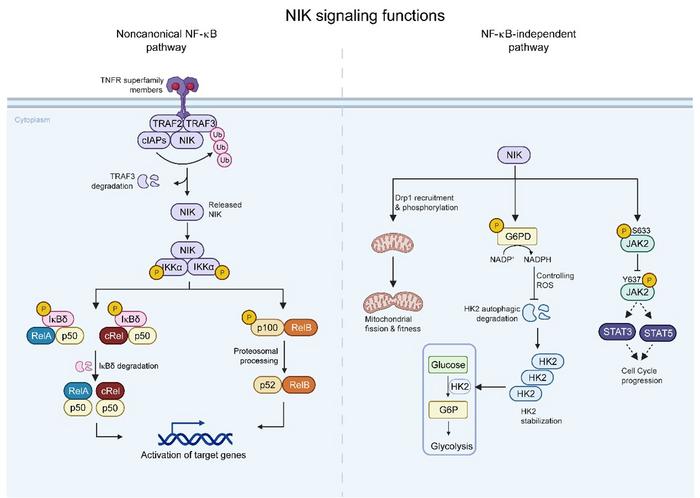
NIK is the central regulator of the non-canonical NF-κB pathway, which is triggered by signaling from a subset of TNFR members. Upon receptor crosslinking by corresponding ligands, TRAFs and cIAP1/2 are recruited to the receptor, where cIAP1/2 ubiquitinates TRAF3 and leads to its degradation, resulting in the liberation and stabilization of NIK. Accumulated NIK activates IKKα, which in turn phosphorylates p100, leading to p100 processing and p52 generation. The NF-κB proteins p52 and RelB are then translocated to the nucleus and activate gene expression. Under certain conditions, NIK also induces degradation of p100/IkBδ, leading to activation of different NF-κB members. NIK also exerts NF-κB-independent functions, including mitochondrial fitness and metabolic functions. In T cells, activated NIK phosphorylates and promotes the function of a metabolic enzyme, G6PD, which catalyzes the generation of NADPH, thereby controlling cellular ROS and preventing autophagic degradation of HK2, a rate-limiting enzyme in glycolysis. At least in some cell types, NIK also promotes mitochondrial fission by facilitating mitochondrial recruitment and phosphorylation of the mitochondrial fission regulator Drp1. In hepatocytes, NIK phosphorylates JAK2 at serine 633, which interferes with phosphorylation of the adjacent tyrosine 637 required for JAK2 activation, thus inhibiting activation of the JAK2-STAT3/STAT5 signaling axis, and influencing cell cycle progression
Credit: Prof. Shao‑Cong Sun from Capital Institute for Medical Sciences Innovation, China
Image source link: https://link.springer.com/article/10.1007/s44466-026-00026-4
Two decades ago, Professor Shao-Cong Sun first discovered the non-canonical NF-κB pathway mediated by NF-κB-inducing kinase (NIK). Since then, more new features and mechanisms of NIK have been unlocked. On February 26, 2026, Prof. Sun reviews these molecular mechanisms underlying NIK activation and function in Immunity & Inflammation.
The review first delineates the core molecular mechanism of the non-canonical NF-κB pathway. NIK is kept at minimal levels through binding to TRAF3 under steady-state conditions. Upon pathway activation, receptors, including TNF receptor (TNFR) superfamily members, recruit adapter complexes that promote the degradation of TRAF3. This process releases NIK, allowing it to accumulate and phosphorylate IKKα. Activated IKKα then phosphorylates the NF-κB precursor protein p100, marking it for partial proteolysis into the mature transcription factor subunit p52. The p52/RelB dimer subsequently translocates to the nucleus to regulate the expression of genes critical for immune functions.
Beyond this established canonical role, the article emphasizes emerging NF-κB-independent functions of NIK, particularly in regulating cellular metabolism and maintaining mitochondrial health, revealing NIK as a multifunctional signaling molecule with broader influence on cellular physiology.
NIK exerts indispensable physiological functions within the immune system. NIK signaling is fundamental for the proper development of secondary lymphoid organs and establishing central tolerance, plays specific roles in T cell differentiation, metabolism, and effector function, and also modulates innate immune responses and inflammation, positioning it as a central coordinator across the entire immunological spectrum.
The pathological consequences of NIK dysregulation are also extensively cataloged. The review provides mechanistic insights into its role in driving diseases such as primary immunodeficiency disorders, multiple sclerosis, myasthenia gravis, systemic lupus erythematosus, rheumatoid arthritis and metabolic disorders. This broad disease association solidifies NIK not only as a crucial physiological regulator but also as a compelling, common node in diverse pathological pathways.
Given its central role in driving pathogenic inflammation, NIK presents a promising therapeutic target. The review analyzes two strategic approaches based on disease context:
Inhibiting NIK activity to treat autoimmune and inflammatory diseases. This could be achieved through the development of highly specific small-molecule inhibitors targeting NIK’s kinase domain or through biologic agents like monoclonal antibodies that block the upstream receptors (e.g., BAFF-R).
Activating the NIK pathway to enhance anti-tumor immunity, particularly in the context of adoptive T cell therapies. Compounds such as SMAC mimetics, which antagonize cIAP1/2, can prevent NIK degradation, leading to its accumulation and pathway activation. This approach seeks to boost T cell persistence, metabolic fitness, and effector function within the immunosuppressive tumor microenvironment.
Despite this clear therapeutic potential, the authors provide a critical perspective by noting that “no NIK-targeted therapy has yet advanced to clinical trials.” This gap underscores the significant and fundamental challenge of selectively modulating a pathway that is essential for maintaining normal immune homeostasis. A deeper mechanistic understanding is required. This includes elucidating the physiological consequences of NIK’s NF-κB-independent functions, deciphering the context-dependent crosstalk between the non-canonical and canonical NF-κB pathways, and mapping the tissue- and cell-type-specific roles of NIK signaling. “The ultimate goal,” the authors conclude, “is to design next-generation, context-sensitive interventions that precisely target the pathological functions of NIK while keeping its vital physiological roles.”
***
Reference
DOI: 10.1007/s44466-026-00026-4
About Immunity & Inflammation
Immunity & Inflammation is a newly launched open-access journal co-published by the Chinese Society for Immunology and Springer Nature under the leadership of Editors-in-Chief Prof. Xuetao Cao and Prof. Jules A. Hoffmann. Immunity & Inflammation aims to publish major scientific questions and cutting-edge advances that explore groundbreaking discoveries and insights across the spectrum of immunity and inflammation, from basic science to translational and clinical research.
Website: https://link.springer.com/journal/44466
About Professor Shao-Cong Sun from Capital Institute for Medical Sciences Innovation
Prof. Sun is a Distinguished Investigator at the Capital Institute for Medical Sciences Innovation (CIMR), a Chair Professor at Capital Medical University, and the founding Director of the CIMR Institute of Immunology (appointed 2024). His pioneering research on NF-κB signaling, ubiquitination, and tumor immune microenvironment regulation has profoundly influenced the field. His work, published in leading journals including Nature, Science, Nature Medicine, and Nature Immunology, provides critical scientific foundations for understanding and treating immune-related diseases. His research mainly focuses on the regulatory mechanisms of autoimmunity, cancer immunology, and inflammatory diseases.
Funding information
This work was supported by funds from the Chinese Institutes for Medical Research (CIMR) to Shao-Cong Sun.
Method of Research
Systematic review
Subject of Research
Not applicable
Article Title
The NF-κB-inducing kinase: a central regulator of immunity and autoimmune diseases
Article Publication Date
26-Feb-2026
COI Statement
The corresponding author Shao-Cong Sun is a member of the Editorial Board of the journal Immunity & Inflammation. However, he was not involved in the peer-review or decision-making process for this manuscript. The authors declare no other competing interests.
Disclaimer: AAAS and EurekAlert! are not responsible for the accuracy of news releases posted to EurekAlert! by contributing institutions or for the use of any information through the EurekAlert system.