
image:
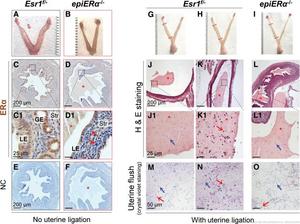
Immune cells in the uterus shortly after mating. Panels A–F show CD45+ immune cells, and panels G–L show ELANE+ neutrophils at two time points: 0.5 days (D0.5) and 3.5 days (D3.5) after mating. (A, G) Normal (control) uterus at D0.5. (B, H) Uterus lacking ERα at D0.5, showing a large influx of neutrophils into the uterine fluid that has not yet liquefied.
Credit: Hancock, Jonathan Matthew; Martin, Taylor Elijah; Li, Yuehuan; Owens-Gonzalez, Skyler; Zhou, Tong; Gresham, Declan James; Watford, Wendy Tharpe; Ye, Xiaoqin.
A new study led by researchers at the University of Georgia and the University of Nevada has uncovered how the uterus prepares for early pregnancy, showing that estrogen receptors play a critical role in regulating the immune system in the first hours after mating. The study, recently published in Reproductive and Developmental Medicine, focused on a receptor, estrogen receptor α (ERα), which is found in the lining of the uterus.
During the earliest stages of pregnancy, the uterus faces a delicate balancing act. After mating, sperm enter the uterus, which triggers a temporary immune response. Immune cells such as neutrophils, macrophages, and other white blood cells move into the uterine lining to manage potential infections and respond to foreign material. This short-term inflammation is normal and helps maintain uterine health. However, if the immune response is too strong or poorly controlled, it can harm sperm, disrupt hormone signals, and make it difficult for embryos to implant properly.
To better understand this process, the researchers studied mice genetically engineered to lack ERα specifically in the uterine lining. They found that without ERα, the uterus showed unusually high levels of inflammation right after mating. Neutrophils flooded the uterine cavity, and key inflammatory molecules, including interleukin-1β (IL-1β), were much higher than in normal mice. IL-1β is a powerful immune signal that recruits more immune cells, amplifying inflammation. This heightened immune activity disrupted the normal environment needed for sperm to survive and for embryos to implant successfully.
“Our findings show that uterine epithelial ERα acts like a regulator, keeping the immune system in check during a critical window of early pregnancy,” said Dr. Xiaoqin Ye, co-author of the study. “It allows the uterus to respond to potential threats while still supporting sperm survival and embryo development.”
The study also revealed that ERα controls immune activity through complex signaling pathways, including IL-1β, and coordinates the activity of multiple genes involved in inflammation. Importantly, the immune regulation by ERα is temporary: by a few days after mating, the inflammatory response naturally decreases, showing that the receptor helps create the right timing for uterine immunity.
These findings improve our understanding of why some pregnancies fail in their earliest stages and could eventually inform new approaches to support fertility. By revealing how estrogen helps balance immune protection and reproductive success, the research highlights the sophisticated ways the female reproductive system prepares for a healthy pregnancy.
Journal
Reproductive and Developmental Medicine
Method of Research
Experimental study
Article Title
Uterine epithelial estrogen receptor α temporally regulates preimplantation uterine immunity involving interleukin-1β signaling
Article Publication Date
17-Dec-2025
Disclaimer: AAAS and EurekAlert! are not responsible for the accuracy of news releases posted to EurekAlert! by contributing institutions or for the use of any information through the EurekAlert system.