Sports enthusiasts are gearing up for the largest college basketball tournament in the nation: March Madness. As fans finalize their brackets and get gameday snacks ready, athletes are also fueling for prolonged and fast-paced competition. Registered sports dietitian Allison McKay and George Mason University Athletics sports dietitian Quinten Patterson, who is also the Graduate Program in Nutrition and Dietetics, explain what keeps college basketball players energized through the final buzzer.
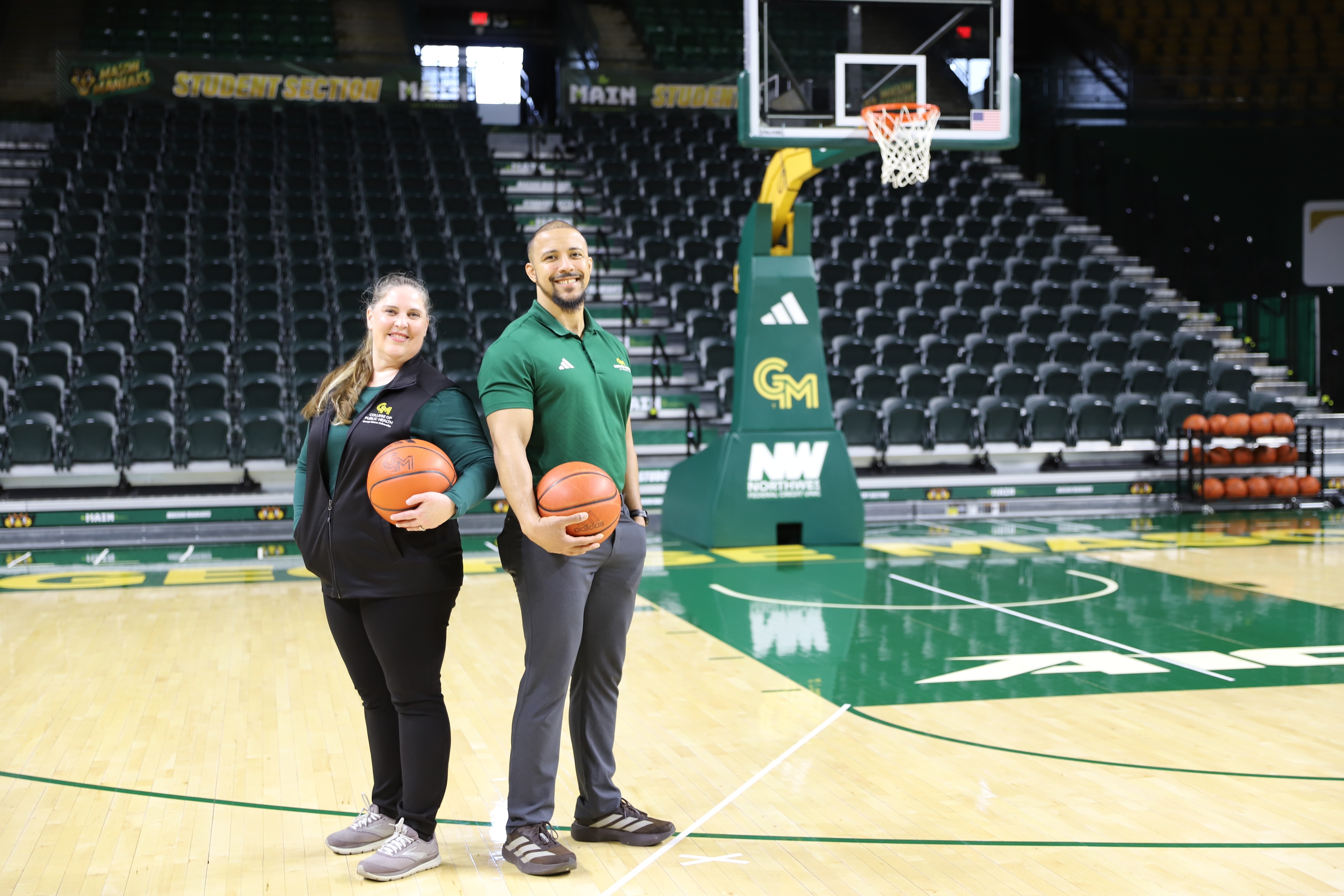
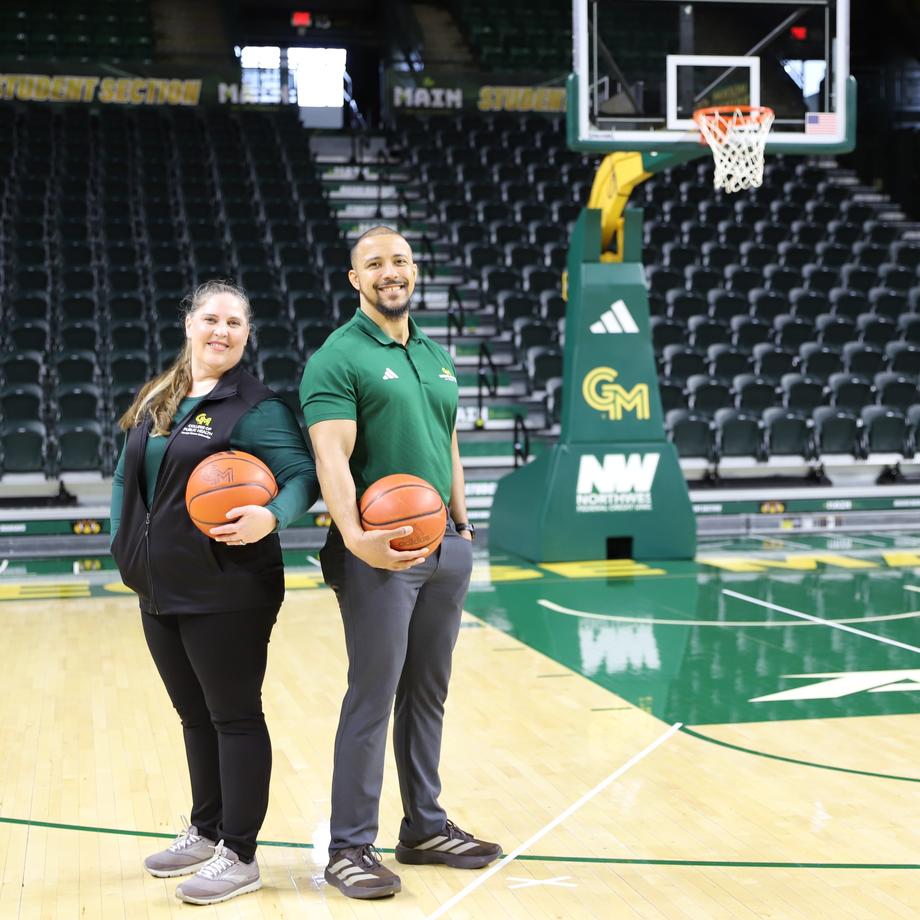
Allison McKay (left) and Quentin Patterson (right) share professional perspective into collegiate athletes’ nutritional needs. Photo by Mary Cunningham.
For fans’ March Madness watch party menus, Patterson and McKay recommend a balanced blend of carbs, proteins, healthy fats, and plant-based foods. Nuts, fruits, vegetables, and chips and dips are great snacks to help you cheer your favorite team through to the finals.
But how can student athletes fuel their Sweet 16 dreams? Learn more from Patterson and McKay about how nutrition impacts college athletes:
How does nutrition support student-athletes’ demanding schedules?
Patterson: Between classes, travel, training, and competition, student-athletes’ busy schedules , up to over in a single day. Enjoying nutrient-dense snacks sourced from whole foods helps give our athletes the bump in energy to get through their busy day. Nuts, fruits, yogurt, and granola are a few examples of whole foods that are delicious, nutrient-dense, and easy to carry around.
What role do nutrition and rest play during long tournaments like March Madness?
McKay: Athletes experience both mental and physical stress during prolonged competitions and tournaments, so sleep, rest, and proper nutrition are critical elements. Not having enough energy during these times can increase possible irritability, anxiety, and can reduce , which can increase the risk of injury. Recovery and nutrition can support resilience and help athletes perform their best in repeated efforts, like March Madness.
What do college basketball players eat on game day to maximize energy and focus?
Patterson: Game day meals have three main components: High-quality proteins, complex carbohydrates, and nutrient-dense fruits and vegetables. Players start their game day with a balanced breakfast in the morning and a pre-game meal a couple of hours before game time. It’s important to avoid fried or other high-fat foods in the hours before tip-off. These foods take a while to digest and can slow down our players on the court.
How can athletes reduce the stress of high-stakes tournaments and games?
McKay: Ensuring adequate fueling, especially carbohydrates, can help reduce stress during heavy training or competitions. Micronutrients such as magnesium, iron (if deficient), zinc, Vitamin D, Vitamin C, and B vitamins can support the muscles and nervous system. Omega-3 fatty acids, which can be found in foods like salmon and chia seeds, can reduce inflammation and support joint health. Student athletes can require up totwo or three times more protein than the average person. Most people need between 0.36 – 0.45 grams of protein per pound of body weight. However, collegiate athletes typically need almost double that — between 0.54 – 0.91 grams of protein per pound of body weight.
How do nutrition needs change when teams play multiple games in a short time span, like the March Madness Tournament?
Patterson: Nutrient timing is important to ensure athletes are ready to go for the next round. Players’ bodies respond better to ingested carbohydrates and proteins in the couple of hours after the game to shuttle those nutrients to their proper places. Post-game meals look similar to pre-game meals in that they are full of high-quality proteins and complex carbohydrates. Healthy fats are a great inclusion here to top off energy stores.
What foods help athletes stay focused during high-pressure games?
McKay: Mental acuity in athletes starts with stable blood sugar levels. Carbohydrates are critical for focus and quick decision-making, as the brain relies heavily on glucose for fuel. Before a high-pressure game, eating easily digestible carbohydrates, like oatmeal, rice, pasta, toast, a bagel, yogurt, or even a smoothie can help to ensure a constant energy source for the competition. During a prolonged event, the athlete may need to have additional carbohydrates from sports drinks or gels to sustain energy levels and prevent fatigue.
How important is hydration during March Madness?
McKay: Ensuring proper hydration is highly important. Even a mild level of dehydration can negatively impact concentration and performance. Starting the game fully hydrated is necessary, and replenishing fluid and electrolytes lost through sweat can make all the difference.
##
MEDIA INQUIRIES: For reporters who wish to speak to Allison McKay or Quentin Patterson about collegiate athlete nutrition or sports dietetics, please email media contact Michelle Thompson at mthomp7@gmu.edu.
Allison McKay, MS, RDN, CSSD, has been a registered dietitian for more than 25 years and has experience providing nutrition education and Medical Nutrition Therapy in hospitals, long-term care facilities and has been a research dietitian in several longitudinal research studies. Prior to working at George Mason, she worked at the Cancer Research Center at the University of Hawaii and was a consulting Dietitian with Dietitian Consulting Services, LLC in Seattle, Washington. She holds an MS in Exercise, Fitness and Health Promotion from George Mason University and is a Board Certified Sports Dietitian.
Quinten Patterson is the George Mason Athletics Sports Dietitian. Patterson’s experience in sports nutrition includes serving as a Seasonal Sports Dietitian for the Tampa Bay Rays Triple-A affiliate, the Durham Bulls, during the 2024 season, as well as assisting NCAA athletes prepare for the NFL combine with EXOS Sports Performance Center in Plano, Tx. Prior to joining George Mason, Patterson was a registered Dietitian at VIDA Fitness, where he provided nutrition counseling and support to clients as part of the organization’s health and wellness initiatives. Patterson joined George Mason Athletics in February 2026 and will serve as preceptor for dietetics students completing supervised practice hours in the Graduate Program in Nutrition and Dietetics.
Patterson previously served as a Renal Dietitian with DaVita, focusing on patient-centered care in a dialysis clinic environment. He also worked as a Clinical Dietitian with the North Carolina Department of Health and Human Services, supporting psychiatric patient care. Early in his career, Patterson held a role at UT Southwestern Medical Center as a Research Assistant, contributing to biomedical and clinical research efforts in developmental nephrology.
About George Mason University
George Mason University is Virginia’s largest public research university. Located near Washington, D.C., Mason enrolls more than 40,000 students from 130 countries and all 50 states. Mason has grown rapidly over the past half-century and is recognized for its innovation and entrepreneurship, remarkable diversity, and commitment to accessibility. In 2023, the university launched Mason Now: Power the Possible, a one-billion-dollar comprehensive campaign to support student success, research, innovation, community, and stewardship. Learn more at gmu.edu.
About College of Public Health at George Mason University
The College of Public Health at George Mason University is the first College of Public Health in Virginia and a national leader in inclusive, interprofessional, public health research, education, and practice. The college is comprised of public health disciplines, health administration and policy, informatics, nursing, nutrition, and social work. The college offers a distinct array of degrees to support research and training of professionals dedicated to ensuring health and well-being for all. The college’s transdisciplinary research seeks to understand the many factors that influence the public’s health and well-being throughout the lifespan.