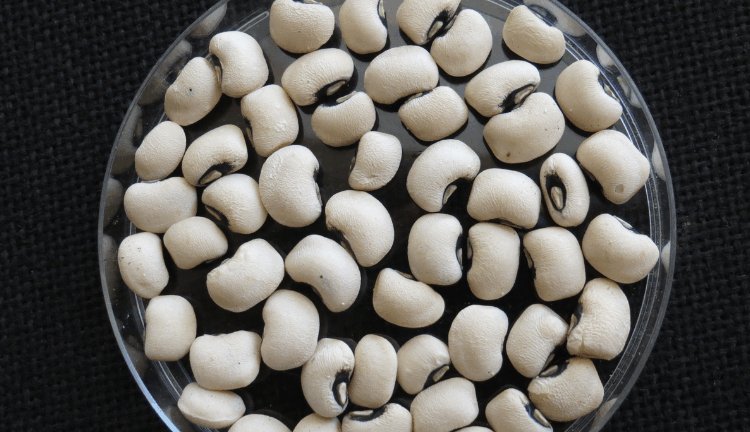
Breeders at IITA are using traditional knowledge and cutting-edge science to develop resilient cowpea varieties. – Photo: 2026
By Busani Bafana
16 March 2026 (IDN) — In villages in Kano State in Northern Nigeria, farmers do not fear the drought. When their maize crop fails, as it does often, cowpea flourishes. They harvest enough of the bean to feed their families with extra to sell and pay school fees for their children.
This is not sorcery but science. At the International Institute of Tropical Agriculture (IITA), cowpea breeders are developing climate resilient and high yielding cowpea varieties that can thrive under harsh weather conditions.
Cowpea is a pulse, a group of dry edible seed plants in the legume family which include lentils, chickpeas and beans, pigeon peas, and bambara beans among others. Pulses are locally adaptable and a cheaper source of protein. They are a perfect crop for fighting hunger and climate change which impacts agriculture production.
Small beans big on nutrition
Often called the “poor man’s meat” cowpea is rich in protein of up to 30 percent and provides a cheap alternative to meat for millions of households. For families who cannot afford animal protein regularly, cowpea is a solution. The bean supplies essential nutrients like amino acids, iron, zinc, and vitamins.
Ousmane Boukar, a cowpea breeder at IITA, says cowpea—sometimes called a “miracle bean”—can grow in very harsh environments of hot, dry soils where many crops fail. It also improves soil fertility by fixing nitrogen and thereby feeding people and the soil.
Boukar said IITA is breeding cowpea to withstand droughts, heat stress as well as flooding and waterlogging. Increasingly breeders are also developing improved cowpea varieties that are resistant to new and more aggressive pests, such as pod borers and aphids, whose populations are increasing with warming temperatures.
“Climate change is making seasons unpredictable, so we aim for varieties that are stable across variable environments,” said Boukar.
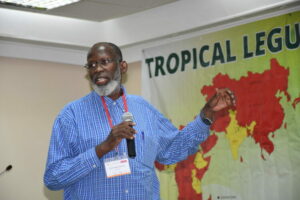 Dr. Ousmane Boukar, a cowpea breeder at IITA | credit: IITA.
Breeding for resilience and prosperity
Patrick Obia Ongom, another cowpea breeder, said the improved cowpea varieties developed by IITA have better yield stability under harsh conditions than the traditional ones farmers grow.
“In a bad year, traditional varieties may fail completely,” said Ongom. “A new improved cowpea variety may still produce some harvest, enough food and seed for the next season. That difference can mean food on the table versus hunger.”
Breeders at IITA are using traditional knowledge and cutting-edge science to develop resilient cowpea varieties. Farmers are engaged in the initial step of designing the type of cowpea variety a breeder will develop and in participatory variety selection trials on their farms.
“Farmers tell us what they want. Yield is important, but taste, cooking time, and market demand matter just as much,” Ongom said, noting that there is no single super cowpea for all of Africa which has many environments from the Sahel, savannas, to humid tropics, each with different stresses.
Ongom recalled farmers in Kano State, Northern Nigeria reporting that one of the improved cowpea varieties, SAMPEA 21, they developed matured early and escaped drought, allowing farmers to harvest when other crops failed.
Breeders use conventional breeding and genetic engineering. In the past it was purely conventional breeding, meaning plants were crossed naturally and the best offspring selected. It takes between 8 and 12 years from initial crosses to farmer release of new resilient varieties but with genomic tools, this process can be shortened to between 5 and 7 years.
Breeders note that the biggest hurdles to breeding include unpredictable climate affecting trials, pests and diseases that break the resilience traits in the improved varieties. Funding gaps and weak seed systems that slow delivery to farmers have also challenged the breeding process.
“If our breeding program is successful farmers will harvest reliable cowpea even under climate stress and meals will include more nutritious cowpea dishes, reducing malnutrition,” said Boukar.
Ongom added that with successful breeding of cowpeas, women will earn more income from cowpea markets, soils will be healthier with less need for fertilizer and villages will be more resilient to climate shocks.
“Cowpea could be a pillar of climate-resilient African diets and rural economies,” Ongom said.
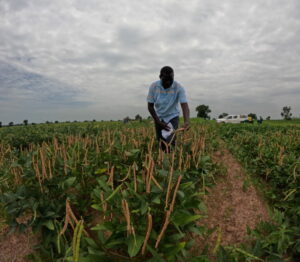 Dr. Patrick Obia Ongom Cowpea Breeder | credit: IITA.