
What appears beautiful within one communal framework may overwhelm, confuse, or even repel another—not because beauty has failed, but because the conditions for aesthetic judgment have not been mutually established.
By Olúwábùkúnmi Awóṣùsì
“And God saw the light, that it was good; and God divided the light from the darkness”. – Genesis 1:4 (NKJV)
There is a Yorùbá appraisal sentence—O jọjú ní gbèsè—oftentimes for the women, that, upon being broken into smithereens, means “owing the eye a debt”. Of course, this language—like every other—is filled with its pockets of idiosyncratic elements and richly laced with anthropomorphic syntax, which often commands the listeners’ eye and viewers’ ear towards a definite and aphoristic pontification.
This statement, often made to praise ravishing features of women, which has oftentimes gaol mesmerisation men and women, begs the question that I intend to explore in this essay: Is beauty truly in the eyes of the beholder?
While this is a question commonly featured in quotidian proto-philosophical convergence in our existential discussions right from time, its factuality and intention of classification still pervade the contemporaneity convergence of intellectualism. Annals has provided art historians, philosophers, and sheer knowledge seekers with discourse from Plato, Aristotle, and Marcus Aurelius on the zeitgeist of the Greek Enlightenment period on the aforesaid topic.
Recently, I intended that you would pardon my historical eccentricities to coalesce time; the 18th-century Enlightenment period in Europe has landmarked critical thinkers such as Kant, Hume, and Burke to contribute vast writings and arguments that posit beauty in the congregation of other pristine elements to further confuse the fertile mind of the human.
Each of these thinkers, therefore, aspires to know what true beauty is. How do you come to the conclusion that something is beautiful? Are there any factors that propitiate one’s eyes to confirm or soften chemical releases that classify an object or someone to be visually appealing? Or even, is beauty what one thinks beauty is? Albeit confusing these questions may be, I also intend to join several writings floating in the Milky Way of digital archives to attempt the conversation of beauty by borrowing from both Western and Yoruba philosophy and merging it with contemporary theories to arrive at perhaps not a definite discussion but an open-ended conclusion to be continued by other plagued minds on a similar subject.
African philosophers, to deviate from Idowu Odeyemi’s argument on defining African philosophy, have, however, produced lectures and opinions to argue beauty—reading as an art historian—from a nuanced perspective, one that recalls the notion as against the racism and stereotypical accounts of early and mid-Western explorers into the flora and fauna of Africa that often refer to African arts as a repellent to visual appeal, thanks to postmodernism, which provides more room for personal conceptions of beauty.
It is, however, ironic that the culture, which at first classified these arts as unrealistic and lacking the basic feature that makes them beautiful, would go on to imbibe—with accorded respect—forms and elements from African arts as exemplified in the works of the widely known Spanish cubist painter, Pablo Picasso. Thence, with brushes distorting forms and styles, beauty—as against Mona Lisa—arose from his easel to become one of his popular works, Girl before a Mirror (1932). These preliminary observations, into which I have quickly diverged, serve as a highlighter towards the oscillatory notion of beauty.
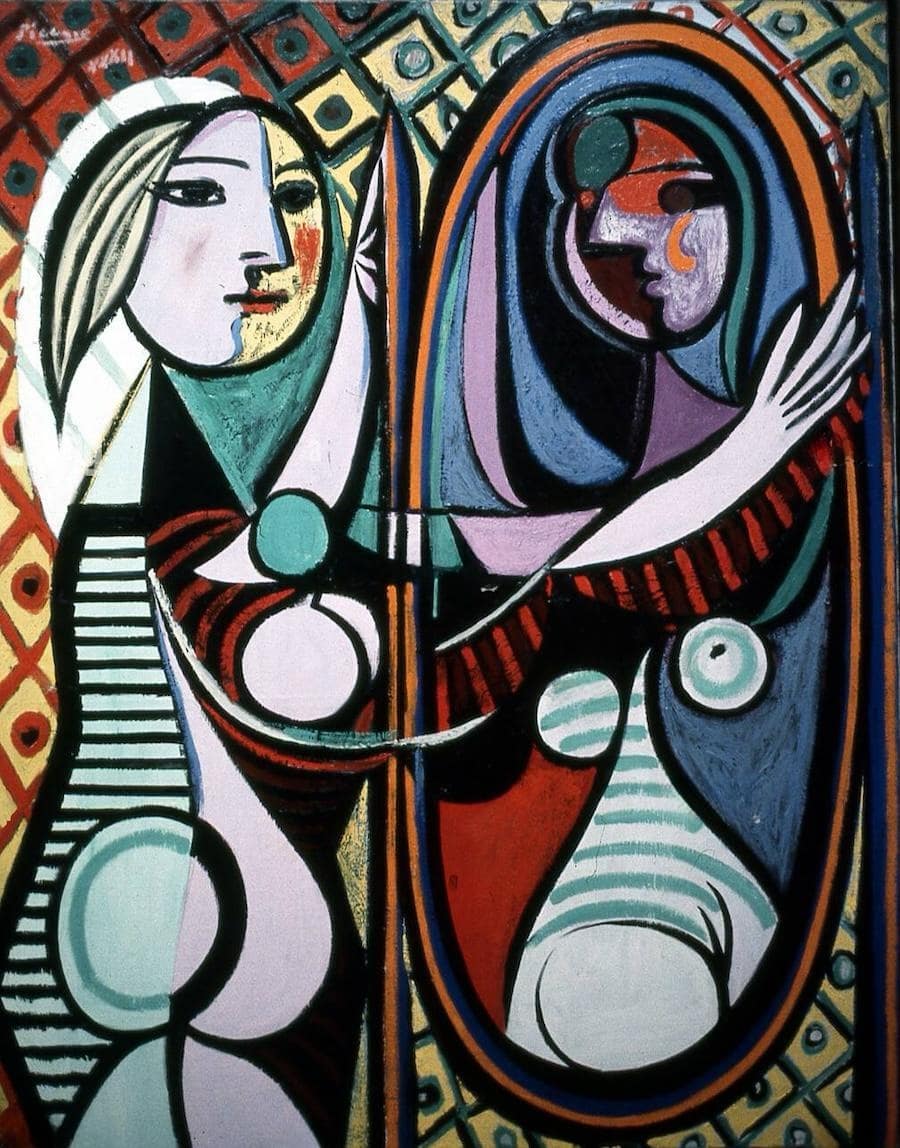 Pablo Picasso’s Girl before a Mirror (1932)
To begin this discourse, I would first examine Plato’s account of the concept. Plato justifies beauty through his Theory of Forms, which, in an attempt to simplify in a neophyte manner, explains the concept of reality and imagination. Hence, to Plato, beauty is a mere reflection of the eternal, objective, and perfect Form of Beauty. This conceptualisation is best captioned in a one-word adjective, pristine. This pristine beauty, to Plato, resides in the realm of ideas, and it becomes the intrinsic foundation of the realm of good. Hence, to Plato, beauty does not just exist in isolation from justification, and it spreads its mythic tentacles to the basic dichotomisation of humanity: good and bad, and favouring good.
Therefore, to the Greek thinker, true beauty inspires a philosophical ascent (anamnesis) from physical allure to the appreciation of intellectual and moral beauty, ultimately leading the soul towards knowledge and virtue, with beauty acting as a powerful guide or “lover’s” impulse towards the ultimate Good. I started my argument from Plato because his work presented beauty in idealised form, as against Aristotle, who saw beauty through symmetry, order, and proportion, a classification that would later favour quattrocento connoisseurs in Italy, as Michael Baxandall documented in his book Painting and Experience in 15th-Century Italy.
In a similar vein, his work captures God’s creation story in Genesis 1:4, which, by impact, highlights the role of good and beauty. Therefore, to imply a syllogism from the correlation of Plato and God, it would be: Good is beautiful; the world God created is good; hence, the world is beautiful. By the way, if I am to bifurcate this into the question of morals and values, I fear that this conclusion will never be reachable and, most importantly, rob us of the initial intention for this essay.
Owing my first definition of beauty to Plato, which focuses on the transcendental aspect of the idea, I will quickly consider Aristotle’s notion and perhaps make an opinionated conclusion on why I do not agree with his concept of beauty from a cultural art historical perspective. For Aristotle, beauty is immanent. To succinctly capture his idea, Aristotle justified beauty through objective principles of order, symmetry, and definiteness (taxis, symmetria, horismenon), grounding it in the physical world.
Hence, he saw beauty from what Frederich Nietzsche, centuries later, would recapture as Apollonian in his work, The Birth of Tragedy, as an embodiment of structure, logic, individualism, and consequently, beauty. Aristotle emphasises that beautiful things, whether living creatures or wholes made of parts, must possess a harmonious arrangement and proper magnitude. This first of all creates a want lacuna that begs physical representation of things that do not fit into mathematical description, say an Amoeba.
On second thought, to infer from the mathematical declaration, it serves as a repellent conclusion for African arts and puts them into a discriminatory category as against works from other regions. To Aristotle, beauty arises from the intellect’s recognition of this rational structure, evident in mathematics, architecture (like the Parthenon), and sculpture, and is perceived through the senses but understood by reason.
African arts, if we are to examine them from various ethnic groups and perhaps consider Frank Willett’s book, African Arts (1985), do not strive to capture a close representation of a lifelike human. The reason for this is partially discussed, but rather than order and symmetry, the beauty of African arts is seen through a concept that I proposed as subtractive emergence. This idea captures the constant chirping of wood, from which most cultures in Africa create their arts. Hence, by removing part of the wood, the image emerges.
To place this into a further justification, the Yorùbá culture in southwestern Nigeria, also a member of the Kwa-speaking group in West Africa, as captured by Willett, has a justification for their beauty, which includes Jíjọ́ra, meaning moderate resemblance to the subject, focusing on an equilibrium state between portraiture and abstraction, and dídán, which means shining and luminousness of surface.
This, therefore, is devoid of Aristotle’s concept. In the Igbo culture, art objects like the Oron figure, the Janus face (Mgbedike) mask, or the Ejagham mask distance themselves from the lifelike human concept just like the Malongo figure from BaKongo, the Guro masks, or others in a similar category, not because they cannot capture the lifelikeness of human symmetry but rather because what makes or equates beauty is presented in the driving idea and how this idea is captured in the art. Rather than asking—from Aristotle’s viewpoint—if the art is in a symmetrical shape, the ideology of African aesthetics asks if the art is carrying out the function it is made for socially, either to entertain, create fear in the hearts of deviants, or anthropomorphised spirits in meetings.
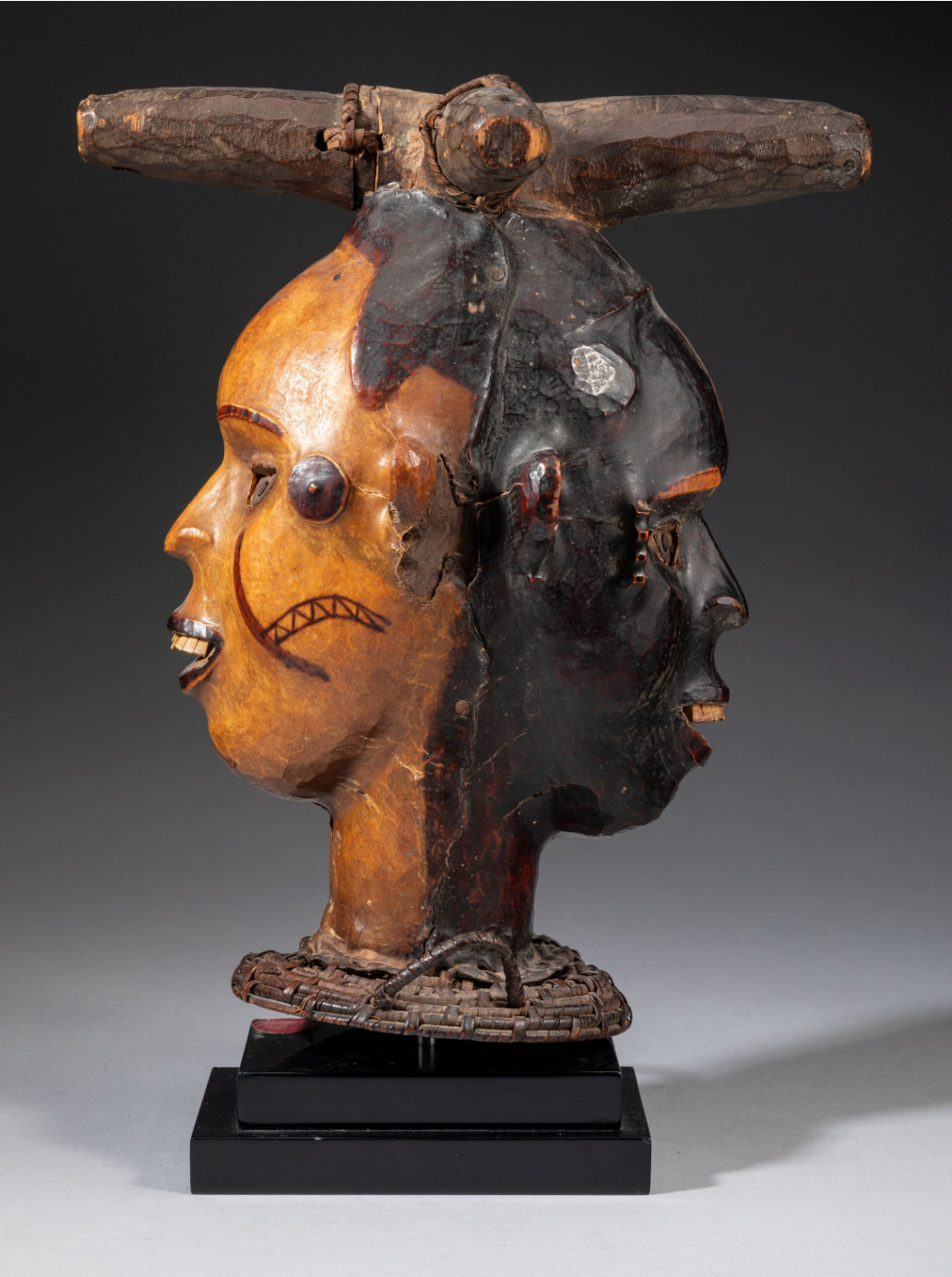 Boki Janus. Credit: APlusAfricanArt
Immanuel Kant—now voyaging into the European Enlightenment period—provides his concept of beauty in a rather different justification from the aforementioned philosophers. He noted that the justification of beauty is seen not as an objective property but as a subjective experience of pure pleasure arising from the harmonious “free play” of our cognitive faculties (imagination and understanding). To Kant, beauty arises from a free, unconstrained interaction (play) between our imagination (which forms images) and our understanding (which categorises). Therefore, before I can call something beautiful, Kant implores me not to think of it either from symmetry or lines or curves, but to let my imagination run wild.
See Also

But this is not just a pandemonium conclusion because for Kant, beauty is disinterested (no personal gain), universal (we demand others agree), and suggests a hidden purpose in the object, bridging our sensible world with our moral, rational world. To capture this in a simplistic example, this means that beauty, according to Kant, is that I do not call Picasso’s work beautiful because I like his brushstrokes; rather, it is beautiful because we all like his brushstrokes. Beauty justification is community.
This conclusion, appreciating sensus communis (common sense), becomes my resting idea to wrap up this essay—context. But before I gravitate to the conclusive part of this essay, it is important to understand the contextual analysis of my usage of Kant’s beauty. Kant says we experience beauty when an object appears to have “purposiveness without a determinate purpose”. Which means we all agree that a rose is inherently beautiful, first, because it is inherently beautiful, not because it is a gift for one’s lover. To therefore accord the term “beauty” to an element, it must distance itself from a self-satisfactory tool. Hence, beauty thus lives in a subjectively universal judgment shaped by the specific interaction between perceiver and object.
By using Kant’s ideal for my contextual judgement of beauty, therefore, I intend to assert that the sensus communis can rather be adapted to various collections of cultures. Therefore, the sensus communis is not a fixed consensus but a regulative ideal—one that presumes shared communicability, even when actual agreement fails.
Take, for instance, a Yorùbá masquerade, which may activate harmony through movement, sound, repetition, and danger, while the same qualities may produce anxiety, confusion, or even repulsion in an outsider. The reason for this is that a Yorùbá person understands the masquerade (through sensus communis) to be an appreciation and propitiation to their ancestor, while the outsider sees it as a gyration of chaos. This dichotomy of thoughts is further captured in one of my essays (unpublished), Decolonizing the Indigenous Art: Yoruba Art and the Insider-Outsider Divide.
Another case study that fits this contextual declaration is Chris Ofili’s sensational 1996 painting, The Holy Virgin Mary, depicting a Black Madonna with a breast made of elephant dung. While this sparked a lot of controversy, including President Donald Trump calling it ‘gross’, if the same material had been used to paint Bodhisattva, perhaps the proselytes of Buddhism would not metaphorically demand Ofili’s head on a spike. The focus in this case study is on how beauty is more contextual than individual.
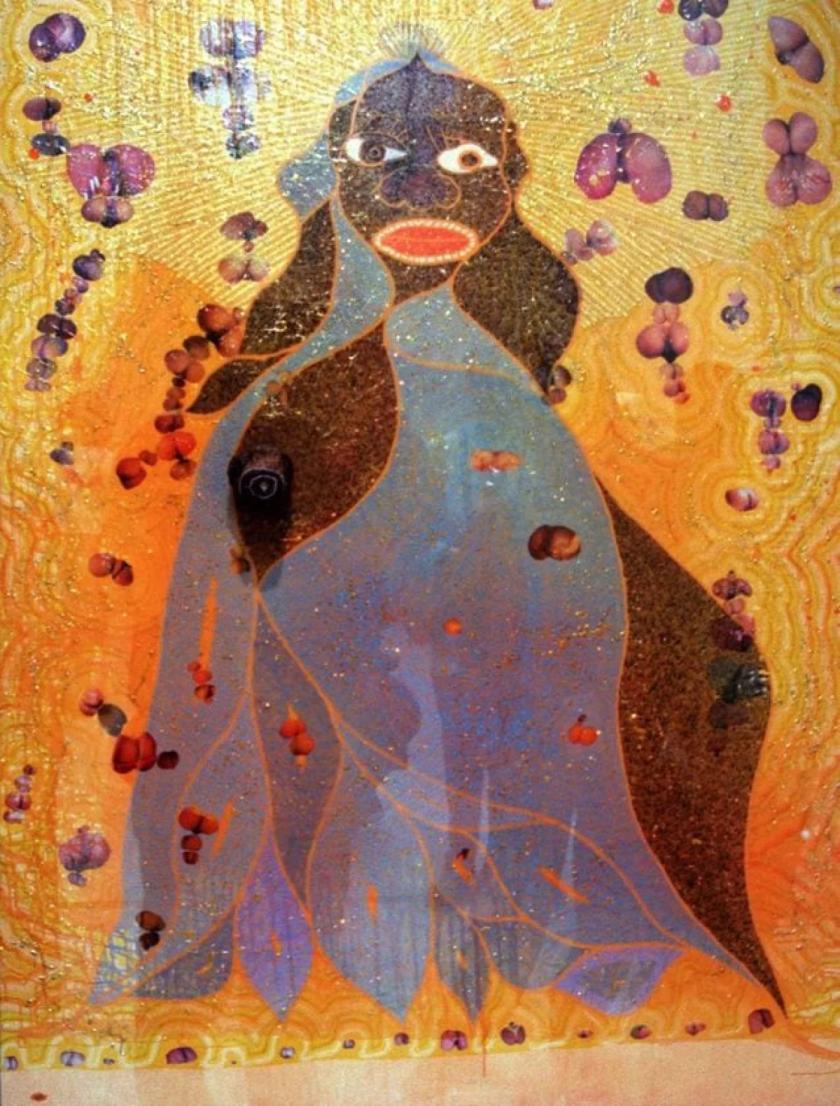 Chris Ofili’s The Holy Virgin Mary (1996)
When I arrived in the United States, I quickly deduced from conversations with friends and acquaintances that the physical features standard of beauty in the country is highly different from my home country. That is, in Nigeria, concern focuses on breasts and buttocks; however, if one began to use this as justification in the States, one might become the proverbial patient dog, except that one might not smell, not to mention eat, the fattest bone. This understanding reminded me of Wole Soyinka’s capturing of former President of Nigeria Olusegun Obasanjo’s case upon getting to Britain and seeing his peers judging beauty standards from a female’s leg. All explanation points to the aforesaid concept—context is beauty, and beauty can or may be contextualised.
To draw the curtain close on this essay, let us go back to the inception: “beauty is in the eyes of the beholder”, and offer a rewrite: “beauty is in the eyes of a common beholder”. The common in this sentence forms a shared common—contextual—knowledge to tie back to the Yoruba aphorism of appraisal, O jọjú ní gbèsè. To owe the eye a debt, then, is to acknowledge that seeing is never innocent. It is shaped by memory, ritual, history, and communal attunement.
Thence, beauty does not reside solely in objects, nor solely in individuals, but in the fragile space between—where perception becomes intelligible, communicable, and affective. In recognising beauty as contextual, this essay does not seek to close the question of what beauty is but rather to keep it productively open, inviting further inquiry across cultures, philosophies, and ways of seeing. Thus, what appears beautiful within one communal framework may overwhelm, confuse, or even repel another—not because beauty has failed, but because the conditions for aesthetic judgment have not been mutually established.
Olúwábùkúnmi Awóṣùsì is a second-year M.A. Art History Fellow at Texas Tech University, a curator, and a researcher whose work focuses on Yorùbá visual culture at the intersection of indigenous knowledge systems and contemporary theory. His writing has appeared in Door Is A Jar, Dawn Review, Orange Blossom Review, Ogbon Review, and elsewhere.
Cover photo credit: Fatherland Gazette