
This week, my in-laws told me a story that stuck with me.
Friends of theirs went out in South Florida. Two people. Each ordered a burger. A normal sit-down kosher restaurant. Nothing upscale. Nothing destination-worthy.
The bill came out to $92, including tax and tip.
No one is shocked by that number anymore. That’s the problem.
I Remember When $25 Felt Expensive
About eleven years ago, I remember seeing a $25 burger on a menu at an upscale restaurant and thinking it was ridiculous. That was the high end. That was something you noticed.
Today, $25 feels like a deal. In many kosher restaurants, it’s closer to the floor than the ceiling.
That shift is not just inflation. Inflation explains part of it. A $25 burger from 2014 lands somewhere in the mid $30s today when adjusted.
But what changed more is how we think.

The Middle No Longer Makes Sense
There’s a growing problem in restaurants, and it’s especially visible in kosher dining.
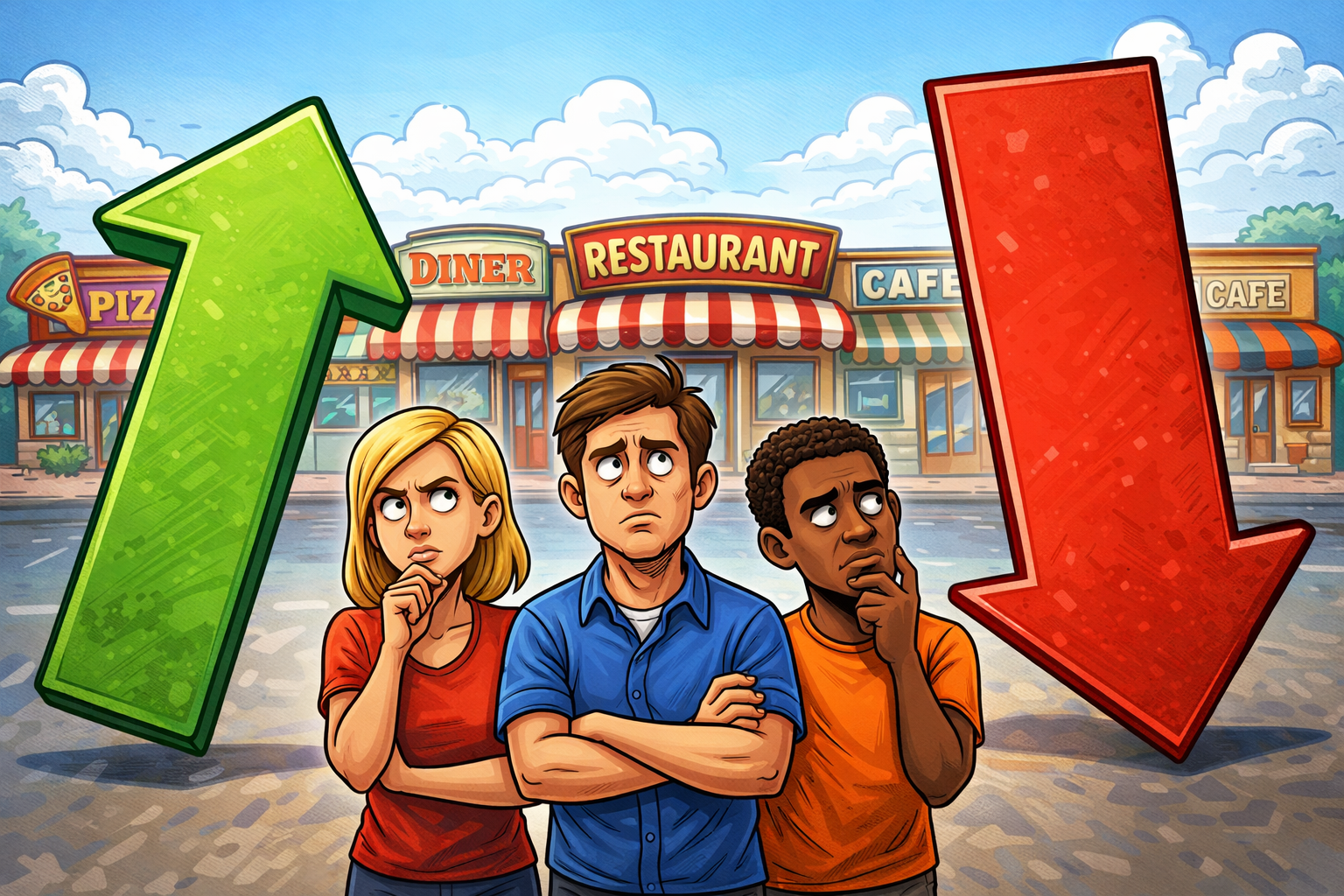
The middle is disappearing.
A typical sit-down burger meal today:
$30 to $36 for the burger
$5 to $10 for a drink or add-ons
Tax and tip push it to $40 to $50 per person
That puts a basic night out for two at $80 to $100 minimum.
At that price, I find myself asking a simple question.
What exactly am I paying for?
It’s not cheap enough to feel casual. It’s not special enough to feel like a night out. It sits in the middle, and the middle is where things start to break.
The Data Says This Is Already Happening
This is not just anecdotal.
Across the restaurant industry, analysts are seeing a clear split in how people spend.
Executives and industry reports are consistently using one word: bifurcation.
Even more telling:
That means people are still spending money.
They’re just being more selective about where.
The Way People Spend Has Changed
From what I’ve seen, and what the data confirms, people are not eating out the same way anymore.
They are making sharper choices:
Go cheap and efficient
Or go expensive and intentional
Research shows many consumers are actively cutting back on how often they dine out or how much they spend per visit (consumer dining behavior trends)
That puts pressure on anything that feels unnecessary.
And the middle starts to look unnecessary.
The $92 Burger Is a Value Problem, Not a Price Problem
The issue is not that two burgers cost $92.
The issue is what that $92 is competing against.
For roughly the same spend, I could:
Spend a bit more and go somewhere that feels like a real night out
Spend half as much and order something quick and easy
The burger loses both comparisons.
That’s the disconnect.
The Sushi Restaurant That’s Always Empty
This week, I got a message from an Instagram follower asking a simple question.
Why is this newish kosher sushi restaurant in the NYC area always empty?
They told me the food is good. The quality is there. But every time they walk in or pass by, it’s quiet.
That question stuck with me, because it connects directly to this same issue.
If the food is good, why isn’t it working?
Because “good” is no longer enough.
If that sushi spot is priced in the $30 to $50 per person range, it immediately gets compared to:
A cheaper takeout sushi option
Or a higher-end omakase or premium sushi experience
If it doesn’t clearly beat the cheaper option on value, or the higher option on experience, it gets skipped.
Not because it’s bad. Because it’s unclear.
That’s the middle.
Kosher Restaurants Feel This More
This dynamic exists everywhere, but kosher restaurants feel it more.
The cost structure is higher across the board:
Meat costs more
Labor is tighter
Kosher supervision adds overhead
The customer base is smaller
So prices naturally rise.
The problem is where those prices land.
Many kosher restaurants end up in that $30 to $40 entrée range by necessity. But that puts them directly into the decision zone where customers start comparing every dollar.
And once customers start comparing, expectations go up fast.
The Psychological Shift
What changed over the last decade is not just pricing. It’s how we evaluate value.
In 2014:
A $25 burger felt expensive
You judged the price
In 2026:
A $30 burger feels normal
You judge the experience
That’s a big difference.
No one reacts to the number anymore. They react to whether it felt worth it.
And “worth it” is harder to deliver than just “not too expensive.”
Not Every Mid-Tier Restaurant Is Failing
To be clear, not everything in the middle is collapsing.
Some restaurants are winning by being very clear about what they are.
The data shows that brands leaning into value messaging are outperforming, even within casual dining (restaurant value trend analysis)
Others succeed by creating a true experience that justifies the price.
But the vague middle, the places that are just “solid,” are having a harder time.
Because “solid” is no longer enough.
What This Means Going Forward
From where I sit, restaurants now have to make a clear choice.
They can be:
A value play, fast, efficient, affordable
An experience, something you plan around
Or a very tight hybrid that clearly communicates both
What doesn’t work anymore is being unclear.
Charging premium-adjacent prices while delivering a standard experience is where the friction happens.
The Real Takeaway
That $92 burger meal for two, even including tax and tip, is not an outlier. It’s a snapshot of a broader shift.
The middle didn’t disappear overnight. It got pushed upward in price without moving upward in perception.
And now customers are noticing.
I’m not shocked by the price anymore. I’m just a lot quicker to decide whether it made sense.
And more often than not, that decision is getting harder for mid-tier restaurants to win.