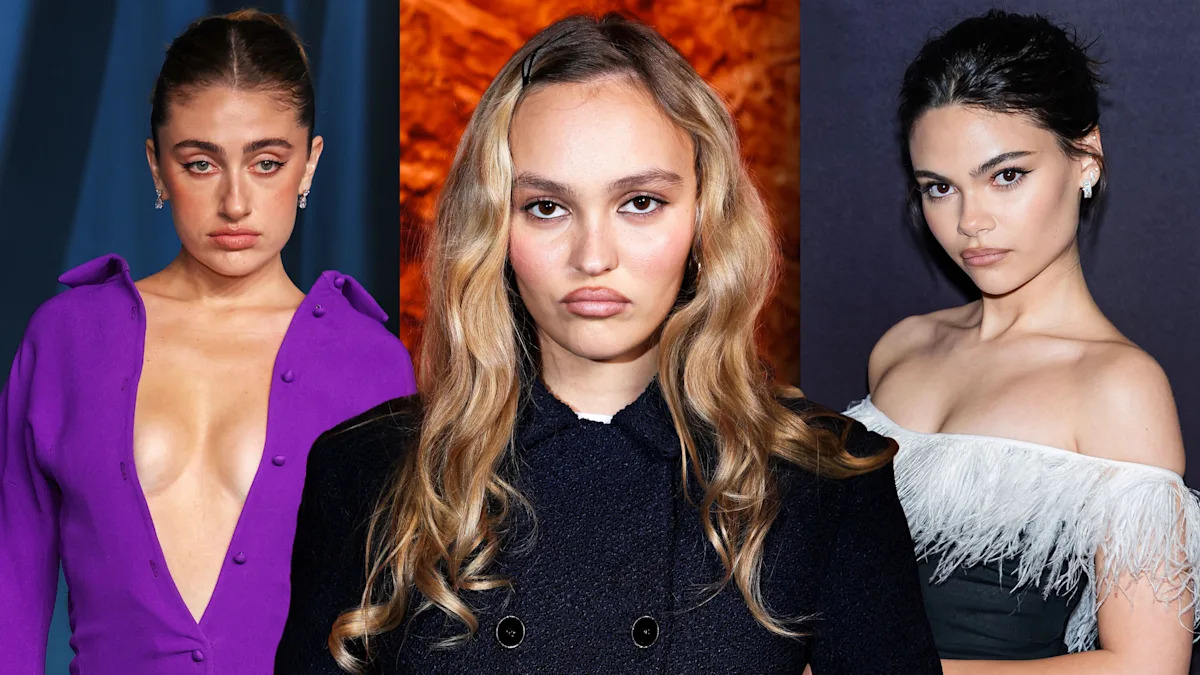
Scroll TikTok long enough and you’ll start to notice it: a subtle but unmistakable expression showing up in selfies and videos. The upper lip lifts slightly while the lower lip tucks upward, creating a look somewhere between a pout and a faint frown. Online, it’s been dubbed the “Gen Z pout” and users say it’s quickly becoming the latest go-to selfie face.
Like the duck lips that dominated Instagram in the early 2010s or the dramatic angles of MySpace-era selfies before that, the expression is becoming shorthand for a generational aesthetic shaped by social media trends and evolving beauty standards. As the look spread across social media — boosted by influencers like Ashtin Earle, TV personalities like Love Island fave Iris Kendall and even red carpet appearances from celebrities like Lily-Rose Depp and Ariana Greenblatt — experts say the viral visage isn’t just another fleeting TikTok trend. It’s a lens into how a generation of digital natives navigates beauty in an era shaped simultaneously by cosmetic procedures, social media aesthetics and the technologies used to capture and edit our faces.
Less about volume, more about balance
Take one look at Kim Kardashian’s 2015 selfie book Selfish to see the lips that defined a generation. The era’s signature look was a protruding pout that emphasized dramatic fullness. The aesthetic was cemented when Kardashian’s sister Kylie Jenner revealed she used lip fillers to achieve her own plumped look — a revelation that helped fuel a surge in cosmetic lip procedures and propelled the launch of her beauty brand, Kylie Cosmetics.
A decade later, a different kind of pout is taking over online. The “Gen Z pout” is gaining popularity through online influencers and celebrities in much the same way, though it reflects a different aesthetic philosophy.
“When we hear the term Gen Z pout, it’s really focusing more on refinement rather than just volume,” Dr. Bob Basu, a Texas-based plastic surgeon and president of the American Society of Plastic Surgeons (ASPS), tells Yahoo. “It’s about enhancing the lips while keeping them balanced and very natural looking.”
Rather than exaggerated fullness, Basu says the current look emphasizes subtle changes in shape, with softer lip definition and a slightly lifted upper lip. “It’s really about shape, balance and proportionality,” he says. “It’s very different from what we saw years ago, where the trend was larger volume, more forward projection, more overfilled.”
The approach reflects a broader aesthetic shift in cosmetic procedures, where dramatic transformations are giving way to more restrained enhancements like the nonsurgical lip flip. The treatment has been trending for several years, and TikTok creator Shannon Zhao credited lip flips as one possible driver of the Gen Z pout back in 2024. “I feel like a lot of people in my generation either have lip flips or they try to do that face in photos,” said Zhao in a TikTok video. In another, she provides a quick tutorial.
That ambiguity — whether someone’s lips look that way because of a cosmetic procedure or a practiced expression — is part of the appeal, reflecting a social media culture where the line between natural and enhanced is often blurred. The trend also reflects a larger pattern that each generation tends to develop its own “photo face,” shaped by the technology and beauty standards of the moment.
How technology shapes the selfie faces of each generation
While the Gen Z pout may feel like a sudden TikTok phenomenon, it’s actually the latest chapter in a long history of photo faces defined by the tools we use to capture them.
“There’s a tendency to use beauty standards to capture a zeitgeist,” Brooke Erin Duffy, a social media researcher and associate professor at Cornell University, tells Yahoo. In earlier decades, beauty trends were largely dictated by fashion magazines and celebrity imagery — like Twiggy capturing the zeitgeist of the 1960s. Today, they often emerge from millions of social media users posting their own faces online. “In the context of social media, we are inundated with these formulaic images as we’re scrolling … there’s certainly an intensification and an exaggeration because there’s just the sheer quantity of these images.”
But the selfie face of the digital era isn’t just shaped by beauty standards, according to Jess Rauchberg, a digital culture expert and assistant professor at Seton Hall University. The technology people use to take and share photos plays a major role too. ”The way we behave, the way we act, what we do, how we even position our bodies are going to change based on the different technologies or platforms we have available,” she tells Yahoo.
Take the MySpace angle of the late 2000s: a dramatic overhead selfie that emphasized the eyes, slimmed the face and showed little of the body. The pose became the platform’s defining aesthetic, but it was largely a byproduct of the technology available at the time.
“You didn’t have the fancy smartphone camera. You were rocking a Motorola Razr or a flip phone,” says Rauchberg. “Based on how that’s designed or what capacities that technology has, it’s going to change the way or inform the way we are engaging in forms of self-portraiture.”
As cameras improved and “Instagram Face” took over in the 2010s, the look shifted toward high-definition perfection — heavy contouring and high-volume “duck lips” designed to pop under the harsh brightness of influencer ring lights. But today’s Gen Z pout represents another shift.
Rauchberg says the look may reflect the more candid era of 2026, where selfies are meant to appear unposed, even when they’re deliberate. “There’s still curation happening, but it’s supposed to appear less artificial,” she says. “It’s more, ‘I’m not using a filter. I’m just positioning my mouth in a certain way when I take a selfie.’”
In that sense, the Gen Z pout may be less about lips than it is about the moment Gen Z finds itself in — one where filters, cosmetic tweaks and viral aesthetics shape how people learn to present their faces to the world, one selfie or TikTok at a time.